

With the Studio Display and Studio Display XDR set to launch on Wednesday, members of the media have started publishing their reviews of the new display options.
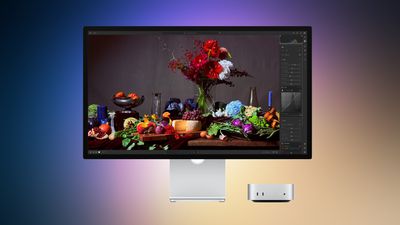
According to The Verge, the Studio Display is the same panel as the prior model, but with an upgraded camera, speakers, and ports. The brightness is the same, and there appear to be no other changes to the display quality.
The Studio Display XDR is the much more exciting update, because it is a replacement for the $5,000 Pro Display XDR. The Verge says that the display is a "great improvement" over the prior model due to the mini-LED backlight, though at this cost, it's only ideal for pros because there are more affordable options for general use. Images and text are "crisp and clear," with minimal light bleed thanks to dimming control, though light bleed is worse than with OLED technology, and viewing angles aren't as wide.
Presets are accurate, and the Studio Display XDR was able to maintain up to 2,000 nits peak brightness. It's "very bright at a normal desk sitting distance." The built-in speakers are loud enough for listening to music, watching videos, and taking calls, and the 12-megapixel camera provides clear video.
YouTuber Marques Brownlee said the Studio Display XDR is "better in every single way" than the Pro Display XDR because it's brighter with improved contrast and less blooming, plus it has an extra Thunderbolt port.
Since the Studio Display XDR has a 120Hz refresh rate, it pairs better with the MacBook Pro that has the same refresh rate. "This is about as good as it gets" for a display to use with a MacBook Pro. Brownlee said that Apple doesn't appear to be targeting professionals with the Studio Display XDR since it's a small market, with the display serving as more of a mixed use product.
There are no displays to compare the Studio Display XDR with because no companies make 27-inch 5K mini-LED displays with a 120Hz refresh rate.
PetaPixel said the Studio Display XDR's build quality is "phenomenal," but the site wasn't a fan of the integrated power cable, the sharp edges on the stand, or the thick bezels around the display.
The Studio Display XDR was color accurate across presets at all brightness levels, but the display was only able to get gamut coverage up to 86 percent with Adobe RGB profiles. PetaPixel also saw some "slightly higher than acceptable contrast deviation" at the upper right corner of the XDR, but most human eyes won't be able to see a difference.
HDR content looked spectacular with no "stutter or judder" and limited haloing, but contrast and black levels did not measure up to OLED because mini-LED is still LED. PetaPixel pointed out that few companies are making displays that are super bright, HDR compatible, extremely color accurate, and with Thunderbolt 5 support. The closest match is the Asus ProArt OLED display.
Other reviews are below:
The Studio Display and Studio Display XDR launch on Wednesday. Pricing on the Studio Display starts at $1,599, while pricing on the Studio Display XDR starts at $3,299.
















Top Rated Comments
Edit: These are two of the mini LED 5k monitors being released by other brands: LG 27GM950B and MSI MPG 271KRAW16 ($899 MSRP, out in H2).
Blooming was fine back in 2019 but oled is the king and apple wanting $3.3k is crazy for blooming to be mentioned in 2026.