Tech Trader Daily reports that popular Voice over Internet Protocol (VoIP) firm Vonage has submitted an iPhone application to Apple for inclusion in the company's App Store, but the application's approval has been delayed by minor technical issues with the application.
"They submitted an application for review," said Apple spokesperson Natalie Kerris told Tech Trader Daily. "There are some technical issues [with the code they submitted] that hopefully can be resolved." Kerris did not elaborate on the nature of the issues with Vonage's application.
In an update to the article, Vonage reported that it has fixed the issue and resubmitted the application to Apple for approval.
"We can confirm that one of our prospective applications is for the iPhone. They identified one issue stating that it is 'simple to fix.' The issue is cosmetic and relates to the labeling of an icon. We've made the requested change and resubmitted the application for approval earlier today."
Apple responded last week to inquiries from U.S. Federal Communications Commission regarding the company's apparent rejection of an official Google Voice iPhone application, noting that it does have an agreement with AT&T to not allow customers to utilize AT&T's network to initiate or terminate VoIP sessions without AT&T's permission. The agreement suggests that the Vonage iPhone application, like similar ones from other services such as Skype, will be restricted to Wi-Fi only for phone calls once it appears in the App Store.
Earlier today, we reported on comments from Adobe Principal Product Manager for Photoshop John Nack pointing to a new FAQ document noting that only Creative Suite 4 will be officially supported on Apple's forthcoming Snow Leopard operating system, with Creative Suite 3 and earlier versions reportedly not having been tested on Snow Leopard.
Nack has now posted an update after investigating the CS3 situation in which he reveals that Adobe and Apple actually did do extensive testing of at least Photoshop CS3 on Snow Leopard and found that it is in fact compatible with the new operating system.
It turns out that the Photoshop team has tested Photoshop CS3 on Snow Leopard, and to the best of our knowledge, PS CS3 works fine on Snow Leopard.
Nack notes that only two minor issues remain that his Photoshop team is aware of: window highlight rings in Expos and text field nudging in Japanese versions of Snow Leopard. But while Photoshop CS3 otherwise appears to be perfectly compatible with Snow Leopard, Adobe has chosen to not categorize it as officially supported due to the level of testing it feels would be required in order to be entirely confident in that statement.
When we say that we officially support a specific OS, you can trust that we've done very extensive testing on that platform. If we haven't done that level of testing, then we simply won't say that we support it. That's why the FAQ reads as it does.
That said, none of us like to inconvenience customers, so the reality is that we *do* actually perform some amount of testing on older product if we believe that there are a significant number of customers using it. So does Apple.
As I say, we have reason to expect that all meaningful issues of running Photoshop CS3 under Snow Leopard have been resolved. However, because we have not done the level of testing that true certification demands, we need to stand by our statement that we don't officially support CS3 on Snow Leopard.
In the interest of time, Nack was able to report only on the Photoshop situation under his direct purview and was unable to investigate the status of other components of Creative Suite 3 with respect to OS X Snow Leopard.
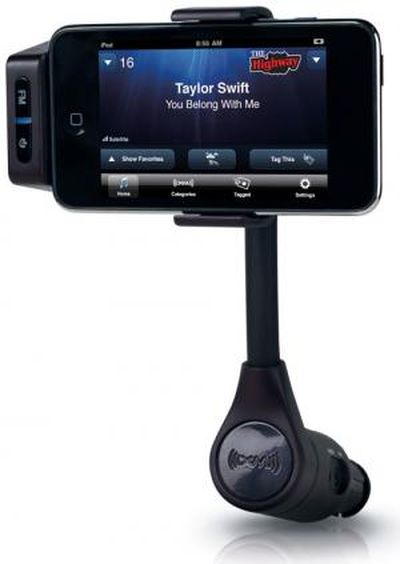
Digital Daily reports that Sirius XM announced at a media event today the launch of XM SkyDock, an accessory that will allow iPhone and iPod touch users to receive live XM and "The Best of Sirius" satellite radio in their vehicles. Scheduled to launch in the fall at suggested price of $119.99, the XM SkyDock utilizes a vehicle's cigarette lighter power port to mount and power the device and iPhone or iPod touch.
Dubbed SkyDock, the $119.99 peripheral uses iPhone OS 3's support for third-party hardware to transform Apple (AAPL) handsets into full-fledged satellite radios. Designed to run off a car's cigarette power adapter, the SkyDock charges your iPhone while you listen to it and supports the ability to tag songs for download from iTunes. Better yet, it gives users access to all XM and "The Best of SIRIUS" channels, even those the company infamously excludes from its online feed, like Howard Stern, MLB Play-by-Play and NFL Play-by-Play.
Sirius XM's press release also notes several other features, including iTunes tagging of songs, sports and stock tickers, as well as various alerts for sports and music news.
Listeners can also tag songs they hear on XM's music channels for later purchase from the iTunes Store - including songs on XM's 24/7 artist branded commercial-free channels such as Jimmy Buffett's Radio Margaritaville, Elvis Radio, Eminem's Shade 45, The Grateful Dead Channel, B.B. King's Bluesville, Willie Nelson's Willie's Place, Siriusly Sinatra and Bruce Springsteen's E Street Radio. Other features include game alerts and sports ticker, artist and song alerts as well as a stock ticker.
The XM SkyDock is compatible with all iPhone and iPod touch models and requires iPhone OS 3.0.
Rumors of the new accessory surfaced last week, although the reports had suggested a slightly lower price point of under $100.
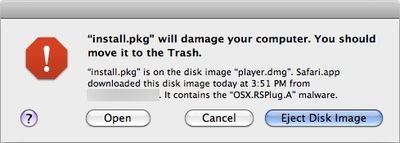
As we briefly mentioned yesterday, antivirus vendor Intego notes that it has received multiple tips that Apple's forthcoming Snow Leopard operating system appears to contain at least some rudimentary antimalware capabilities. According to screenshots of warning dialog boxes submitted by Snow Leopard users, the operating system is able to warn users that a downloaded file contains malware, specifically the OSX.RSPlug.A Trojan Horse first discovered in October 2007.
We're not sure yet exactly how this works, but the above screen shot shows this feature working with a download made via Safari, detecting a version of the RSPlug Trojan horse in a downloaded disk image.
MacRumors received the first report of this Snow Leopard feature in February 2009, soon after the release of developer build 10A261. But while the feature appears to have been present in Snow Leopard builds since that time, little is known about the functionality and from where Snow Leopard is drawing its information for identifying malware.
Intego's posting regarding the feature implies that Apple is not licensing the information from that company, while ZDNet has confirmed that Apple is not using the open-source ClamAV engine. It is possible that Apple is licensing the functionality in part from another commercial antivirus company or developing its own system, but Apple has not revealed any details about the feature on its extensive security page for OS X Snow Leopard, referring only to the existing standard scan of downloaded files to determine if an application is included in a given package.
Update: The Register notes that Apple has simply included information on two Trojan Horses, OSX.RSPlug.A and OSX.Iservice, in one of Snow Leopard's system files, identified to MacRumors as the following:
While Apple could certainly update this file with identifying information for new threats that arise in the future, there does not appear to be a full-fledged antivirus package with regularly-updated virus definitions deployed in Snow Leopard.
Adobe Principal Product Manager for Photoshop John Nack reports that the company has put together a Snow Leopard FAQ (PDF) notifying customers that while its Creative Suite 4 package is compatible with Apple's forthcoming Mac OS X Snow Leopard, Creative Suite 3 and other earlier versions have not been tested for compatibility and will not be updated if found to be incompatible.
Apple and Adobe have worked closely together (as always with new OS releases) to test compatibility. As for CS4, everything is good with the exception of auto-updates to Flash panels (which I guarantee you're not using*) and Adobe Drive/Version Cue (which doesn't work at the moment on 10.6). CS3 & earlier haven't been tested.
In response to a reader's comment expressing surprise that Creative Suite 3 had not even been tested, Nack responds that while CS3 almost certainly was tested by Adobe, the company has likely taken a conservative route in its guidance in case users do experience issues with CS3 under Snow Leopard.
I found that really surprising, too, and I'll try to get more info. I'd frankly be shocked if people at Adobe & Apple really hadn't tested CS3 on 10.6. I *think* it's just some corporate conservatism at work here, and Adobe doesn't want to over-promise anything. As I say, though, I'll try to find out more.
Upon further questioning of Adobe's lack of support for Creative Suite 3 on Snow Leopard, Nack points out that limited resources dictate that the company focus on current and future priorities, including customer support and feature development, rather than spending time assessing and modifying software released nearly two and a half years ago to ensure continued compatibility.
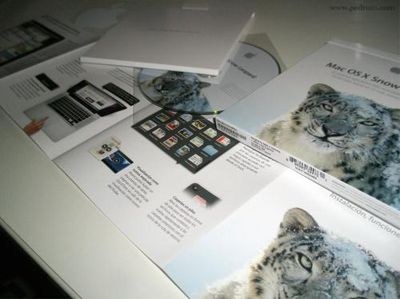
Spanish site Applesferareports [Google translation] that a Tumblr/Twitter user by the name of pedro10 has received a retail copy of Mac OS X Snow Leopard in advance of Friday's official launch.
After installing Snow Leopard, pedro10reports that the retail disc does in fact contain Build 10A432, which had been rumored to be the "Golden Master" version sent to manufacturing for retail distribution. Some unconfirmed reports in recent days had suggested that a different build might have been the shipping version of Snow Leopard, but this appears to not be the case.
As proof, pedro10 posted the above photographs of the Snow Leopard retail packaging.
As Friday's public launch of Mac OS X Snow Leopard approaches, many users are considering whether to upgrade and wondering what new features they can expect in Apple's updated operating system. While many consider Snow Leopard to be focused on "under the hood" changes to improve and streamline performance, Apple's Enhancements and Refinements page also covers a wide variety of visual and functional changes, many of which had previously been reported by Apple or sources using developer builds of Snow Leopard, but we highlight here a few of those of interest.
- "Put Back" and Stacks Navigation: Apple has added the ability for users to quickly restore items from the Trash folder to their original locations and now allows users to easily navigate within stacks by adding a scrolling feature in grid view and adding an arrow icon to allow users to navigate the folder hierarchy. The folder hierarchy icon began as a "thumbnailed" picture of the parent folder, but was replaced with the simpler arrow icon in later developer builds.
- GPU-Accelerated Video Playback: QuickTime X, included as part of Snow Leopard, utilizes video-decoding capabilities built into the NVIDIA GeForce 9400M graphics processor found in many Macs, reducing load on the system's CPU and freeing it up for other tasks.
- Text Editing Features and Integration: New features include automatic correction for common spelling errors and expanded data detectors to automatically find information such as dates and addresses and provide smart options for such tasks as creating iCal or Address Book entries or mapping locations.
- Full Multi-Touch Gesture Support for Compatible Models: All of Apple's notebooks introduced since 2008, beginning with the original MacBook Air, have included Multi-Touch trackpad capabilities, but many of the early models have been unable to take advantage of newer four-finger gestures, a limitation that will be removed in OS X Snow Leopard.
- iChat Enhancements: Snow Leopard brings 640 x 480 video chats to iChat Theater, four times the resolution of those in Leopard, as well as reduced upload bandwidth requirements for video chats.
- Security: Apple has devoted an entire page of its Snow Leopard site to highlighting security features of Mac OS X, from "sandboxing" programs to limit the damage malicious software can cause and anti-phishing features in Safari to password strength assessment and parental controls. A report today is also pointing to an apparent antivirus feature built into Snow Leopard, and while MacRumors first received reports of this feature after developer build 10A261 was released in February, no further details of the feature have been unearthed.
AppleInsider reports that Apple is currently overhauling the design of the MacBook, looking to bring a fresh exterior look to the aging entry-level notebook while also rebuilding the computer's interior architecture.
People familiar with Cupertino-based company's plans say the 13-inch portables are presently undergoing an industrial design overhaul that will see them reemerge in the coming months with a slimmer, lighter enclosure and restructured internal architecture to boot.
The report points to the likelihood of multiple models beginning at price points below the current $999 entry-level price, utilizing low-end components to allow Apple to better compete against budget PC notebooks.
Though details are few and far between, Apple is expected to achieve these markdowns through largely existing tactics, such as using lower-end components and previous-generation Core 2 Duo chips and architectures from Intel Corp. Battery life should receive a boost from cutting-edge technology that recently found its way into the company's other notebook offerings, while high-end legacy features like FireWire connectivity are likely to be sacrificed in the tradeoff.
Sources also claim that Apple had briefly considered using Intel's Atom processor in the MacBook as a way to quickly drop notebook prices, but decided against the move as the much-rumored tablet project came closer to fruition and allowed Apple to redevelop its ideas of the company's product mix for the future.
Apple's white polycarbonate MacBook has been viewed by many as sorely in need of a refresh, having been carried along as a single low-end model when the aluminum unibody MacBooks were introduced in October 2008 and left to carry the "MacBook" banner on its own when the aluminum models were rebranded as MacBook Pros in June 2009.
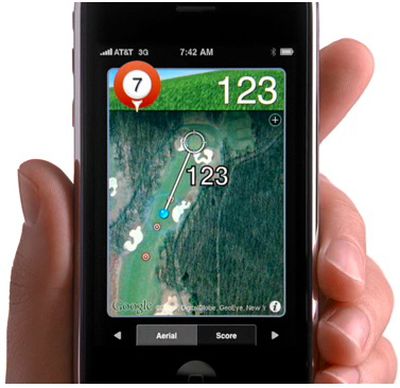
Apple has released a new iPhone 3GS commercial targeting sports enthusiasts. Like many recent iPhone ads, 'Avid' highlights three applications linked by a common theme and is available in Apple's iPhone ad gallery.
- Golfshot: Golf GPS [App Store, $29.99] - Provides GPS range-finding and aerial views for over 15,000 golf courses worldwide. - MLB.com At Bat 2009 [App Store, $9.99] - Offers live video streaming of limited Major League Baseball games, as well as audio streaming, video highlights and recaps, and "Gameday" live graphical pitch-by-pitch coverage. - TouchSports Tennis '09 [App Store, $0.99] - Offers a realistic 3D tennis game experience with multiple characters and courts to choose from.
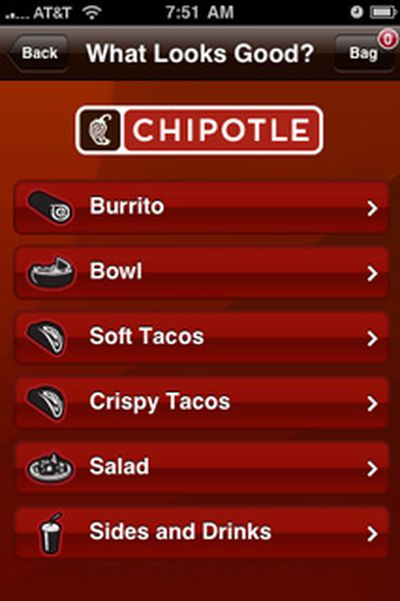
The Chipotle Ordering app is back in the App Store after only a short period of availability earlier this year. First appearing in January, the app was live for only a few hours and then pulled due to unanticipated demand that overloaded the servers handling orders. At that time, the plan was to have the app return to the App Store after a couple of weeks.
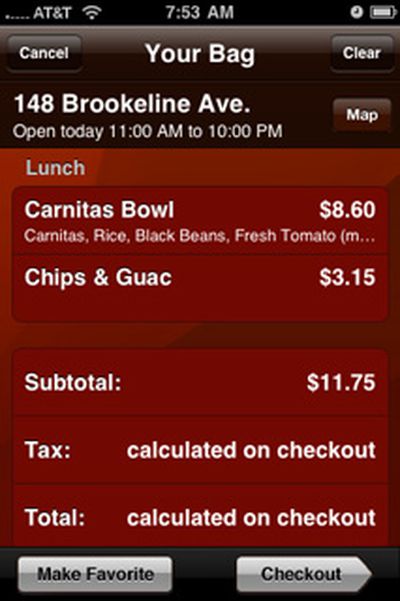
The app offers the ability to locate nearby Chipotle restaurants and browse the menu. Desired items can be ordered and paid for with a credit card. Favorite menu items can be saved for future orders.
The Chipotle Ordering app is free and can be found in the App Store here (link opens iTunes).
Parallels today introduced the Parallels Desktop Switch to a Mac Edition, bundling tutorial and migration tools with the company's Parallels Desktop 4.0 software that allows Macs to run Windows in a virtual environment, allowing users to switch between OS X and Windows without the rebooting required by Apple's Boot Camp solution. As the product name implies, the new edition is targeted at Windows users making the switch to Mac, and provides them with tools to easily move their Windows applications and data to their new Mac and offers them more than two hours of video tutorials to ease the transition to Mac.
"The growth in switching is partially due to the ease-of-use and cool capabilities of the Mac," said Serguei Beloussov, CEO of Parallels. "However, users don't want to lose the data they have accumulated and the applications they are already familiar with. Building on our proven track record of Mac innovation, we have addressed this concern and made learning the new operating system even simpler through interactive on-demand tutorials. These are combined with intelligent moving tools and our industry-leading Parallels Desktop for Mac, which offers the greatest performance and stability for running Windows seamlessly on Mac."
Training materials include video, on-screen demonstration and written prompts developed from the perspective of a Windows user and are user-directed allowing users to focus on areas of most interest to them. Migration tools include a USB transfer cable and Parallels Transporter software that allows users to easily move their entire Windows system into the Parallels Desktop virtual machine on their Mac.
Parallels Desktop Switch to a Mac Edition is available today at a suggested retail price of $99.99.
Apple has started airing two more "Get a Mac" ads featuring Justin Long as "Mac" and John Hodgman as "PC". The latest ads continue to target Microsoft's aggressive Laptop Hunters campaign which has focused on Apple's relatively higher prices than comparably equipped PCs.
The new ad called Top of the Line features actor Patrick Warburton who is best known for his portrayal of David Puddy from the Seinfeld sitcom. The new ad focuses on potential viruses and other "headaches" that may affect PCs, but not Macs. A second ad called Surprise was also posted today delivering a similar message.
The Wall Street Journal reports (subscription required) that Steve Jobs has been focusing almost exclusively on Apple's much-anticipated tablet computer since his late June return from a medical leave of absence for a liver transplant. The report notes that employees who had become accustomed to a certain level of freedom in their work during Jobs' leave of absence have found his close attention to even the minutiae of the project "jarring".
Since his return in late June, the 54-year-old has been pouring almost all of his attention into a new touch-screen gadget that Apple is developing, said people familiar with the situation.
Those working on the project are under intense scrutiny from Mr. Jobs, particularly with regard to the product's advertising and marketing strategy, said one of these people. The people familiar with the matter declined to give details on the tablet or disclose when the device would come out.
In a response to The Wall Street Journal's request for comment, Jobs simply reported that "much of [their] information is incorrect" while declining to provide additional specifics.
Jobs' attention to detail on the tablet is said to be similar to his singular focus on the iPhone in the months leading up to its 2007 launch. Jobs has been quite particular about the tablet project over the last several years, having set such high standards that he had reportedly nixed the project twice before finally finding the technology sufficient to achieve his vision.
At Apple, a tablet-like device has been many years in the making. Apple filed a patent related to a tablet device as early as 2000, according to a Thomson Reuters patent database.
But development has come in fits and starts. Mr. Jobs killed the project twice in recent years, the first time because the battery life was too short, and the second time because there was insufficient memory, said one of the people familiar with the matter.
The report concludes by summarizing recent rumors pointing to a tablet introduction later this year or early next year at a price point somewhere between the iPhone and the entry-level MacBook. Also unknown, according to the article and other observers, is whether the device will run full Mac OS X or if it will run a version of the iPhone OS.
In a note to clients released this morning, Piper Jaffray research analyst Gene Munster estimated that Apple will sell approximately 5 million copies of OS X Snow Leopard during the remainder of this quarter. Apple announced earlier this morning that the new version of the company's operating system will go on sale this Friday, August 28th.
Munster calculates an average selling price for Snow Leopard of $22, considering the product mix of Leopard upgrades ($29) and "Up-to-Date" purchases for those who have purchased a new Mac since June 8th ($9.95), yielding approximately $110 million in gross revenue for the quarter and about $66 million in net profit based on an estimated 60% profit margin. That result would add approximately $0.05 per share to Apple's earnings for the quarter, although Munster believes that that contribution is already factored into analyst's estimates for the quarter, as pricing and the estimated release date have been known for some time now.
Munster also sees OS X Snow Leopard as relatively minor upgrade, but one which that will allow Apple to position it as a value-priced upgrade for existing users and cutting-edge technology for new users against the "antiquated technology" of Windows users stuck on XP and Vista who are beginning to think about the upgrade path for Windows 7.
Apple sold two million copies of Mac OS X Leopard during its launch weekend in October 2007.
TomTom's highly-anticipated GPS app for the iPhone finally made it to the App Store last week. First announced WWDC on June 8, TomTom's demo video during the event promised a slick app that mimicked the look of its standalone-GPS products and applications for other smartphone platforms while promising an appropriately iPhone-esque interface. We've had a chance to put the app through some initial paces to see how it performs.
Download and set-up
The TomTom app for the U.S. and Canada takes some time to download given its 1.21 GB size. The size of the app is attributed mostly to the map data it holds, carrying street-level data for the all of the U.S. and Canada, including points of interest (POIs). It can be installed on to iPhone 3GS and 3G models, though would not install on a first-generation iPhone.
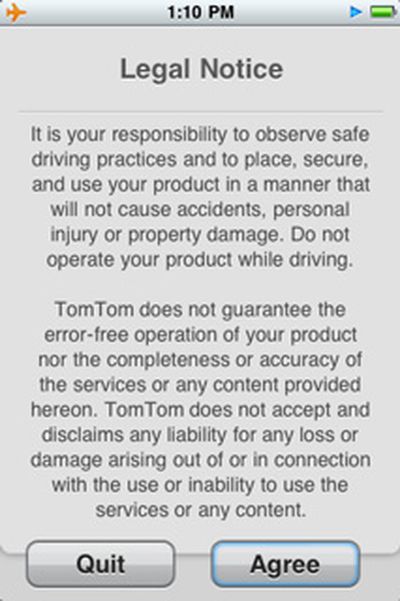
Opening the app for the first time prompts a legal advisory to pop up, which must be acknowledged in order to proceed. After this, you are free to roam about and explore the app, with no settings prompts or "getting started" information shown. The voice is set to "Lori," a female American English voice by default. If you want to change the voice, you have a whopping 75 from which to choose in languages from Afrikaans to Vlaams. There are 11 voice selections that speak English available, though none of these are computerized voices capable of pronouncing street names. Changing the voice guidance language does not change the language of the app's English interface.
First trips
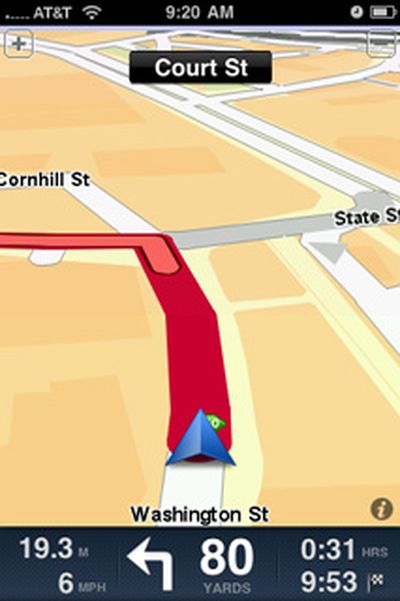
On our first trips out using the TomTom app to navigate, getting a GPS fix in suburban Boston under clear skies took under 30 seconds. Relative to well-known surroundings, the app showed an accurate location most of the time, with only a couple of moments when the icon representing our location appeared off to the side of the current road. The graphics are sharp and professional, though tracking is just a wee bit jumpy on the 32GB iPhone 3GS used for testing, though this does not hamper navigation in any way. Switching between landscape and portrait mode is smooth when the iPhone's orientation is changed.
The volume of voice guidance is loud enough to be heard over music playing at a low volume through the car's stereo. Adjusting the voice's volume can be accomplished using the iPhone's volume rocker though you must do this while the voice is speaking, otherwise you'll only adjust the ringer volume. If you tap on the lower left corner of the information pane at the bottom where navigation information is shown, you'll get an on-screen volume slider that will adjust the voice's volume directly.
Music from the iPod application can be played during navigation, though it stops instantly when voice guidance is given, and then starts playing again right after. This is a pretty abrupt way to handle voice guidance and a fade-in/out effect would be less startling and easier on the ears.
When a call is received, navigation guidance stops and the standard iPhone incoming call screen is shown. If the call is accepted, the phone app takes precedence, displaying the standard in-call screen. Once the call has ended or an incoming call is rejected, Tomtom opens up on its own immediately, and navigation resumes once it obtains a GPS fix. The same behavior is exhibited if a call is initiated via a Bluetooth accessory, such as a car kit.
Unscientific eyeballing of the iPhone's built-in battery percentage meter showed about a 5% drop for every 10 minutes of guidance with Wi-Fi and Bluetooth on and connected to the car's Bluetooth system. Turning Wi-Fi and Bluetooth off should improve battery life during navigation, but connecting your iPhone to a power source would be wise to avoid a dead battery in the middle of navigating an unfamiliar place for all but the shortest trips.
Interface and features
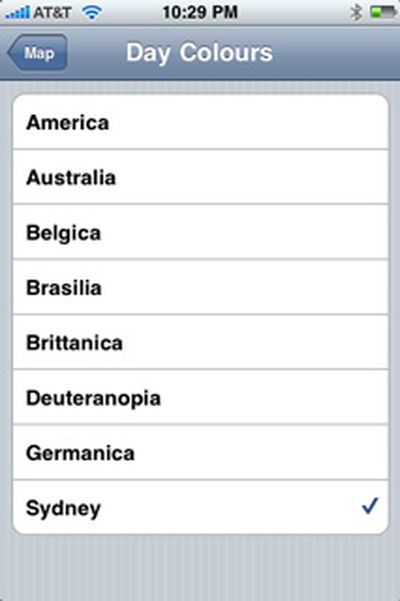
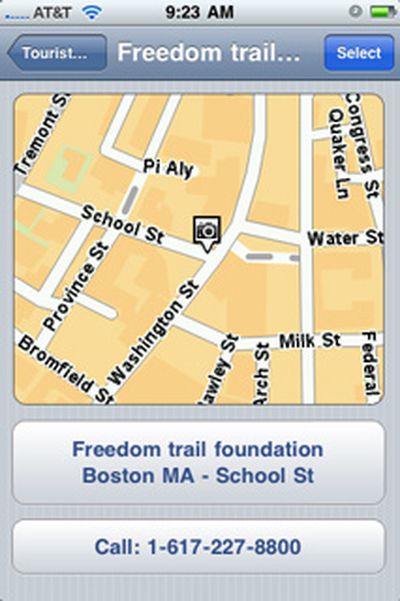
The TomTom app offers an interface that will be very familiar to anyone who has ever used a TomTom stand-alone device or app on another smartphone or PDA platform before. The ability to change the day and night color schemes is present, although a setting to allow the app to automatically switch between day and night color schemes using the iPhone's ambient light sensor seems to be missing. At first glance, POI data appears to be robust, allowing us to easily find retail store chain and government office locations. Many POIs have phone numbers, which can automatically be called through a shortcut button in the POI summary view.
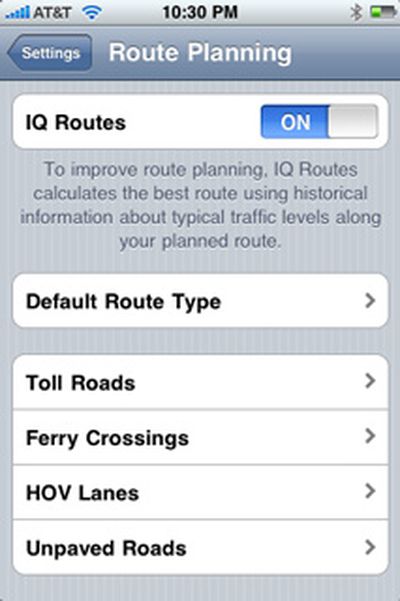
Also included is IQ Routes, a relatively recent offering from TomTom that promises to provide optimal route guidance based on historical traffic information for the route you need to travel. Looking at other features offered on their stand-alone units, the TomTom iPhone app has not inherited text-to-speech voice guidance nor live traffic information.
Initial thoughts
So far, the TomTom app shows promise, though it has some heavy competition from Navigon, Sygic, CoPilot and many others. Currently priced at $99, TomTom is the most expensive navigation app available for the U.S., coming in at over $60 more than the least expensive full-featured GPS app that covers the U.S. and Canada, CoPilot Live, which is priced at $34.99.
The accessory cradle, which will have its own GPS chip, a loudspeaker, and ports for charging and audio output, is not yet available nor is its price known though unconfirmed information points to a possible price of 99 + VAT for the cradle and app together and compatibility with the iPod touch. TomTom put out a new video of the cradle a few days ago, highlighting its features:
The upcoming main review of the TomTom app will include more information about the app's settings, customization options, POI database, as well as a more in-depth look at the app's performance on the road and its advance planning features.
The TomTom app for the U.S. and Canada can be found here (link opens iTunes) and costs $99.
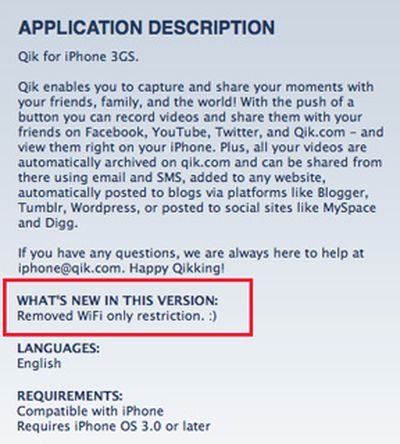
The Qik app that first arrived in the App Store earlier this month has already been updated to a new version that removes the Wi-Fi only restriction. At its initial release, the popular video sharing application was able to upload previously-recorded videos to Facebook, YouTube, Twitter, and Qik's own site via Wi-Fi only. Now, video uploads can also be done over a 3G or EDGE cellular data connection.
The Qik iPhone app still lacks the ability to stream live video, a feature present in versions available for other platforms.
The Qik app is free and can be found here (link opens iTunes).
Bloomberg reports on Apple's retail store performance amidst the current economic situation, noting that Apple's retail sales have held up remarkably well as other merchants have seen sales slip.
Apple, based in Cupertino, California, increased revenue at its stores by 2.5 percent in the first six months of the year to $3 billion as the rest of the retail industry suffered. During the same period, sales at all U.S. retailers fell 9.2 percent compared with the first half of 2008, according to the U.S. Commerce Department.
The report focuses on Apple's flagship Fifth Avenue store in New York City, noting that the store may be the highest-grossing retail outlet in the famed shopping district on a per-square-foot basis.
Apple's Fifth Avenue emporium probably has annual sales of more than $350 million, topping any of the chain's other outlets, said Jeffrey Roseman, executive vice president of real- estate broker Newmark Knight Frank Retail in New York. The location is 10,000 square feet, putting its sales per square foot at a minimum of $35,000, based on Roseman's estimate.
Other high-end retailers noted in the report, such as jewelry shops Tiffany & Co. and Harry Winston, are reported to be bringing in closer to $12,000 to $18,000 per square foot annually.
A previous report had pegged Apple's annual sales for its Fifth Avenue store at as much as $440 million, although that number may have been slightly inflated, as it came from the building's owner as it was being marketed for sale.
Gdgt reports that RealNetworks has submitted its Rhapsody app for the iPhone and iPod touch to the App Store for approval. The app will provide on-demand streaming music to Rhapsody subscribers and it will offer a limited free trial for non-subscribers to test the service.
The RealNetworks blog describes that the app will be easy and intuitive to use and will include the ability to search the entire Rhapsody library of over 8 million songs. A video demonstrating the app has been posted: