A post [Google translation] from the staff of Chinese forum WeiPhone.com claims to share a host of official Apple download links for tomorrow's software releases. While the links are not currently active, they include iOS 6 beta build 10A5316k for a variety of devices, as well as a developer preview of Safari 6 for OS X Lion.
The accuracy of the claim can not be confirmed given that the links are not yet pointing to the files, but clicking on the links does take users to an error page stating "Your session has expired." Altering the URLs to reference a different build number or making other changes yields an "Access denied" error message, suggesting that there is indeed something unique about the leaked URLs.
A similar list of links addressing last year's downloads also leaked out just as Apple's WWDC 2011 keynote was getting underway.
Assuming that the list is accurate and complete as far as iOS 6 beta is concerned, it appears that Apple will not be including support for the original iPad in its next-generation operating system. In addition, Apple appears to be dropping support for the third-generation iPod touch.
It is unclear whether the leaked list is intended to cover all of Apple's software releases for tomorrow, but we would also expect a new build of OS X Mountain Lion to appear as Apple moves closer to a public release.
Apple's announcement to move their Macs from PowerPC to Intel processors in 2005 was a huge surprise at the time. Serious reports about the plan hit the web only two days before the official announcement at WWDC 2005. The immediate reaction on MacRumors included a 2936 comment thread with some very strong reactions to the switch-up.
Now, a post by the wife of a former Apple employee at Q&A site Quora fills in some fascinating details about the Mac OS X on Intel project.
According to Kim Scheinberg, she and her husband John Kullmann had decided to move back to the east coast in 2000. In order to make the move, Kullmann had to work on a more independent project at Apple. Ultimately, he started work on an Intel version of Mac OS X. Eighteen months later, in December 2001, his boss asks him to show him what he's been working on:
At this point, JK has three PCs in his office at Apple, and another three in the office at home, all sold to him by a friend who sells custom built PCs (can't order them through the usual Apple channels because no one in the company knows what he's working on). All are running the Mac OS.
In JK's office, Joe watches in amazement as JK boots up an Intel PC and up on the screen comes the familiar 'Welcome to Macintosh'.
Joe pauses, silent for a moment, then says, "I'll be right back."
He comes back a few minutes later with Bertrand Serlet.
Max (our 1-year-old) and I were in the office when this happened because I was picking JK up from work. Bertrand walks in, watches the PC boot up, and says to JK, "How long would it take you to get this running on a (Sony) Vaio?" JK replies, "Not long" and Bertrand says, "Two weeks? Three?"
JK said more like two *hours*. Three hours, tops.
Bertrand tells JK to go to Fry's (the famous West Coast computer chain) and buy the top of the line, most expensive Vaio they have. So off JK, Max and I go to Frys. We return to Apple less than an hour later. By 7:30 that evening, the Vaio is running the Mac OS. [My husband disputes my memory of this and says that Matt Watson bought the Vaio. Maybe Matt will chime in.]
The next morning, Steve Jobs is on a plane to Japan to meet with the President of Sony.
More engineers were assigned in 2002, and she says that's about when rumors of the project started to appear.
Indeed, in August 2002, we reported on the first news report about Marklar from eWeek:
According to sources, the Cupertino, Calif., Mac maker has been working steadily on maintaining current, PC-compatible builds of its Unix-based OS.
At the time, it was described as a "fall-back plan", in case the PowerPC should fail to deliver. Later, reports would also claim that PC manufacturers were wooing Steve Jobs to allow them to license Mac OS X and sell PCs running Apple's operating system.
Ultimately, Apple decided to transition from the PowerPC to Intel processor in 2005. The transition was a success, and all Macs now run on Intel processors.
With Apple appearing to have a full slate of announcements lined up for its Worldwide Developers Conference (WWDC) keynote on Monday, we're offering this roundup to summarize a number of the high-profile rumors that have been circulating ahead of the event.
Apple has already announced that it will be previewing iOS 6 and OS X Mountain Lion at the event, and with Apple also expected to introduce a number of new Macs and perhaps make some additional announcements, the schedule appears to be packed.
iOS 6
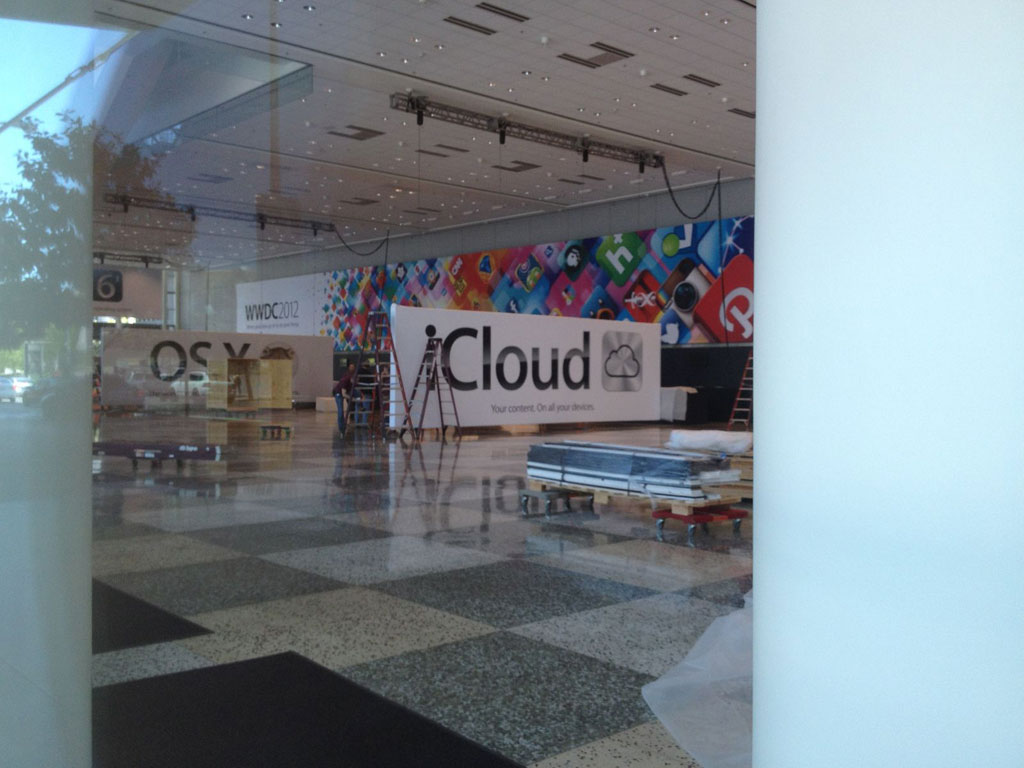
Apple is not keeping it secret that iOS 6 will be a major component of WWDC 2012, with banners featuring the unannounced version of iOS having already been hung at the site of the conference. While we expect Apple will detail the many new features of iOS, the biggest new feature will be Apple's own mapping solution, which has been reported by multiple sources. Apple has been dependent on Google for mapping and navigation since the iPhone's original launch, but over the past several years Apple has made moves and acquisitions in an attempt to build its own solution. Here is a list of rumored features for the latest version of iOS:
OS X Mountain Lion is another known product that Apple will be discussing at the conference. Apple previously announced the new version of OS X back in February. The features included Notification Center, Messages, Reminders, Game Center, and Airplay. We've since seen hints at several other new features that Apple may also be including in OS X:
The third banner that is being prominently displayed in the Moscone lobby is one for iCloud. Apple CEO Tim Cook has said that iCloud is a strategy for the next decade. Due to a slip-up by Apple, we've already seen some of the new features that Apple is planning to bring to iCloud in iOS 6:
MacBook Airs, MacBook Pros, Mac Pros, iMacs and Retina
Due to a leaked inventory list, we know that Apple is shipping a dozen new Mac models to their retail stores, although the exact breakdown is somewhat open to how you interpret the part numbers and prices. At the least, it seems we'll see new MacBook Airs, Mac Pros and MacBook Pros. Depending on your interpretation, we may also see iMacs.
Meanwhile, Retina-class displays on Apple's new Macs has been an ongoing rumor that's even been corroborated by Bloomberg. Apple has already built in Retina-display support in OS X, and many expect them to release the corresponding hardware this week.
Apple has been rumored to be bringing a television set to market late this year or early next year, and there have been rumblings that the company may take its first steps toward that goal at WWDC with an unveiling of the operating system that will power the TV. Additional claims have suggested that Apple will be introducing an SDK to open up the current Apple TV set-top box to third-party developers. Those apps would naturally also be compatible with the television set should it come to fruition. We should note that all these Apple TV claims come from a single uncorroborated source, and may not happen next week.
iPhone
A number of parts claimed to be for the next-generation iPhone have already begun leaking from Apple's supply chain, with the highest-profile leak so far being a hands-on video showing the back cover of the device. Apple is unlikely to introduce new iPhone hardware at WWDC, however, with most observers believing that the company will stick to the September/October timeframe seen last year with the iPhone 4S.
Live Keynote Coverage
The WWDC 2012 Keynote kicks off at 10am Pacific on Monday, June 11th. We will be providing live text and photo coverage here. We will also be issuing Twitter updates through our @MacRumorsLive account. Separate news stories regarding the event announcements will go out through our @MacRumors account.
Apple's kicking off their 2012 Worldwide Developer's Conference at 10am Pacific on Monday, June 11th. MacRumors will be at the keynote and we will be providing live text/photo coverage of the event here. We will also be issuing Twitter updates through our @MacRumorsLive account. Separate news stories regarding the event announcements will go out through our @MacRumors account.
Apple will not be streaming a live video feed, but does offer the video for download several hours after the event. MacRumors readers interested in a "spoiler-free" environment to wait for the full keynote video to become available can follow the spoiler free story. A direct link to the official keynote video will be posted there when it becomes available.
Apple is expected to make a number of announcements at the keynote. We already know that both iOS 6 and Mountain Lion will be major focuses of the event. We will be posting a full roundup of all rumors shortly. As always, stay tuned for last-minute leaks and rumors as there is usually activity leading right up to the event.
With Apple's WWDC 2012 Keynote kicking off on Monday, some users are interested in avoiding all of the announcements and waiting until Apple posts the recorded video of the event so as to experience it without already knowing the outcome.
For those individuals, we've posted this news story, which will be updated with the link to the presentation once it becomes available from Apple. No other news stories or announcements will be displayed alongside this story.
Users waiting for the video to be posted are welcome to gather in the thread associated with this news story, and we ask that those who follow the events refrain from making any posts in the thread about tomorrow's announcements.
Last year, Apple announced that it was phasing out developer access to UDIDs, the unique iOS device identifiers that allowed developers and advertisers to not only track usage of their own content, but also in some cases track users' movements across apps and browsing sessions. The company earlier this year began rejecting apps that continued to use the UDID rather than implementing unique identifiers that would enhance privacy by remaining unique to the developer's app.
The Wall Street Journal now reports that Apple is preparing to release new tools to assist developers with tracking usage of their apps without using the UDID, maintaining user privacy while still making it easy for developers to gather usage data on their apps.
Apple Inc. is planning to release a new way for mobile app developers to track who uses their software, according to people briefed on Apple's plans, the company's latest attempt to balance developers' appetite for targeting data with consumers' unease over how it is used.
The new tool, which could be detailed in the coming weeks, aims to better protect user privacy than existing approaches, these people said.
The report notes that Apple has been inconsistent about blocking apps that use the UDID for tracking purposes and that the new tools will provide developers with ways to collect important data anonymously without being linked to the UDID that when combined with data from other apps could be used to identify the specific user of a given device.
No other details on the tools have yet been revealed, but the company could share more information at next week's Worldwide Developers Conference.
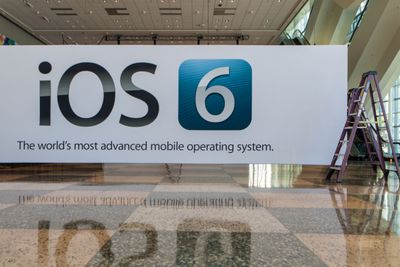
Instagram user Zac Altman has posted a photo showing a new banner going up at the Moscone West convention center confirming that Apple will be unveiling iOS 6 at next Monday's keynote address.
iOS 6 has been assumed to be a major topic of discussion for the event, but Apple has so far mentioned only that it will discuss the "future of iOS" at the event. The banner also displays a silver-colored theme that has been rumored to making its way to the iPhone to replace the blue theme present in many of Apple's apps. The silver theme has already been showing up on the iPad, but rumors of an Apple mapping app have suggested that the silver theme will moving to the smaller screen as well.
With Apple having dropped numbering and other descriptors from its latest model of the iPad earlier this year, there has been speculation that the company may follow suit with other products such as the iPhone. Today's banner indicates that the company will at least continue marketing iOS using its version number.
Yesterday, 9to5Mac reported that an iPhone user running on T-Mobile's network had observed the curious phenomenon of 3G connectivity showing up on his device when in the immediate vicinity of the Moscone West convention center where Apple is holding its Worldwide Developers Conference next week. The user, who frequently passes by the convention center, had never seen 3G network support there before.
iPhone users on T-Mobile USA have historically been limited to the carrier's slower EDGE network due to frequency incompatibility, but late last year the carrier began refarming its spectrum in select areas to move 3G service over to the 1900 MHz frequency band compatible with the iPhone. Just one month ago, T-Mobile announced that it would be taking the initiative nationwide, making the carrier ready for the iPhone by the end of 2012.
In response to the observation of 1900 MHz 3G service showing up specifically at Moscone West to beef up service for its users and speculation that Apple could make some sort of announcement about a T-Mobile iPhone at the event, the carrier issued a statement acknowledging the testing but calling its alignment with Apple's WWDC keynote "coincidental".
While upgrading coverage inside the West side of the Moscone Center, T-Mobile has also deployed 4G HSPA+ service in the 1900 MHz band to test the live network on a small scale. As part of the company’s previously announced $4 billion network modernization effort, T-Mobile plans to launch 4G HSPA+ service in the 1900 MHz band in a large number of markets by the end of the year, which will make our 4G network compatible with a broader range of devices, including the iPhone.
NOTE: The time and location of this test is just coincidental.
T-Mobile is the only one of the four major U.S. carriers to not offer the iPhone, due to its current frequency incompatibility, and the carrier has been increasingly disadvantaged as even small regional carriers and prepaid networks have begun rolling out the device to an increasing number of customers.
Following up on its report from last week claiming that Apple will show off the operating system for its future television set product at next week's Worldwide Developers Conference, BGR now briefly reports that Apple will be using the event to introduce a new software development kit (SDK) to allow third-party developers to build apps for the Apple TV.
We have heard from a trusted source that Apple will be introducing a TV SDK at WWDC next week. This would enable third-party developers to create software for Apple’s TV products.
The report reveals no other details on Apple plans, but we do note that Steve Jobs himself admitted just as the revised Apple TV was launching in September 2010 that the company could open an App Store for the Apple TV "when the time is right".
With rumors of an Apple television set continuing to build, Apple may now consider the time right to begin allowing developers to build apps for the existing Apple TV set-top box ahead of the company's larger entry into the market.
Dow Jones Newswires reports that Apple is facing a fine of roughly $1.9 million to settle a case brought by Australian regulators over Apple's use of the "4G" term in marketing for the new iPad when the device is not compatible with such networks outside of the United States and Canada.
A federal court in Melbourne heard Friday that Apple had agreed to pay A$2.25 million to settle a case brought against it by the Australian Competition and Consumer Commission. The company also has agreed to pay the commission's costs of A$300,000, commission lawyer Colin Golvan told the court.
Specifically, Australian carrier Telstra has rolled out a 4G LTE network, but due to differences in frequencies used in various countries, the new iPad does not support Telstra's 4G network and must rely on 3G connectivity.
Apple has taken several steps to address the issue internationally, clarifying the language on its site discontinuing the "Wi-Fi + 4G" descriptor on a worldwide basis in favor of "Wi-Fi + Cellular".
Bloomberg Businessweek publishes a new profile of Phil Schiller, Apple senior vice president of marketing who served for years as Steve Jobs' right-hand man regarding the company's public presentations and comments, but who has also been intimately involved in product development and positioning.
He helped Apple’s late CEO work through the meat-and-potatoes of creating new products: Defining target markets, determining technical specs, setting prices. It was Schiller who came up with the spin-wheel interface on the original iPod, and he was a champion of the iPad when other executives questioned its potential. “Because Phil’s title is marketing, people believe he’s focused on what’s on the billboards,” says Gene Munster, an analyst with Piper Jaffray (PJC). “He’s much more important than people give him credit for.”
The profile notes that while Schiller and Jobs appeared vastly different in their personal lives and interests, the two were always on the same wavelength with regard to Apple's plans, earning Schiller the internal nickname of "Mini-Me". Like Jobs, Schiller has also been known to be ruthless in shooting down ideas considered not good enough for Apple to pursue, earning him another nickname of "Dr. No".
Schiller is one of the key executives responsible for helping Apple maintain its momentum as it transitions away from Jobs' influence, and he knows that he will be one of those held most acutely responsible if Apple's future products fall short.
Schiller shares many of Jobs’s passions and impulses. The big question is how well he can channel them into new ideas and products. Four former Apple managers say many consider him overly controlling and worry that he lacks the bold creative instincts needed to maintain Apple’s edge. Particularly in his expanded marketing role, some fear he will be a more conventional leader, prone to hyping products in ways that tarnish Apple’s hard-won brand loyalty.
With the iPad now over two years old and experiencing booming growth, the pressure is on Apple to set the stage for its next breakthrough product, which some believe to be television. But regardless of Apple's plans, Schiller will be playing a key role in nurturing Apple's progress and serving as a public face for Apple to help spread its message.
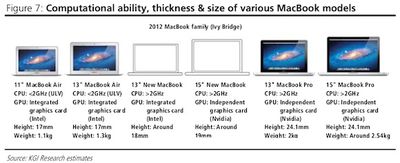
KGI Securities analyst Ming-Chi Kuo today issued a new report outlining his belief that Apple's thinner, Retina-equipped Mac notebook will arrive next week as a new model, referring to the machine simply as a "MacBook". Kuo believes that this MacBook will be offered alongside upgraded versions of the existing 13-inch and 15-inch MacBook Pro models, with Apple being reluctant to do away with the current 13-inch design in particular due to its massive popularity.
We expect Apple (US) to unveil a new MacBook series independent from the MacBook Air and MacBook Pro lines at Worldwide Developers Conference (WWDC) in June. We expect the new MacBook to have the following features:
(1) Basic 13” model to be priced at US$1,199 (2) No disc drive (3) To come in both SSD and HDD (4) Lighter and slimmer than MacBook Pro, with equal computing power (5) Retinal display with tapered edge, larger battery capacity
Kuo also reiterates his earlier claims that Apple will discontinue the 17-inch MacBook Pro this year, citing estimates that the model makes up only 1% of Apple's notebook sales.
The introduction of this new "MacBook" model would leave Apple with a lineup of six notebooks, although Kuo predicts that issues with display yield and heat dissipation will push the release of the 13-inch MacBook back until August, leaving only the 15-inch model to make its debut next week.
Mention of an independent graphics chip on 13" MacBook Pro is an error - should be integrated graphics
We should note that this configuration of models is not accounted for in our speculation on part numbers that leaked earlier this week, but we did receive an unconfirmed tip of a different configuration that would match up with Kuo's claims fairly closely. In that scenario, new iMacs are not accounted for in the list and the J30/J31 model numbers represent updated 13-inch and 15-inch MacBook Pro models while the D2 model represents this new Retina-equipped 15-inch MacBook.
Kuo believes that Apple will wait until next year to re-simplify its notebook lines with Intel's Haswell platform, at which point the company will merge the MacBook Pro and this new MacBook model, leaving a set of four models: 11-inch and 13-inch MacBook Airs and 13-inch and 15-inch MacBooks.
We do find Kuo's claims to be somewhat difficult to believe, as we fail to see how this new "MacBook" model is substantially different in performance from the MacBook Pro and thus do not see why users would be interested in a non-Retina MacBook Pro given the existence of this new MacBook line. Given the scenario outlined by Kuo, the only "advantage" of the thicker MacBook Pro would be an included optical drive, but users are finding such a feature to be increasingly unnecessary and easily replaceable by digital downloads such as through the Mac App Store, direct file transfers, and cloud-based storage, with an external optical drive available to be connected only on the rare occasions when necessary.
Still, Kuo has offered accurate information on Apple's notebook plans in the past, being the first to outlined the MacBook Air redesign that included the new 11-inch model, and thus we feel that his claims are worth some consideration and discussion.
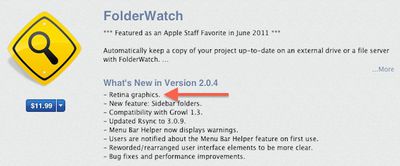
The report suggests that the application's developer may possibly have been given advance notice of Retina Mac displays by Apple, but we believe that to be unlikely and assume that the developer included the improved graphics based on circulating rumors and Apple's existing HiDPI modes quietly built into its recent operating system versions. Supporting the latter speculation, the developer issued a Tweet earlier today indicating that the "Retina" claim simply refers to the HiDPI mode already seen in OS X.
Still, Apple approved the update with "Retina graphics" listed as the first bullet point in the "What's new" section regarding the update, suggesting that the mention was at least seen by reviewers who approved the update as it was submitted. Consequently, the move is gaining significant attention as a potential signal from Apple itself that Retina-capable Macs are on their way next week.
Of course, it is unlikely that even Apple's Mac App Store reviewers have been briefed on upcoming Mac capabilities, so we hesitate to make too much of the news at this point.
Apple is expected to introduce a Retina 15-inch MacBook Pro at a minimum next week, with the feature expected to make its way into Apple's other display-equipped Mac models over time.
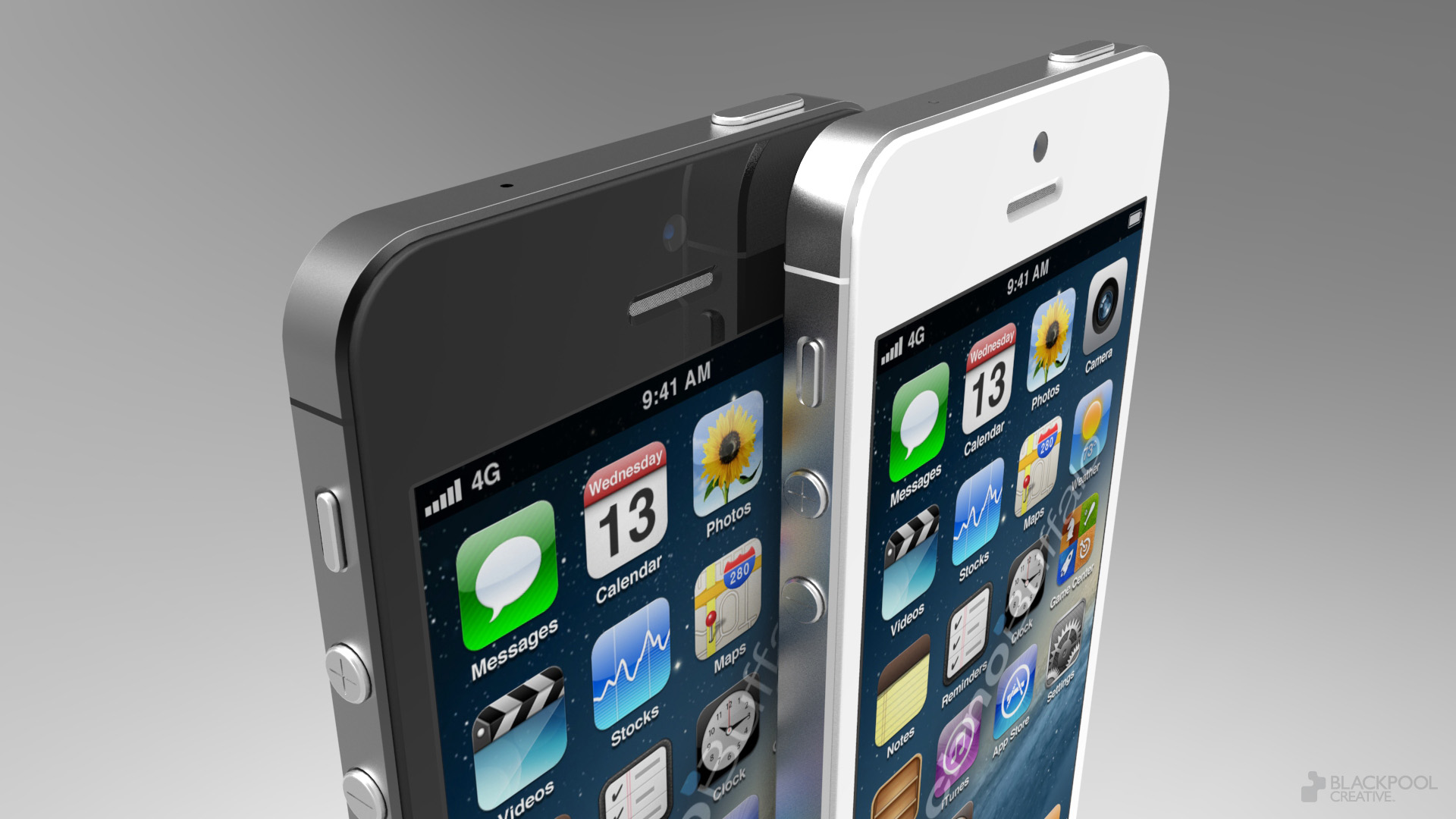
There’s been quite a bit of hype recently in the Apple universe over the imminent announcement of a new iPhone, or rather the new iPhone (aka iPhone 5). Many of the biggest media outlets have already published photos and videos of “leaked” parts that are supposedly from the iPhone 5 as it makes its way into the manufacturing phase at Apple’s suppliers. I thought it would be fun to piece together these fragments to see what the iPhone 5 might look like when Apple makes the big announcement
Besides the video below, he's also created a zip of 76 high resolution images for download.
The numerous part leaks have fueled interest in this longer 4" screen iPhone design. Last year, early 3rd party case designs had suggested an even more dramatic redesign, but that design never came to pass.
Apple will be taking the stage at WWDC next week, but most observers don't expect Apple to unveil the new iPhone at WWDC. The new iPhone is not expected to be introduced until the fall (September/October).
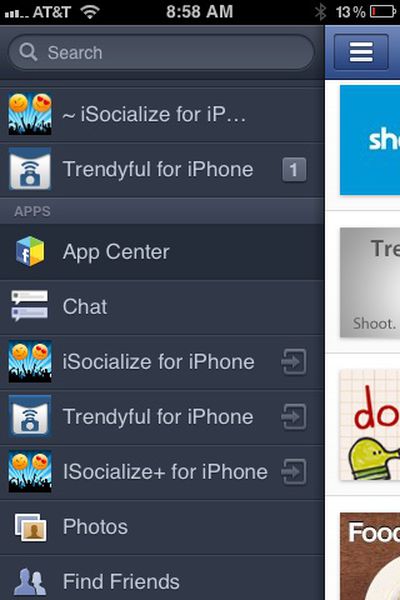
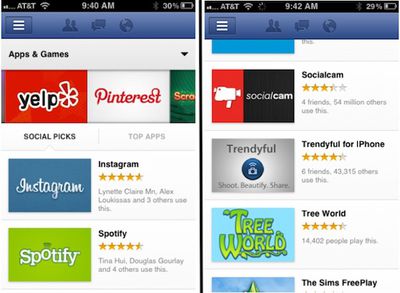
As noted by TechCrunch, some users of Facebook's app for iOS have noticed the social network's new "App Center" tab showing up in the navigation menu within the app. The feature is designed as a one-stop destination for app discovery on a variety of platforms, with recommendations based on Facebook's editors' selections and personalized by drawing from the usage of each person's friends.
Similar to the interfaces that the company showed off in early May when it announced the App Center plans, you can see a left-hand navigation feature within Facebook’s feature-heavy iOS app. Apps with unread notifications appear in the top section. If you click through, you see the App Center (and you’ll note that the logo in the screenshot also matches what Facebook has previously released).
Within the app center, a "Social Picks" tab offers apps based on what the user's friends have used, while a "Top Apps" tab contains picks from Facebook's editors as determined by quality and popularity. The listings include iOS, Android, HTML5, and desktop apps, with users able to click directly through to the App Store or other marketplaces to download apps.
The Next Web argues that the addition of App Center will be a major boost for Apple, helping quality apps to surface from among Facebook's hundreds of millions of users and those top apps to be easily accessible to other users.
By launching this App Center, Facebook is actually doing Apple a gigantic favor in two regards. First, it will become a serious point of distribution for Apple developers, secondarily it will be a great avenue to talk Facebook developers into building iOS apps if they haven’t so far. [...]
Facebook’s App Center won’t be clouded by anything other than actual data and usage. Imagine that, apps will actually bubble up to the top based on how often people engage with them.
After several years of what has appeared to be a tenuous relationship between Apple and Facebook, it certainly appears that the two companies are now moving to work more closely together. At the D10 conference late last month, Apple CEO Tim Cook hinted at Facebook integration and perhaps other announcements in that vein, urging users to "stay tuned".
For us, we want to provide customers simple and elegant ways to do the things they want to do. Facebook has hundreds of millions of customers. So, anyone that has an iPhone or iPad, we want them to have the best experience with Facebook on those platforms. So stay tuned.
Just a few days after Cook's comments, it was reported that Apple will indeed show off Facebook integration in iOS 6 at next week's Worldwide Developers Conference, making it much easier for users to post photos, status updates, and other content to the social network from within iOS.
With Facebook also feeding back into the App Store through its own App Center on iOS, it certainly seems that the companies are moving quickly to solidify their relationship for their mutual benefit and to the benefit of the millions of users who rely on both Apple devices and Facebook's social network.
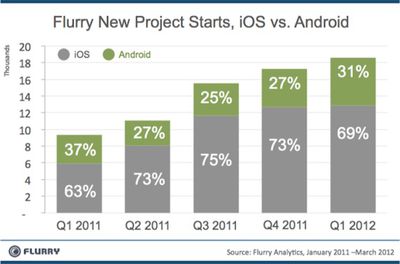
Flurry Analytics today released a new report highlighting developer interest in iOS and Android as measured by downloads of Flurry's tools for integrating analytics into apps. With a new high of over 18,000 SDK downloads by developers during the first quarter of 2012, Flurry found that iOS continues to hold a substantial lead over Android with 69% of those downloads being for iOS.
For every 10 apps that developers build, roughly 7 are for iOS. While Google made some gains in Q1 2012, edging up to over 30% for the first time in a year, we believe this is largely due to seasonality, as Apple traditionally experiences a spike in developer support leading up to the holiday season. Apple’s business has more observable seasonality.
Flurry points to Apple's dominance in the tablet market as one significant driver of its popularity with developers, with Flurry's numbers showing that the iPad accounted for 88% of all user sessions on tablets during the first five months of 2012. Samsung's Galaxy Tab placed second with just 9% of the market with Amazon's Kindle Fire representing 3%.
Flurry also offers data on fragmentation within the Android ecosystem, illustrating how both multitude of devices and operating system versions leads to developers having to design their apps to be compatible with an increasingly complex variety of user setups.
Looking at revenue generation, Flurry calculates that for every dollar of revenue per active user generated on iOS, a developer can only expect to earn 24 cents on Android, demonstrating the main reason why developers continue to choose iOS as their first priority for app development.
At the end of the day, developers run businesses, and businesses seek out markets where revenue opportunities are highest and the cost of building and distributing is lowest. In short, Android delivers less gain and more pain than iOS, which we believe is the key reason 7 out of every 10 apps built in the new economy are for iOS instead of Android.
Flurry's report comes as TechCrunch reminds readers of Google Chairman Eric Schmidt's claim from December stating that within six months most developers would choose to develop for Android as their first priority. With six months having passed and developers clearly still choosing iOS first, TechCrunch reaches a similar conclusion that fragmentation, particularly on the operating system side, has been a major contribution to Android app development falling short of Schmidt's predictions.
Most notably, seven months after the launch of Android 4.0 Ice Cream Sandwich, Google's own data reveals that only 7.1% of Android phones are running the latest operating system, a number in line with that observed by Flurry. In contrast, iOS 5 is reported to be installed on 75-80% of active devices as measured from a sample of downloads from the popular Audiobooks application.
Following a rumor from late March claiming that Apple will be adding Baidu as a search engine option on the iPhone in China, Bloomberg reports that Apple will indeed be taking that step, perhaps announcing the addition at next week's Worldwide Developers Conference.
While customers will have the option to select Baidu as their main vehicle for searching the Web, Google’s product will probably remain the default choice, one person said. At present, users of iPhones and iPads in China can access Baidu search by downloading it separately as an application.
Baidu maintains an 80% share of the search market in China, making it a natural addition for Apple as it seeks to drive overall growth with a focus on the booming consumer market there.
Bloomberg also reiterates claims that Apple will announce next week that it is abandoning Google Maps on iOS in favor of its own mapping solution, but the report offers no other details on the company's plans for the transition.
In line with rumors from earlier this week, Virgin Mobile USA today announced that it will begin offering the iPhone on June 29. Virgin Mobile USA is a prepaid brand operated by Sprint.
Notably, Virgin Mobile will be offering service plans for as low as $30 per month with no commitment when customers sign up for automatic payments.
Virgin Mobile's Beyond Talk unlimited data and messaging plans for iPhone start at $35 per month for access to Sprint's Nationwide Network, and customers can receive a $5 per-month plan discount when they register for automatic monthly payments with a credit card, debit card or PayPal account, making iPhone available for as low as $30 per month. Customers can also use their iPhone as a mobile hotspot through Virgin Mobile for an additional $15 per month.
Unlike Cricket, which announced last week that it will begin offering the iPhone on a prepaid basis on June 22, Virgin is not offering any subsidy on iPhone hardware, with the 8 GB iPhone 4 being priced at $549 and the 16 GB iPhone 4S coming in a $649.
Cricket is offering the iPhone for $150 less, but its service plan consists solely of a $55/month offering with unlimited talk, text, and data. With Virgin Mobile offering plans for as low as $30, low-use customers can make up that hardware price differential in six months of service.
All three of Virgin Mobile's plans include unlimited texting and data (throttled after 2.5 GB), with voice minutes being the differentiating factor. With the $5 discount for automatic payments, Virgin Mobile's plans are priced at $30 (300 minutes), $40 (1200 minutes), and $50 (unlimited minutes).
Virgin Mobile will offer the iPhone through its website and at RadioShack, Best Buy, and other select retailers.


 A post [Google translation] from the staff of Chinese forum WeiPhone.com claims to share a host of official Apple download links for tomorrow's software releases. While the links are not currently active, they include iOS 6 beta build 10A5316k for a variety of devices, as well as a developer preview of Safari 6 for OS X Lion.
 Apple's announcement to

 OS X Mountain Lion is another known product that Apple will be discussing at the conference. Apple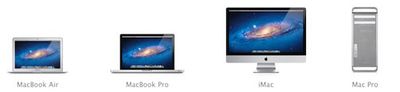




 Following up on its
 Bloomberg Businessweek publishes a new