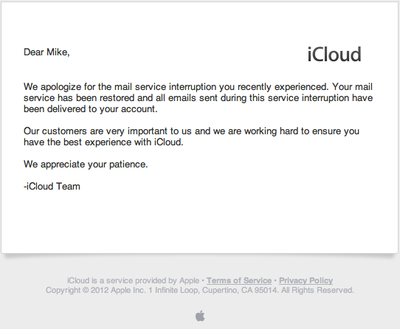
Apple has sent an emailed apology to customer affected by the recent iCloud outage that took down email for a small fraction of users for several days. Apple claimed the outage only affected 1.1% of iCloud users.
We apologize for the mail service interruption you recently experienced. Your mail service has been restored and all emails sent during this service interruption have been delivered to your account.
Our customers are very important to us and we are working hard to ensure you have the best experience with iCloud.
We appreciate your patience.
-iCloud Team
Apple has not disclosed any plans to offer a service credit or refund to affected users, though compensation is slightly more tricky because the base iCloud service is now free.
Mac Otakara reports that Apple's new Lightning dock connector is capable of hosting USB peripheral devices, meaning that Apple could potentially allow users to connect devices such as keyboard and other accessories directly to their Lightning-equipped mobile products.
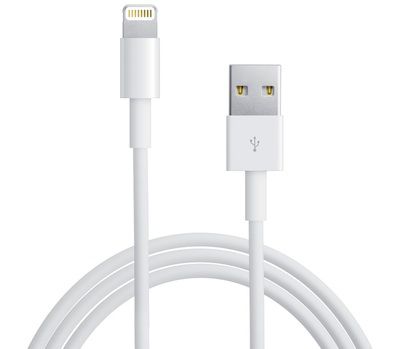
Apple's Lightning to USB cable
Even if the report is true, however, it would require that Apple build device support for such functionality on top of the Lightning compatibility in order to allow accessory manufacturers to tap into the USB capabilities. Such functionality is also not new with Lightning, as Apple's iPad Camera Connection Kit has long provided an adapter that allows uses to connect not only camera but also a number of other peripherals to their iPads.
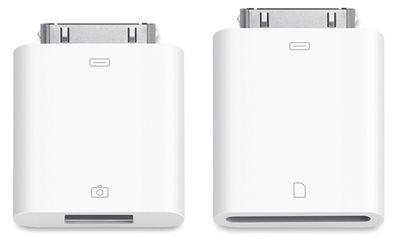
Apple's iPad Camera Connection Kit with USB-based camera adapter at left
Consequently, we hesitate to give too much importance to this claim, as Apple has long had the ability to support some USB-based peripherals via the original 30-pin dock connector but has elected not to make extensive use of the compatibility and the may take a similar stance with Lightning.
We've been following Apple's work at its Maiden, North Carolina data center for quite some time, and early last month we saw some good aerial photos showing ongoing work at the site including the installation of a major solar farm to help meet Apple's renewable energy goals for the center.
GigaOM now shares some new video stills shot from the air by WCNC-TV showing that installation at the massive solar farm is nearly complete with the 100-acre site now filled with row after row of ground-mounted solar panels.
The solar farm is just one of two being developed Apple to support the data center, with the one captured on film located directly across the street from the center and the other located a few miles away. Together, the two similarly-sized solar farms will provide roughly 40 megawatts of power, with an on-site fuel cell facility providing an additional 5 megawatts.
Regulatory documents indicate that Apple plans to complete installation at the solar farm across the street from its data center by November 1, with operation set to commence by December 21. While solar panel installation appears to already be nearly complete, it is unclear if Apple is ahead of schedule on the project, as there is undoubtedly additional infrastructure work that will be required before the solar farm becomes operational.
Following some criticism from environmental group Greenpeace that overstated Apple's reliance on dirty energy sources for its data center power, Apple went public with plans to power all of its data center with 100% renewable energy. Beyond the North Carolina data center, Apple operates a smaller center in Newark, California near its headquarters and is in the process of developing new centers in Oregon and Nevada.
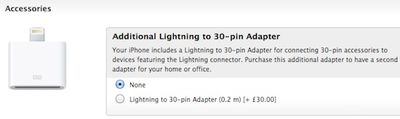
As noted by iPhoneinCanada.ca soon after pre-orders for the iPhone 5 went live earlier today, Apple's online store in several countries appeared to be noting that the company's Lightning to 30-pin Adapter would be included with customers' orders free of charge. The disclosure came in the form of an option to add an "additional" adapter as an accessory.
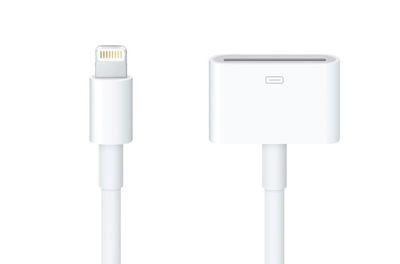
Your iPhone includes a Lightning to 30-pin Adapter for connecting 30-pin accessories to devices featuring the Lightning connector. Purchase this additional adapter to have a second adapter for your home or office.
Customers were only presented with the option to add the cable-equipped adapter and not the direct-plug adapter, and Apple's "What's in the box" documentation did not list the adapter as included, leading to considerable customer confusion.
After initially reporting on the inclusion of the free adapter, The Next Web followed up by asking Apple's online sales representatives about the issue. According to sales staff, the listing was an error in the Apple online store, and the adapter is not being included standard with iPhone orders. Apple has also removed listing from its store pages and no longer mentions the adapter's inclusion.
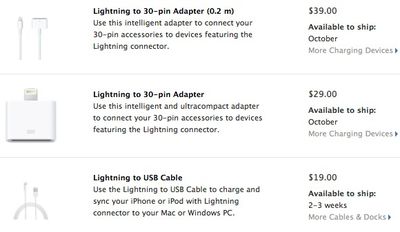
Apple's adapters are available for standalone purchase at $29 for the direct-plug version and $39 for the cable version, but they will not ship until next month.
Update 12:26 PM: Apple has issued a statement to The Loop confirming that the adapter is not included with the iPhone 5.
“The Lightning to 30-pin adapter does not come in the box with iPhone 5. It is sold separately,” Apple spokesperson, Natalie Harrison, told The Loop. “However, the Lightning to USB cable does come with iPhone 5 for connection to AC chargers and other devices.”
While Apple's shipping estimates on iPhone 5 pre-orders quickly slipped to two weeks just an hour after the online store reopened earlier, the company's U.S. carrier partners have seen their supplies holding up a bit better with continued estimates of delivery on launch day on September 21.
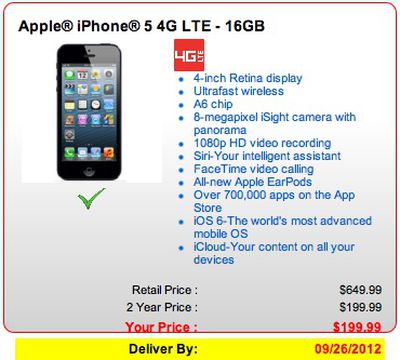
That appears to be changing now, as Verizon is the first of the three major U.S. carriers to see its shipping estimates slip with new pre-orders now estimated to arrive on September 26.
AT&T and Sprint are still citing September 21 availability, but it appears that customers may want to move quickly if they wish to obtain the iPhone 5 on launch day without waiting in line at retail stores.
Update 9:15 AM: While AT&T's site continues to cite delivery on September 21 for new pre-orders, a number of customers are reporting that their confirmation emails are quoting shipment in 14-21 business days.
Update 9:55 AM: AT&T's site is now quoting the 14-21 business day shipping estimate previously reported by some customers.
With shipping estimates for new pre-orders of the iPhone 5 through Apple's online store slipping to two weeks just an hour after pre-orders began earlier today, customers are also snapping up Apple's supplies of Lightning adapters and cables.
Alongside the iPhone 5 announcement on Wednesday, Apple introduced a pair of adapters to allow users to continue using older cables and accessories based on the long-standing 30-pin dock standard: a $29 direct plug adapter and a $39 short-cable adapter.
Availability of the new adapters has already begun to slip significantly, with Apple now quoting shipping estimates of "October" for new orders through its online store. The company's $19 Lightning to USB cable, which comes standard with Apple's latest devices but which should be popular as a standalone purchase with customers wanting to set up multiple charging locations, has also slipped from 1-3 business days to 2-3 weeks.
Apple has also acknowledged that it will be launching HDMI and VGA cables for Lightning-equipped devices, but the company has not yet made them available for order.
Update: A number of readers have noted that the adapters have been listed as shipping in October since they first showed up in Apple's online store on Wednesday. Shipping estimates on the USB cable have, however, indeed slipped.
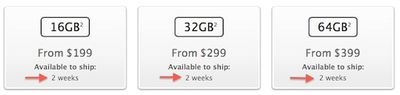
Just an hour after pre-orders for the iPhone 5 went live, Apple Store shipping estimates for new pre-orders have already slipped to two weeks in the U.S., U.K., Canada, Germany, and Australia. Once transit times are accounted for, users pre-ordering now may not receive their iPhones until nearly two weeks after the official launch date of September 21.
Customers may still be able to receive launch-day delivery by ordering through their carriers. AT&T, Verizon, and Sprint are listing 9/21 delivery dates at the time of this posting -- but those dates may not immediately reflect available stock.
Customers may also still purchase the iPhone 5 on September 21st by going to a retail location. Apple is opening retail stores at 8 a.m. that day for the launch. Verizon, AT&T and Sprint stores are likely to have availability of the iPhone 5 as well on that day.
Last year, it took about 22 hours to sell out of the pre-order launch day stock for the iPhone 4S.
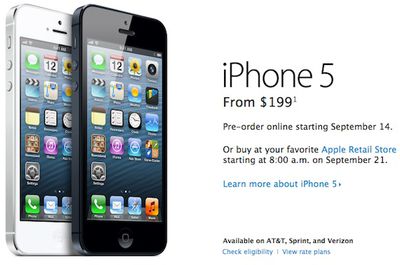
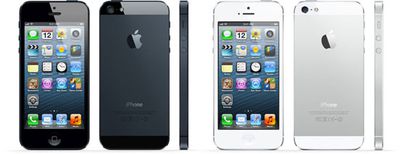
Verizon, AT&T, and Sprint and Apple are now accepting pre-orders for the iPhone 5. U.S. customers can order on Verizon, AT&T or Sprint. Pricing may vary with your upgrade eligibility. Standard prices with 2 years contract are $199 (16GB), $299 (32GB), and $399 (64GB). The iPhone 5 comes in white or black.
Delivery for pre-orders is expected on September 21st. Alternatively, customers will be able to purchase at retail locations on that same date.
Update 12:26 AM: Users are reporting that Apple's site is extremely slow, and even still down for many users. Customers seem to be having more success using the Apple Store app for iOS, although users needing to change carriers can not take advantage of the app. Orders through carrier websites also seem to be moving fairly smoothly in the United States.
Update 12:32 AM: Apple appears to be having difficulties connecting to carrier servers to verify customer information, and is in some cases issuing reservation confirmations. Users with reservations will receive emails once connections to carrier systems have been reestablished, and they will have 24 hours from that point to return to Apple.com and complete their orders.
Both Apple's Online Store and AT&T's website have gone offline in preparation for the iPhone 5 preorders in the next few hours. AT&T has posted a countdown to their site. MacRumors also has a countdown at the top of our front page.
iPhone 5 pre-orders begin at 12:01am Pacific and 3:01am Eastern on September 14th. In the U.S., the iPhone 5 will be available on AT&T, Sprint and Verizon.
TechCrunch reported that unlocked pricing for the iPhone 5 was going to be $649 (16GB), $749 (32GB), and $849 (64GB) but that the unlocked phones would not be available until several weeks after the launch.
Customers can also buy directly from retail stores starting on September 21st. Pre-order customers will get delivery of their iPhones on September 21st.
One MacRumors reader expressed particular concern over the lack of video support, noting that many in-car aftermarket entertainment systems use the video out function of the 30-pin connector to display and control apps from head units. It seems, however, that Apple does have at least a partial solution.
As The Verge reports, Apple is building Lightning to HDMI and Lightning to VGA adapters and quotes an Apple spokesperson as saying they "will be available in the coming months." Without these adapters, iPhone 5 owners' only option to output video from the device would be AirPlay.
The Verge doesn't reveal pricing, but the Apple Digital AV Adapter -- the 30-pin to HDMI adapter for the iPad and iPhone 4S -- is $39 direct from Apple.
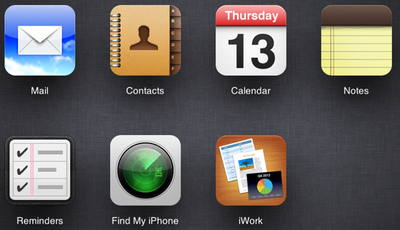
Apple has added the web versions of Reminders and Notes to the public iCloud.com website for access from desktop Macs and PCs. These web apps have been live for developers in beta for several months.
Notes is a fairly faithful reproduction of the skeuomorphic notepad on the iPhone. Users can create, edit, and delete notes, with updates reflecting on iOS devices in near-real time. Reminders works the same way.
The iCloud website has been updated in time for the iPhone preorder launch tomorrow, as well as the release of iOS 6 for all iOS users next Wednesday.
The Verge has confirmed that the Verizon version of the iPhone 5 will not support simultaneous voice and data.
The AT&T iPhone has supported simultaneous talk and data since the iPhone 3G was released because of the GSM network it uses.
Verizon gave this statement to MacRumors:
iPhone 5 was designed to allow simultaneous voice calling on the Verizon Wireless network while browsing the Internet over WiFi. This is no different from the current iPhone 4S.
Sprint has not yet confirmed whether its iPhone 5 will support simultaneous voice and data, but it uses the same physical hardware as the Verizon iPhone. The Vergeassumes that it will be behave the same way.
Update: According to The New York Times, it was Apple's choice to prevent Sprint and Verizon phones from using both LTE data and voice on simultaneously. Because the LTE network only supports data and not voice, Apple would have to add a third antenna to the iPhone 5 to allow both LTE data and CDMA voice together.
An Apple spokeswoman told The Times, "It is not yet possible to do simultaneous voice and data on networks that use CDMA for voice and LTE for data in a single radio design."
So why does Verizon’s Samsung Galaxy S III, a 4G LTE phone, juggle calls and data? Samsung added an extra antenna so that it pulls data from the 4G LTE network at the same time that it’s using another antenna to do voice, said Anand Shimpi, editor in chief of AnandTech.
Then why didn’t Apple add another antenna? It actually already has two antennas in an effort to improve reception, and it would have had to add a third antenna just for Verizon and Sprint phones to give them simultaneous data and calls, Mr. Shimpi explained. Leaving that third antenna out allows Apple to simplify its manufacturing process of the iPhone for multiple carriers. Plus, in the next two years the 4G LTE network is supposed to evolve to support voice calls, which would render another antenna unnecessary later.
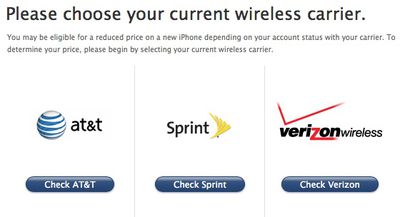
For those customers looking to confirm whether they are eligible for fully-subsidized or early upgrade pricing for the iPhone 5 or interested in comparing service plans across carriers, Apple is offering a pair of tools through its online store to assist with finding such information.
Featured on the iPhone 5 store page, the eligibility tool allows current iPhone owners to select their current carrier from among AT&T, Sprint, and Verizon, and enter some information to retrieve personalized information on pricing for the iPhone 5. Given that the iPhone 4S debuted just eleven months ago, many iPhone 4S customers are not yet eligible for full or even partial subsidy on the iPhone 5, so they may want to confirm launch day pricing on their accounts and see the dates when they will qualify for improved pricing.
A second tool available through the iPhone 5 store page allows users to quickly and easily view service plans from among the three major U.S. carriers in order to help customers decide which carrier and plan will best meet their needs.
AT&T offers the greatest number of basic options, with customers able to choose from individual and family plans, as well as the carrier's new Mobile Share plans. Sprint provides several options for both individual and family plans, while Verizon is now offering only Share Everything plans with unlimited voice and text.
Customers can select one option from each of the three carriers and then view their details side-by-side to help compare each company's offerings.
Verizon, Sprint and AT&T have all confirmed that FaceTime over Cellular will be supported by their networks on all devices that are capable of the feature. This contradicts other reporting which suggested that FaceTime over Cellular would only be available on the iPhone 5.
Verizon told MacRumors today that "if FaceTime works via cellular on any Apple device, it will work on any Verizon Wireless data plan with no special arrangements."
AT&T said something similar, confirming today that FaceTime over Cellular would work on all supported devices, so long as the customer has a new Mobile Share data plan. Sprint has said in the past that it is committed to unlimited data and does not discriminate based on the application used.
Apple's iOS 6 footnotes say that the only supported devices for FaceTime over Cellular are the iPhone 4S, iPhone 5, or iPad (3rd generation) with cellular data capability.
Late night television has poked fun at the gadget wars before, but the frenzy of the iPhone 5 launch has opened up a number of new comedic opportunities.
- The new iPhone is 18% thinner and 20% lighter than the 4S, making it the first smartphone with specs one can measure in Triscuits.
- Apes that touch the glowing new mini-monolith are suddenly able to turn basic tools into weapons.
- Siri has been upgraded; the "intelligent personal assistant" will tell you sports scores, and automatically place bets with your bookie.
- Price: $199 for 16GB, $299 for 32GB, $399 for 64GB with two year contract signed in bone marrow.
In addition to Conan's post, Jimmy Kimmel's team took the 'iPhone 5' out on the street yesterday to get first impressions from the general public -- the obvious problem, however, is that the iPhone 5 isn't actually out yet. Instead, they took the iPhone 4S and told folks it was the new 5:
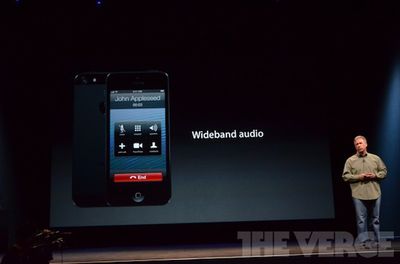
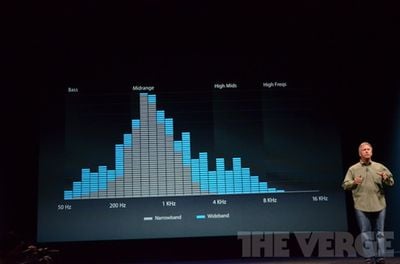
One of the iPhone 5 features highlighted by Phil Schiller during yesterday's introduction was wideband audio, which offers "crisper word clarity and more natural sounding speech" according to Apple's press release. Schiller noted that the feature requires carrier support and that it would be supported by over 20 carriers on the iPhone 5 at launch, but did not specify which carriers those would be.
Phone Scoop reported late yesterday that Sprint has confirmed it will not support wideband audio (frequently marketed as "HD Voice") on the iPhone 5, and PCMag.com has a good overview of why none of the three major U.S. carriers are likely to support it.
There are three ways to do high-quality, or "wideband" voice calls.
One is to use a new codec, called AMR-WB, over a "3G GSM" (UMTS) network. That's what some European carriers are doing and what's in the iPhone. This is relatively easy to implement on the phone side, provided that the network supports it. In the U.S., only AT&T and T-Mobile would be eligible to do this, and they won't because they're focused on 4G (see below.)
The report goes on to discuss the other two mechanisms for providing HD Voice support, which include a CDMA-related codec being used by Sprint and voice-over-LTE technology being pursued by both AT&T and Verizon, but the iPhone 5 does not support either of those mechanisms.
The result is going to be extremely limited HD Voice experiences in the U.S. for at least a few years. It'll be restricted to calls between limited sets of phones, probably on the same carrier, and it won't be on the iPhone 5.
Beyond wideband audio, Schiller touted several other audio enhancements on the iPhone 5, including a total of three microphones for noise cancelation and accurate voice transcription, a smaller and improved speaker, and a noise-canceling earpiece.
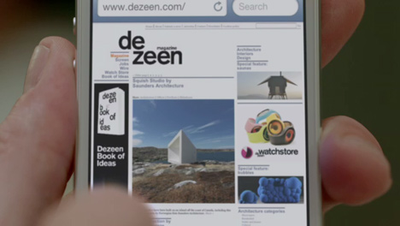
Architecture website Dezeen was prominently featured in the iPhone 5 promotional video revealed yesterday, and today the site has posted a brief behind-the-scenes look at how the collaboration came to fruition.
The site is featured in the video starting around the 1:16 mark, with the iPhone 5 user opening an email with a link to the website. He clicks the link, views the site, navigates to Safari's bookmarks list and then opens another page. The page is viewed during a section of the video discussing how LTE technology provides for "really fast downloads over your cellular network."
Apple contacted Dezeen earlier this year asking us to create a bespoke version of our home page and an editorial page for a possible future marketing campaign. Apple specified that both had to be free of external advertisements and social media buttons, but they did not give any details of how the pages might be used.
The pages [were] created for us by our long-term collaborators Zerofee. Besides the iPhone versions of Dezeen, we also created billboard-sized pages that may, or may not, appear in Apple Stores and outdoor advertising hoardings as part of the marketing push for the iPhone 5.
Given how secretive Apple tends to be with its marketing materials, it remains to be seen if this disclosure by Dezeen will impact Apple's marketing strategy going forward.
While Apple has yet to officially announce tomorrow's starting time for iPhone 5 pre-orders, it is beginning to look like the launch will follow the same pattern as last year with pre-orders starting at 12:01 AM Pacific Time / 3:01 AM Eastern Time.
Apple sales representatives have been telling customers asking about availability that pre-orders will begin at that time, and both Verizon and Sprint have announced 12:01 AM Pacific launches for their own pre-orders. AT&T has not yet officially released a pre-order starting time.
Last year, Apple was nearly 45 minutes late in starting pre-orders and experienced significant issues with online processing for quite some time after they did launch, and many users had better luck pre-ordering through their carriers.
Update 10:24 AM: Apple has confirmed to Wired that it will begin taking iPhone 5 pre-orders at 12:01 AM Pacific Time tomorrow.





 The Verge has