Amazon and Microsoft today jointlyannounced that Alexa and Cortana will soon be able to communicate with each other.
Microsoft said the collaboration will allow access to Alexa via Cortana on Windows 10 PCs later this year, and via the Cortana app for iOS and Android at an unspecified point in the future. Similarly, users will be able to access Cortana on Alexa-enabled devices like the Amazon Echo, Echo Dot, and Echo Show.
iPhone users should eventually be able to open the Cortana app and say "hey Cortana, open Alexa," to access Amazon's virtual assistant. Alexa can be used to shop and manage orders on Amazon, ask a variety of questions, stream music and audiobooks, check the news and weather, and many other tasks.
However, iPhone users won't be able to say "hey Cortana, open Alexa" from the Home screen, or when the device is locked. Apple only allows third-party virtual assistants to function within their apps, so accessing Alexa via Cortana will be a lot more cumbersome than simply using Siri.
For a complete virtual assistant experience, iPhone users could also say "hey Siri, open the Cortana app" and then say "hey Cortana, open Alexa."
Alexa can already be used in the Amazon app on iOS [Direct Link], while Cortana has been available on the App Store [Direct Link] since December 2015.
In early 2016, AT&T began its first test of a fixed wireless 5G cellular network within Austin, Texas and expanded that test to new local businesses this past June, including a car wash, an apartment unit, and a church. Today, the carrier announced that its test of next-generation 5G cellular connectivity will be expanding to new businesses and residential customers in three new U.S. cities by the end of 2017: Waco, Texas; Kalamazoo, Michigan; and South Bend, Indiana.
AT&T noted back in 2016 that the 5G trials introduced download speeds in gigabits per second, improving upon the normal megabits per second that customers on current wireless networks see, allowing 5G customers to "download a TV show in less than 3 seconds." In today's press release, AT&T said that it has seen speeds up to 1 gigabit per second in Austin, and latency rates "well under 10 milliseconds." In 2016, the carrier predicted 5G latency at somewhere between 1 to 5 milliseconds. In the Austin apartment unit, AT&T set up a fixed wireless 5G home with various apps running simultaneously on the same connection, with usage centering on streaming DIRECTV NOW, 360-degree video, and international video calls without lag. While the test remained at fixed locations in Austin for over a year, AT&T said that its findings demonstrated "how people can live, work, and play in a connected home of the future."
AT&T said that its findings in Austin will help during the expansion to the three new cities, with new insights gained into millimeter wave performance and propagation, and how obstructive objects (foliage, buildings, etc), the weather, and device placement can impact the 5G signal in the real world. As with other carriers, AT&T's 5G test data is being contributed to the 3rd Generation Partnership Project (3GPP), a group of telecommunications organizations that oversee the development and maintenance of major communication networks.
“In Austin, we see all types of weather and substantial foliage,” said Marachel Knight, senior vice president, Wireless Network Architecture and Design, AT&T. “Taking our fixed wireless 5G trials out of the lab and into the real world helps us learn important factors about mmWave and 5G. And in doing so, we’re learning how to better design our network for the future.”
As it expands, the carrier said it will apply the knowledge it gained from the Austin tests, while also increasing the number of participants and expanding the physical footprint of the 5G network trials in each new city, hinting at much larger tests coming to Waco, Kalamazoo, and South Bend. In these three cities, trial participants are said to potentially include universities, hospitals, churches, restaurants, and other small businesses, bringing the ability to stream live TV and experience faster broadband services over the 5G connection.
AT&T will continue to test both fixed and mobile wireless solutions based in the millimeter wave spectrum in these field trials, and in closed "testbed" settings. The goal for the new expansion is to "help speed up" the deployment of new 5G network standards, with AT&T hoping that this deployment will happen as soon as late 2018. AT&T is working with Ericsson, Samsung, Nokia, and Intel during these trials, which also includes a test location in Indianapolis as of July, 2017.
Sprint, T-Mobile, and Verizon have also announced interest in 5G networks, with Sprint saying its own wide-scale 5G network will launch by 2019, and T-Mobile aiming for nationwide 5G coverage by 2020. Of course, all of this progress hinges on the 3GPP first completing the 5G Release 15 standard. According to AT&T, once Release 15 is out then 5G-supported "commercial equipment" will be available within six months.
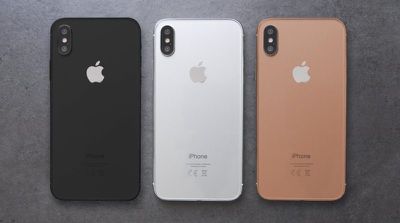
Apple's upcoming "iPhone 8" could rely entirely on gesture controls for carrying out tasks like navigating to the home screen and opening the new multitasking App Switcher in iOS 11, a new report on Wednesday claimed.
Apple has tested the complete removal of the home button – including even a virtual one – in favor of touch-based gestures, according to images of the new OLED iPhone viewed by Bloomberg and seen by people familiar with the company's plans. Those gestures are said to begin by dragging up a "thin bar" from the bottom of the screen to open the device to the home screen, where an app dock resides.
Across the bottom of the screen there's a thin, software bar in lieu of the home button. A user can drag it up to the middle of the screen to open the phone. When inside an app, a similar gesture starts multitasking. From here, users can continue to flick upwards to close the app and go back to the home screen. An animation in testing sucks the app back into its icon. The multitasking interface has been redesigned to appear like a series of standalone cards that can be swiped through, versus the stack of cards on current iPhones, the images show.
The iPhone dock will appear on the home screen in a similar way to the iPad dock as seen in the iOS 11 beta, but with six rows of up to 24 icons per screen, according to the report.
In addition to the software-based changes, Bloomberg said that the new OLED screen on Apple's "premium" handset is rounded on the corners, whereas current iPhone screens have square corners. The power button on the right side of the phone is also reportedly longer so that it's easier to press while holding the device in one hand, according to images.
Elsewhere, in perhaps a more contentious move, Apple has apparently opted not to hide the notch area at the top of the OLED screen, so a definite cutout area will be visible when using apps with non-black backgrounds.
The cutout is noticeable during app usage in the middle of the very top of the screen, where the status bar (the area that shows cellular reception, the time, and battery life) would normally be placed, according to the images. Instead, the status bar will be split into left and right sides, which some Apple employees call "ears" internally. In images of recent test devices, the left side shows the time while the area on the right side of the notch displays cellular and Wi-Fi connectivity and remaining battery life. Because of limited space, the status bar could change based on the task at hand, according to a person familiar with the testing.
Bloomberg also claims that when the display shows black, the superior color reproduction of the OLED screen ensures that it "blends in perfectly" with the notch and thin edges on the front. The screen is also reportedly flat like previous iPhones, in contrast to the fully curved displays found on Samsung's latest smartphones.
Lastly, the report adds that Apple plans to include a stainless steel band around the phone which the glass curves into. According to images seen by Bloomberg, the steel band "has small antenna cuts on the corners like past iPhones to improve reception".
While Apple often tests different designs of its products, the hardware details covered here will have been finalized long ago, although the software interface could still change before iOS 11 gets its official public release. Apple is expected to debut the redesigned OLED iPhone at a September 12 launch event alongside iterative updates to its current smartphone line-up, as well as a new upgraded Apple TV with 4K support and Apple Watch Series 3 with LTE capability.
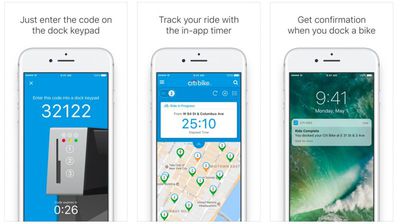
Bicycle sharing service Citi Bike released version 6 of its iOS app on Tuesday to bring Apple Pay support to customers in New York City and New Jersey.
Now that Apple's mobile payment system is supported by the service, riders using the app are able to purchase a single pass or Citi Bike membership using their digital wallet instead of plastic.
The app includes a color-coded map of New York City and New Jersey which help users discover nearby bicycle stations including live information on bike and dock availability, with the option to reserve a bike supported in selected locations.
In addition to Citi Bike's core service features, the app also includes recent ride stats such as start and stop location, ride time, distance, and calories burned, while push notifications alert customers to their ride time and when they have securely docked their bike.
Citi Bikes are available 24 hours a day, seven days a week, across Manhattan, Brooklyn, Queens, and Jersey City. The Citi Bike app is a free download for iOS from the App Store. [Direct Link]
Xiaomi has announced that it will unveil the second-generation version of its nearly bezel-free Mi MIX smartphone on September 11, just one day ahead of Apple's expected "iPhone 8" launch event in California.
The Chinese mobile maker confirmed rumors of its event in Beijing next month by sharing a launch poster over microblogging site Weibo featuring a profile of the "full screen" Mi MIX 2 and the accompanying phrase "Evolution, approach to final perfection".
Xiaomi turned heads in October of last year when it unexpectedly announced the 6.4-inch Mi MIX, which it called "the world's first edgeless display" smartphone, just as iPhone 8 rumors were beginning to gain steam. The device was pooh-poohed by some as "vaporware" when Xiaomi described it as a "concept phone", but the company began shipping the Mi MIX in December in limited quantities and received some respectable reviews.
Once again, French designer Philippe Starck is said to have worked with Xiaomi on the Mi MIX 2, which is expected to feature an even higher screen-to-body ratio than its predecessor, but will adopt a slightly smaller 6-inch display with an 18:9 (2:1) aspect ratio.
Speculation suggests Xiaomi may choose a metal rather than ceramic chassis to make the handset easier to mass produce this time. Internally, the Mi MIX 2 is thought to include a Snapdragon 835 chipset, 6GB of RAM, 128GB of storage, and a 3,400mAh battery. Prices are expected to start at around $600, with a higher tier model featuring 8GB of RAM and 256GB of storage for around $750.
Other China-based smartphone vendors rumored to be launching all-screen handsets to rival Apple's so-called "iPhone 8" include Huawei and Gionee, with others expected to follow suit. Apple will reveal its first iPhone with edge-to-edge OLED display alongside upgraded versions of its iPhone 7 and 7 Plus next month.
Western Digital today announced the launch of its latest personal cloud storage solution, the My Cloud Home. My Cloud Home is designed to make it easy for customers to set up and use a personal cloud storage solution to meet all of their storage needs.
The company is aiming to make My Cloud Home the one stop storage destination for all of a person's devices, aggregating photos, videos, and files from smartphones, computers, USB devices, social media accounts, and more.
As a connected cloud solution, the My Cloud Home is available on any tablet, smartphone, or computer with an Internet connection using the My Cloud Home mobile app, and because it's a local storage product, there is no subscription fee.
Consumers seek a way to effortlessly consolidate their growing mounds of photos, videos and other files with a solution flexible enough to accommodate content from all of today's devices - from smart phones to computers and from drones to social sites," said Jim Welsh, senior vice president, Client Solutions, Western Digital. "Enabling consumers and professionals to master their digital lives from anywhere in the world is a priority for Western Digital."
My Cloud Home can be set up to automatically copy content from smartphones and computers to provide a hassle-free backup solution, and it connects to social networks and other cloud services like Dropbox. TV Shows, movies, and other content stored in My Cloud Home can be played in Plex through an integration with the Plex app.
Western Digital is offering the My Cloud Home in 2, 3, 4, 6, and 8TB configurations. There's also a My Cloud Home Duo with 4, 12, and 16TB of storage space, designed with RAID 1 functionality to duplicate content onto a second drive for extra security should one drive fail.
The My Cloud Home next to the My Cloud Home Duo
The My Cloud Home and My Cloud Home Duo are available today from Best Buy and other major retailers. Pricing starts at $159.99 for the 2TB solution. 3TB is available for $179.99, 4TB for $199.99, 6TB for $259.99, and 8TB for $319.99.
The My Cloud Home Duo is priced at $309.99 for 4TB, $399.99 for 8TB, $549.99 for 12TB, and $699.99 for 16TB.
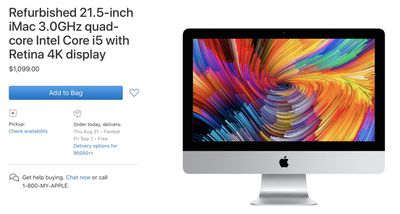
Apple today updated its online store for refurbished products to add the new 21.5-inch iMac models that were initially released in June of 2017.
Today marks the first time the new 2017 iMacs in the 21.5-inch configuration have been available through the refurbished store since their launch at the Worldwide Developers Conference. The new iMacs feature Kaby Lake processors, upgraded displays, faster solid state storage, and discrete graphics.
Apple's refurbished store features only 4K models with Retina display at this time and does not have any refurbished non-Retina 21.5-inch iMac models available for purchase.
At the time of this post, there were eight different refurbished 4K 21.5-inch iMacs available in various configurations, with prices discounted by approximately 15 percent. An entry-level 4K model with 8GB RAM, a 1TB hard drive, and a Radeon Pro 555 is available for $1,099, for example, a $200 discount off of the regular $1,299 starting price.
Apple has a several different configurations available, from low-end to top-of-the-line. As with all refurbished products, stock will fluctuate regularly based on the machines Apple is getting in for repair. The addition of the new 2017 21.5-inch models follows the introduction of refurbished 2017 27-inch iMacs earlier this month.
All of Apple's refurbished products go through a rigorous refurbishment process before being offered for sale, which includes inspection, repairs, cleaning, and repackaging. Refurbished Macs come with a one-year warranty that can be extended with an AppleCare+ purchase. For more info on purchasing a refurbished product from Apple, make sure to check out our guide.
As two new episodes of "Carpool Karaoke: The Series" air tonight, Apple has shared trailers for next week's episodes, which will pair Michael Strahan with Jeff Gordon and Shaquille O'Neal with John Cena.
The first trailer features media personality and former football player Michael Strahan and Fox NASCAR announcer and former professional race car driver Jeff Gordon. The two dress up with props, race on bicycle rickshaws, and sing along to songs like Olivia Newton-John's "Physical."
The second trailer pairs former basketball player Shaquille O'Neal with wrestler John Cena. The two athletes sing songs like "Maneater" by Hall & Oates and "Mama Said Knock You Out" by LL Cool J.
The episodes shown off in the trailer featuring the two athlete mashups will air on Tuesday, September 5.
Tonight's Tonight's "Carpool Karaoke: The Series" episodes are now available to watch. The first episode stars Miley Cyrus, her dad Billy Ray, her sister Noah, her mom Tish, her brother Braison, her sister Brandy, and her brother Trace. The second episode Queen stars Latifah and Jada Pinkett Smith with appearances by Regina Hall and Tiffany Haddish.
"Carpool Karaoke: The Series" debuted on August 8. Since then, Apple has been uploading two episodes per week. Carpool Karaoke is available solely to Apple Music subscribers.
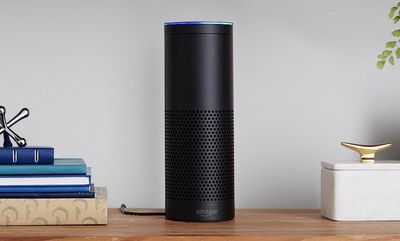
Amazon today added a new Alexa feature that allows several Amazon Echo devices to be synchronized and controlled across multiple rooms in a home. Echo owners can now target music to a specific Echo device or play the same music on more than one Echo.
The feature works with a variety of music services, including Amazon Music, TuneIn, iHeartRatio, and Pandora, with support for Spotify and SiriusXM coming soon. To use multi-room support, users will need to use the Alexa app to create groups with two or more Echo devices, giving the group a name like "downstairs." Once the group is enabled, commands like "Alexa, play John Mayer downstairs" will work.
"In just the last few months, we've added dozens of new features to Alexa that enhance your entertainment experience--control of Amazon Fire TV and your home entertainment systems via Echo; music lyrics, Amazon Video, and movie trailers on Echo Show; and activity-based music searches--and we're just getting started," said Toni Reid, Vice President, Amazon Alexa. "Today, we're making Alexa even smarter with an all-new feature that lets you play music synchronized on multiple Echo devices to provide room-filling music throughout your home."
Amazon's move to add support for multiple Echo devices comes as Apple prepares to launch both the HomePod and an AirPlay 2 protocol. Multiple HomePod devices can be used simultaneously, and with AirPlay 2, speakers that support the feature can be paired together for a whole-home music experience.
Multi-room music support is available for the Echo, Echo Dot, and Echo Show in the United States, UK, and Germany starting today. Amazon says it plans to extend the ability allow users to control multi-room music on other connected speakers with just a voice command through a new Multi-Room Music SDK that device makers can build into their speakers. Amazon plans to work with brands like Sonos, Bose, Sound United, and Samsung, and some of these manufacturers are also working to support AirPlay 2 in future devices.
In other Echo-related news, the original Amazon Echo is out of stock on Amazon.com, fueling speculation that a new device launch is imminent. Rumors have suggested Amazon is working on a new version of the Echo that's designed to better compete with Apple's upcoming HomePod. The new Echo device is said to feature improved sound quality, better microphone technology, and a new design.
Instagram has allowed users to share multiple photos in a single post since February, but those photos have been limited to the traditional square aspect ratio, preventing users from sharing landscape or portrait mode images in a multi-photo post.
Starting today, that limitation is changing. Instagram is now allowing users to share multi-photo posts in any aspect ratio, including taller portrait mode photos and wider landscape mode photos.
After we first rolled out in February, these posts could only be made up of squares. Now, when uploading your photos and videos, you'll have more creative flexibility with the ability to share in landscape and portrait formats. To keep the experience smooth and consistent, however, all photos and videos in your post must be shared in the same format.
While there will no longer be a need to crop portrait and landscape photos when sharing them in multiple photo posts, all images in the post need to share the same aspect ratio, so there's no mixing portrait and landscape photos in one post.
Instagram says the new photo uploading capabilities are available starting today, but it appears the feature may still be rolling out to some users as it is not yet available to everyone.
The National Academy of Television Arts and Sciences today announced the recipients of the 69th annual Technology & Engineering Emmy Awards, with Apple winning an award in the "Contextual Voice Navigation for Discovering and Interacting with TV Content" category.
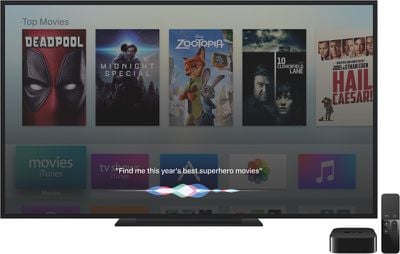
Apple received the award for the Siri voice integration built into the fourth-generation Apple TV, which allows users to search for content using voice-based commands. Other winners in the same category include Comcast, Universal Electronics (UEI), and Nuance Dragon TV.
Siri has been available on Apple TV since 2015, which is when the fourth-generation set-top box with tvOS became available for purchase. Siri has a range of functions on the device, ranging from TV show/movie/actor/topic search capabilities to features like a vocal rewind option that allows users to do things like ask "What did she say?" to jump back 15 seconds and temporarily turn on subtitles.
Siri can open apps and games, respond to typical commands for information about sports scores, movie times, weather, and more, and Siri can answer questions about movies and TV shows. "Who directed this movie?" and "Who stars in this movie?" are just a couple of examples of the kinds of queries Siri can respond to. Siri can even answer complex topic-based requests, like "Find comedies from the 80s starring Chevy Chase" or "Find movies for kids from the 90s."
Award recipients will be honored at the Technology & Engineering Emmy Awards at the National Association of Broadcasters on Sunday, April 8, 2018 in Las Vegas, Nevada.
Apple plans to introduce a new fifth-generation Apple TV at its September iPhone-centric event, believed to be taking place on the 12th of the month. The fifth-generation Apple TV will continue featuring Siri support, and could even introduce new Siri-related features.
According to Apple, the new code is available alongside new ARKit "best practices" published in the Human Interface Guidelines. Apple also asks developers working on an "amazing" ARKit experience to share it with the company.
Design intuitive augmented reality experiences for iOS using the best practices now available in the Human Interface Guidelines, and explore new sample code for ARKit. We can't wait for your apps to be available to hundreds of millions of people with the launch of iOS 11 this fall. If you're working on creating an amazing experience with ARKit and would like to share it with us, let us know.
The new demos cover interactive content in ARKit and audio in ARKit, while the Human Interface Guidelines cover ideal app design like using the entire display, creating convincing illusions, being mindful of user safety, interacting with virtual objects, positioning virtual objects, and more.
Along with new ARKit info, Apple today also informed developers that starting in the fall, apps will need to support App Store transactions of promoted in-app purchases for in-app purchases to be properly displayed on the App Store.
iOS 11 includes new functionality that will let users browse in-app purchases from the App Store app and purchase them before downloading an app, and developers will need to implement support when the GM version of the Xcode 9 is released.
With iOS 11, users can browse in-app purchases directly on the App Store and start a purchase even before downloading your app. During the iOS 11 beta period, promoted in-app purchases are displayed on the App Store without the ability to buy. Starting this fall, your app must handle App Store transactions of promoted in-app purchases in order for your in-app purchases to be displayed on the App Store. Once the GM version of Xcode 9 is released, simply implement the new delegate method within SKPaymentTransactionObserver, rebuild your app, and submit for review. You can also customize which promoted in-app purchases a user sees on a specific device with the SKProductStorePromotionController API.
Apple is expected to release iOS 11 in September alongside new iPhones, and that's when the first ARKit apps will become available for download.
Apple this week invited several media sites to its Cupertino campus to show off some upcoming ARKit apps being developed by major companies like The Food Network, Ikea, Giphy, and AMC, according to CNBC, The Verge, and TechCrunch.
Ikea demonstrated its previously announced "Ikea Place" app, designed to allow users to preview what Ikea furniture will look like in their homes ahead of a purchase. The Verge says it's highly customizable, letting users see the size, materials, and texture of furniture.
The Food Network is developing an app that will let users create custom digital desserts that can then be reproduced in real life through a custom recipe, while AMC and Next Games have teamed up for an augmented reality zombie game called "The Walking Dead: Our World."
Image from CNBC
GIF app Giphy plans to introduce tools that will let GIFs be added to the real world, and Climax Studios CEO and developer Simon Gardner showed off an upcoming AR game called Arise, which is an augmented reality puzzle game solved by tilting the iPhone to steer a character through the level.
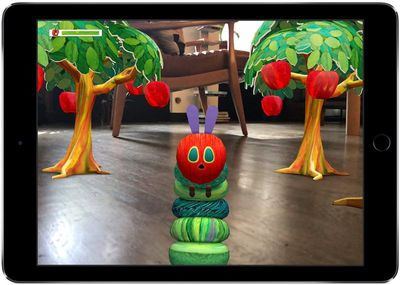
The Very Hungry Caterpillar, a popular children's story turned into an app, will take advantage of ARKit to offer kids a chance to raise a virtual caterpillar, feeding it until it turns into a butterfly.
Image from Apple, via The Verge
All of the developers present had the same general opinion about ARKit according to The Verge -- it "could be the real game changer in AR." Many of the developers said it was simple to create an ARKit app, sometimes taking just 7 to 10 weeks to develop. For more on these ARKit apps, make sure to check out the full reports from CNBC, TechCrunch, and The Verge.
Along with these official looks at ARKit, we've also seen several developer concepts surfacing in the months since ARKit was announced. Check out our previous coverage for details on what will be possible with the new feature:
The first ARKit apps will launch in September following the public debut of iOS 11. When iOS 11 and ARKit become available, Apple's iPhones and iPads will instantly become the largest augmented reality platform in the world. ARKit will be available on all Apple devices with iOS 11 and an A9 processor or better (iPad Pro and iPhone 6s/6s Plus and later).
Thunderbolt 3 docks continue to flood the market, and today I'm taking a look at IOGEAR's Thunderbolt 3 Quantum Docking Station. IOGEAR's dock offers many of the same features typically seen on other Thunderbolt 3 docks, including multiple USB ports, a Gigabit Ethernet port, headphone and microphone jacks, a DisplayPort port, and a pair of Thunderbolt 3 ports to allow for daisy chaining, all in a familiar horizontal design used by many other docks.
Most notably, the IOGEAR Thunderbolt 3 Quantum Docking Station looks identical to CalDigit's TS3 Lite that I reviewed a few months ago, with the exception of color and finish. While CalDigit's dock has an enclosure of brushed aluminum and black matte plastic, IOGEAR's has more of a satin matte finish that's slightly lighter in color, paired with white matte plastic. In size, shape, and port layout, however, these two docks are identical.
Caldigit's TS3 Lite (left) vs. IOGEAR's Thunderbolt 3 Quantum Docking Station (right)
The IOGEAR dock looks decent, with its aluminum finish coming close to the silver color Apple uses on its notebooks. A fairly unobtrusive IOGEAR logo is printed on the top of the dock, and it comes with an external power brick and a 0.5-meter Thunderbolt 3 cable for connecting to a host computer at maximum speeds.
Meeting the standard for Thunderbolt 3 docks, IOGEAR's version supports up to a single 5K display over Thunderbolt 3 or dual 4K displays over a combination of Thunderbolt 3 and DisplayPort. I experienced no hiccups connecting an LG UltraFine 5K display at up to 60 Hz through one of the dock's Thunderbolt 3 ports.
In line with every other dock I've reviewed with the exception of OWC's Thunderbolt 3 Dock, IOGEAR's dock includes three USB ports, with IOGEAR opting to go with one Type-A on the rear and one each of Type-A and Type-C on the front for easy access.
All three ports run at 5 Gbps USB 3.1 Gen 1 speeds, and the inclusion of a Type-C port is a nice benefit as peripherals start to move in that direction. The USB ports operate at expected speeds once overhead is accounted for, with a CalDigit Tuff SSD running at 325 MB/s write and 350 MB/s read over both Type-A and Type-C, in line with other Thunderbolt 3 docks featuring 5 Gbps USB ports.
As with the TS3 Lite, one of the main limitations with IOGEAR's dock is that it only supports up to 15 watts of charging power over Thunderbolt 3/USB-C, meaning it won't be able to power your MacBook Pro over the same cable used for data and video and you'll need to hook up your computer's power brick.
Attempting to power my 2016 15-inch MacBook Pro solely through the dock merely slowed the rate of battery life decrease, even under light usage. Depending on your setup such as willingness to use your Mac's power brick or having another monitor with higher charging power already connected, this might not be a deal breaker, but with many other Thunderbolt 3 docks offering 60 or even 85 watts of charging power it's an unfortunate limitation.
The real deal breaker, however, is price, unless you're very careful in shopping around. IOGEAR's dock carries a list price of $299.95, in the same range as docks with better features such as higher charging power, and a full $100 more than the essentially identical TS3 Lite from CalDigit. You can certainly find cheaper prices on IOGEAR's dock such as current $225 pricing at Amazon, but even that is still higher than the TS3 Lite.
Authorized reseller Provantage currently has it for $178, but with shipping starting at $27, the deal isn't quite as good as it first appears. Even with those deals, it's disappointing how much hunting you need to do to try find a good price on this dock.
As a result, it's hard to recommend the Thunderbolt 3 Quantum Docking Station unless you can find it at a really great price. The TS3 Lite is generally cheaper for identical features, while other docks like OWC's Thunderbolt 3 Dock with more USB ports and an SD card slot or Elgato's dock or CalDigit's TS3 with more features at the same list price offer better values.
Note: IOGEAR provided the Thunderbolt 3 Quantum Docking Station to MacRumors free of charge for the purposes of this review. No other compensation was received. MacRumors is an affiliate partner with Amazon and may earn commissions on purchases made through links in this article.
Intel today introduced its new Xeon-W workstation-class processors at the IFA trade show in Berlin, and the new chips line up nicely with the processor capabilities we’re expecting to see in the iMac Pro.
The new chips, which use an LGA2066 socket and Skylake-SP architecture, come in 8, 10, and 18 core configurations with Turbo Boost up to 4.5GHz, 48 PCI Express 3.0 lanes, and support for up to 512GB of DDR4–2666 ECC memory.
Click to enlarge
Apple has said the iMac Pro will feature Intel’s Xeon processors, with 8, 10, and 18 core chips available as optional configurations with up to 42MB cache and maximum Turbo Boost up to 4.5GHz.
Specifically, Apple could be planning to use the 8-core 3.7GHz Xeon W–2145, the 10-core 3.3GHz Xeon W–2155, and the 18-core 2.3GHz Xeon W–2195. Pricing on the chips starts at $1,113, but a price is not yet listed for the high-end 18-core processors.
According to Intel, the Xeon-W chips offer a 1.87x boost in performance compared to a 4-year old workstation with an Intel Xeon E5–1680 v2 Romley processor, like the 2013 8-core Mac Pro, and up to 1.38x higher performance compared to previous-generation Xeon E5–1680 v4 chips.
Intel plans to release its high-end 18-core chips in the fourth quarter of 2017, which also lines up with the target release date of the iMac Pro. The other chips may see earlier release dates.
Though Xeon-W chips do appear to work for the iMac Pro, there is still some question as to whether they’re the chips Apple plans to use. A June report from Pike’s Universum suggested Apple would use Intel’s server-grade Purley processors with an LGA3647 socket rather than the desktop-class LGA2066 socket.
That information was based on firmware files found in the macOS High Sierra beta, but it’s possible it was inaccurate. Intel announced some Purley chips in July, but that announcement did not include chips that would be appropriate for the iMac Pro.
Along with Xeon processors, the iMac Pro will include Radeon Pro Vega graphics, up to 4TB of solid state storage space, four Thunderbolt 3 ports, up to 128GB of ECC RAM, and a redesigned thermal architecture to support those components.
Rumors based on firmware findings suggest the iMac Pro could also include a Secure Enclave with an ARM coprocessor like the MacBook Pro with Touch Bar, but it’s unclear at this time what that functionality will be used for as Apple has made no mention of Touch ID support.
The iMac Pro is positioned as a workstation class machine aimed at pro users with demanding workflows, and it’s priced accordingly. When it launches in December, pricing for the iMac Pro will start at $4,999.
At its Worldwide Developers Conference in June, Apple announced that an Amazon Prime Video app would be coming to the Apple TV later this year.
No release date was given, but Apple's September iPhone event seemed like an ideal time for the app to see an official release. Unfortunately, that may not happen. In a piece on Apple's troubles establishing TV-related deals, Recode says that according to its sources, the app may not be live in time for debut at the iPhone event.
An Amazon Prime Video app is something that Apple TV owners have desired for years, as it is one of the only major streaming video services absent from the set-top box.
With no targeted launch date on the horizon, it isn't clear when the app will see a launch, but we can expect it before the end of 2017 based on Apple's initial announcement.
While an Amazon Prime Video app may not launch at Apple's September event, Apple TV enthusiasts do have one product to look forward to -- a fifth-generation TV with support for 4K HDR. The new set-top box, with an upgraded processor and perhaps other upgraded features, is set to launch in September alongside new iPhones and an LTE Apple Watch.
Apple is aiming to hold its annual iPhone event on Tuesday, September 12, TechCrunch reported today, confirming information shared yesterday by The Wall Street Journal.
According to TechCrunch, the September 12 date is "nearly locked in," but may hinge on whether Apple is able to complete work on the Steve Jobs Theater at its new Apple Park campus in time. Construction on the theater is still underway, but Apple is said to want to inaugurate the theater with the launch of the iPhone 8, its most radically redesigned iPhone in years.
Because media invites often go out 7 to 10 days before a major event is held, Apple has very little time to make a decision on where the event will be hosted, if a decision has not been made already. With Labor Day coming up next Monday, Apple will need to send out invites by the end of this week or on Tuesday, September 5 at the latest if the event is to be held on September 12.
Should the 1,000 seat Steve Jobs Theater not be completed in time, Apple could elect to use the Bill Graham Civic Auditorium in San Francisco, where several past iPhone events have been held. There's nothing on the auditorium's schedule for the week of the 12th, so it remains a possibility.
With September approaching, it won't be long before Apple's plans are confirmed. If Apple does hold an event on September 12 -- and it's unlikely the event would be pushed beyond that date -- the new iPhones could see an official launch on Friday, September 22. If Apple accepts pre-orders, sales could start a week ahead of launch on Friday, September 15.
Apple's 2017 iPhone event will be its biggest in years thanks to the launch of a redesigned OLED 5.8-inch iPhone with an edge-to-edge display, inductive charging, facial recognition, and dozens of other new features. The new high-end device will launch alongside two standard but also redesigned devices in typical 4.7 and 5.5-inch sizes.
Apple is also expected to unveil a new 4K Apple TV and a third-generation Apple Watch with LTE at the event.
Apple this week announced that two of its retail stores, located at Village Pointe in Omaha, Nebraska and South Hills Village in Pittsburgh, Pennsylvania, will reopen Saturday, September 2 at 10:00 a.m. local time. Both locations have been closed for renovations for the past several weeks.
Apple's old Village Pointe store in Omaha, Nebraska
Apple Village Pointe will remain located on Davenport Street in an expanded storefront. The additional space should be a welcomed change for both the store's employees and customers, as foot traffic to Apple stores has undoubtedly increased since the location originally opened in September 2006.
Apple South Hills Village will relocate to a different unit within the shopping mall, and it will likely gain some extra square footage as well.
Each store has received a makeover based on Apple's next-generation retail design, which typically includes wide, open spaces with some combination of large glass doors, sequoia wood tables and shelves, large video screens for Today at Apple sessions, and light boxes spanning the length of the ceiling.
All new Apple Stores opened since September 2015 have been based on the new design language, including flagship-tier locations such as Apple Union Square in San Francisco and Apple World Trade Center in New York City. Apple has also renovated over 40 other stores to reflect the newer aesthetic.
Apple's first foldable iPhone, with a book-style design featuring a 5.4-inch outer display and a 7.6-inch inner display with a minimal crease down the middle.


 In the Austin apartment unit, AT&T set up a fixed wireless 5G home with various apps running simultaneously on the same connection, with usage centering on streaming DIRECTV NOW, 360-degree video, and international video calls without lag. While the test remained at fixed locations in Austin for over a year, AT&T said that its findings demonstrated "how people can live, work, and play in a connected home of the future."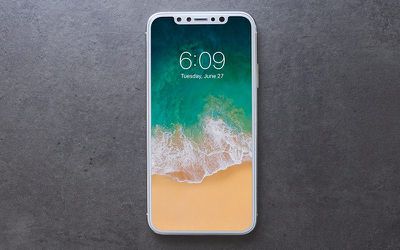









 Apple today