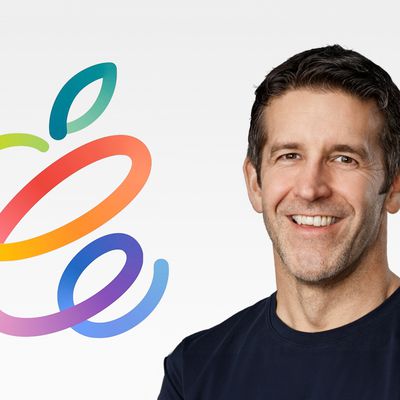
Apple held its earnings call for the fourth fiscal quarter of 2026 today, and it was Apple CEO John Ternus' first earnings call in his new role. He had Apple CFO Kevan Parekh on hand, and he brought in Chief Operating Officer Sabih Khan.
The trio covered iPhone Duo sales, Siri AI, and increasing memory costs, among other topics.
iPhone Duo
After the earnings release, Ternus told Reuters that Apple isn't able to meet demand for the iPhone Duo, and there's no word on when supply/demand balance will be reached.
Ternus also acknowledged display issues and said a "very small percentage" of units have been returned.
iCloud+
Ternus reiterated Apple's plans to add usage limits on server-side AI features like Siri AI and photo editing. Users who need more capacity will be able to purchase expanded access, but there's still no pricing information or details on the limits included with each iCloud+ plan.
When asked about token consumption, Parekh said it's still early days on how much is done on-device vs. with Private Cloud Compute.
The mix of [on-device and cloud Siri] is very early days, and so it's hard to predict exactly what the mix of those costs are going to look like. Obviously, on device, you know, it's very very efficient. No real costs associated with that. But on the server side, we have some inference costs.
I think again, we've just recently launched it and made it available to more users. And so we're in the very very early stages of understanding the kind of mix of those costs, as well as further requirements we might have on the compute side.
Siri AI
Ternus said Apple has real room to expand Siri's capabilities over time, and that Apple wants customers to be aware of what AI agents have access to.
As far as agentic capabilities, you know, we think these are promising tools for users. We just want to make sure that users are aware of what they're giving access to. We want to make sure this is done in a way that protects security and privacy. So, you know, we're pushing really hard on that with Siri AI, but we're also really encouraged the fact that Apple devices are the best places to use all forms of AI.
He also said Apple's privacy focus differentiates it from other AI providers.
I mean, if you think about it, so much of your personal data is on your iPhone. You know, whether it's your contacts, your communications, health data, financial data, all of that, and Siri can tap into that and help you access it in a way that's very secure and private, and that nobody else has access to. Even Apple doesn't have access to it, and so we think that is a core kind of differentiator that we're excited about, and we're going to continue to push on that.
iOS and macOS Merging
With the MacBook Pro gaining a touch display, an analyst asked if we're going to see a single unified operating system in the future.
Ternus said Apple tries to make the best version of each and every product, while also adding features like Handoff that span across devices, but the company has no plans to make major changes.
If you look at what we did last week with the MacBook Pro, we took a huge leap forward. These MacBook Pros are better in every way than the ones that came before them, and we're really proud of that. And so we don't have any fundamentally different changes that we're planning right now. Nor would we talk about it anyway.
China
Revenue in Greater China was up 21 percent during the quarter, which was a quarterly record. Performance was primarily driven by the iPhone and the Mac.
Install Base
Apple has more than 2.5 billion active devices.
Memory
Ternus said the memory situation is "unprecedented," and Apple expects even higher memory costs in the December quarter. Price increases in June and September offset some of the increase, as do lower costs from some non-memory components and carry-in inventory.
Beyond the December quarter, Apple thinks memory prices will continue to increase.
Supply Constraints
iPhone, iPad, and Mac were constrained in the September quarter, which Khan said was driven by demand combined with limited availability of the advanced nodes SoCs are produced on. He said constraints on advanced nodes are easing with the transition of more of the lineup to 2nm chips.
iPhone
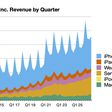
iPhone revenue was $57.6 billion, up 17 percent year over year and a new September quarter record.
Ternus was asked why Apple didn't release a standard iPhone 18 alongside the iPhone 18 Pro, Pro Max, and iPhone Duo, but he skirted the question.
Mac
Revenue was $10.8 billion, up from $8.7 billion, despite supply constraints. Full-year Mac revenue was $37.9 billion, up from $33.7 billion in 2025. Ternus said Apple has never sold more Macs in a fiscal year than it did in 2026.
iPad
iPad revenue was down in the quarter, coming in at $6.2 billion, down from $7 billion in the year-ago quarter. Apple said revenue was down because of supply constraints and a difficult compare against the launch of the A16 iPad last year.
Services
Services revenue hit $31.6 billion, up from $28.8 billion in the year-ago quarter, and a new all-time record. In 2026, services revenue was $123.3 billion.
The App Store saw a record number of nearly a billion average weekly visitors, and Apple saw growth in the number of users who are paying for at least one service.
Wearables
Wearables, Home, and Accessories revenue was $8.3 billion, down 8 percent year over year. There was a difficult compare against the launch of the Apple Watch SE 3 and AirPods Pro 3 in 2025.
The new Apple TV 4K, the HomePod mini, and the Apple HomeView didn't ship during the September quarter.
December Quarter
Apple expects revenue to grow 7 to 10 percent year over year, leading to the best quarter for revenue in Apple's history. Services revenue is expected to grow between 8 and 9 percent.
Gross margin is expected to be between 45 and 46 percent, impacted by higher memory costs and costs related to the ramp of Siri AI.
Apple expects constraints on the Mac and iPad in the December quarter, primarily driven by memory because demand has been higher than expected.