Apple's New AI Models Contain 'None' of Google's Gemini Assistant - MacRumors
Skip to Content

Apple's New AI Models Contain 'None' of Google's Gemini Assistant

Apple executives have detailed the architecture of the company's new Apple Foundation Models (AFM) and clarified exactly how Google's technology factored into their development.
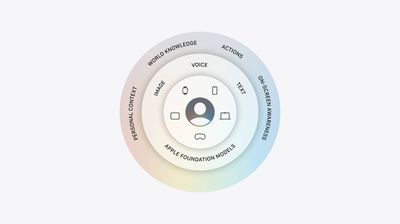
apple intelligence architecture
Craig Federighi, Apple's SVP of Software Engineering, held a post-keynote tech talk (via 9to5Mac) with press on Monday alongside AI VP Amar Subramanya, Siri lead Mike Rockwell, and software VP Sebastien Marineau-Mes to walk through how the third-generation AFM family was built and how it powers Apple Intelligence.

"The amount of the Google Assistant we use is none," Federighi said, explaining that Apple uses none of the Gemini models deployed to Google's customers, none of Google's client-side code, and no Google Search infrastructure as the knowledge backbone.

Of course, we don't have the Gemini app as our app. In fact, none of that client code is part of how we run on iOS. For these models, we use none of the models that Google deploys to their customers, nor do we use the infrastructure and means by which they deploy models to their customers. And then, when it comes to the knowledge base, we of course don't use Google Search or anything like that as the foundation of our system.

Subramanya outlined the new AFM family, which spans two on-device models and three server-side models. The on-device tier consists of AFM Core, a next-generation dense architecture model, and AFM Core Advanced, which uses a sparse architecture and is natively multimodal.

Subramanya said AFM Core Advanced is "unlike any on-device model we've run before," enabling new features including invitation and expressive voices without any cloud requests. On the server side, AFM Cloud handles latency-optimized Private Cloud Compute requests, while AFM Cloud Image powers image generation and editing features including spatial reframing.

The key detail on the Google collaboration came in Subramanya's description of how these four models were trained. "All of these are custom built for Apple Silicon, trained using proprietary data with reinforcement learning and refined using outputs from Gemini frontier models," he said, making clear that Google's contribution was distillation-based, not a wholesale adoption of Gemini.

The fifth and most capable model, AFM Cloud Pro, is designed for agentic tool use and complex reasoning tasks, with quality that Subramanya said is "similar to Gemini frontier models." This model marks a departure from Apple's standard Private Cloud Compute setup.

To run it, Apple worked with both Google and Nvidia to extend its private cloud infrastructure to Nvidia GPUs hosted in Google's cloud. Marineau-Mes said Apple wanted to use Nvidia's latest chips but required them to be configured so they couldn't read the contents of Apple's servers. A recent Nvidia technology called "ambiguous confidential compute" provided the solution.

We wanted to avail ourselves of the latest technology from Nvidia, and so we set out to extend private cloud compute to third-party cloud.

Federighi described the broader system architecture as being organized around a System Orchestrator, a piece of software he called "key to the privacy architecture of our entire system." The orchestrator routes any given query to the appropriate model, on-device or cloud, based on the complexity of the request and the personal context required.

It draws on an App Toolbox for in-app actions, a Spotlight Semantic Index for personal content, and on-screen context for real-time awareness. For queries involving current events, responses are found through Apple's own World Knowledge Service, which Federighi said the company has been building for several years.

Apple also maintains that all Private Cloud Compute infrastructure, including the extended Nvidia GPU capacity in Google's cloud, can be independently verified by third-party researchers to confirm that user data is never stored or accessed.
Popular Stories

android switching tool

Switching From iPhone to Android Just Got Easier With Android 17

Wednesday July 22, 2026 9:35 am PDT by
Android 17 includes a wireless native migration experience for transferring more types of data from an iPhone, making the process of switching to an Android device easier. Google says the upgraded method allows Google Accounts, passwords, Wi-Fi credentials, and eSIMs to be transferred. It also supports photos, videos, contacts, messages, and calendars, like the prior version of the switching ...
google selfie video

You Can Now Recover Your Google Account With a Selfie Video

Thursday July 23, 2026 3:00 am PDT by
Google today introduced a new selfie sign-in option for Google Account recovery. It offers an alternative way for Google users to access their accounts alongside passkeys, recovery contacts, and other entry methods. To create a selfie video, you look at your device's camera and then follow Google's instructions to complete a series of head movements to capture multiple angles. The video is...
european union eu

Google Fined $1 Billion by EU for Search Bias and App Store Restrictions

Thursday July 23, 2026 5:39 am PDT by
Google was today fined €890 million ($1 billion) by the European Union for breaching antitrust rules with regard to its search and Google Play store services. The European Commission found that Google had broken the Digital Markets Act (DMA) by using its dominant position in the search market to favour its own services, like shopping and hotel deals, over those of rivals. The Commission ...

Top Rated Comments

10 weeks ago
This is really encouraging actually. Kinda like how a few years into iOS (I think around version 3-4), Apple dropped a massive whitepaper about iOS security that was like 100 pages long. It documented the security features from physical hardware to bootloader all the way through API. And, largely, iOS has been reasonably secure. The security scaffolding they built was legit— imperfect like anything but actually considered. The same could not be said for Android at the time. Android has mostly caught up on security but it took a while. Good to see Apple step up on the privacy, in theory, on AI.

It will be interesting to see how customers react to something fully baked in contrast to something like Copilot.

Based on what I’ve seen, this seems like much more organic approach to OS-level AI:

1. Privacy, at least on paper, is an actual consideration
2. Seems actually aware of broad context rather than just snippets and lots of guessing about intent
3. Isn’t just bolted on modern-era clippy with more telemetry and no cute mascot

Apple may not invent the wheel these days but, at least once they start shipping wheels, they’ve already been on the balancer and are road-ready.
Score: 17 Votes (Like | Disagree)
10 weeks ago
So basically they payed Google for their employee expertise to help Apple make THEIR new models, not some rerouting through Google. All the privacy doomers were wrong. This is identical to if they did it in house by themselves.
Score: 14 Votes (Like | Disagree)
10 weeks ago
Wow, an entire MR thread that hasn’t devolved into negativity and conspiracy theories before the first page ends?

And it’s an article about Apple Intelligence?

Is it opposite day?
Score: 12 Votes (Like | Disagree)
10 weeks ago

This is really encouraging actually. Kinda like how a few years into iOS (I think around version 3-4), Apple dropped a massive whitepaper about iOS security that was like 100 pages long. It documented the security features from physical hardware to bootloader all the way through API. And, largely, iOS has been reasonably secure. The security scaffolding they built was legit— imperfect like anything but actually considered. The same could not be said for Android at the time. Android has mostly caught up on security but it took a while. Good to see Apple step up on the privacy, in theory, on AI.

It will be interesting to see how customers react to something fully baked in contrast to something like Copilot.

Based on what I’ve seen, this seems like much more organic approach to OS-level AI:

1. Privacy, at least on paper, is an actual consideration
2. Seems actually aware of broad context rather than just snippets and lots of guessing about intent
3. Isn’t just bolted on modern-era clippy with more telemetry and no cute mascot

Apple may not invent the wheel these days but, at least once they start shipping wheels, they’ve already been on the balancer and are road-ready.
It’s clear from posts these past 2 days that practicallly nobody on MR has ever read any of Apple’s security whitepapers.

They’re quite interesting and you can glean a lot of information about how Apple services work.
Score: 11 Votes (Like | Disagree)
10 weeks ago
Testing the new Siri on my 16 Pro Max, it's honestly quite impressive. There are obviously some quirks that need to be solved, and it also seems Siri has issues drawing information from 3rd party apps, but still, night and day difference from the previous version of Siri.
Score: 8 Votes (Like | Disagree)
10 weeks ago
This is honestly pretty effin cool!
Score: 7 Votes (Like | Disagree)