iPhone 16's 'Revolutionary' Battery Removal Process Shown in Video - MacRumors
Skip to Content

iPhone 16's 'Revolutionary' Battery Removal Process Shown in Video

Over the weekend, well-known repair website iFixit shared an iPhone 16 and iPhone 16 Plus teardown video, and an accompanying blog post. Notably, the video shows Apple's new electrical battery removal process in action on the standard iPhone 16.
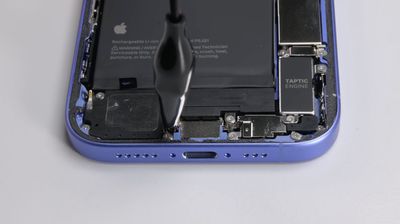
iFixit iPhone 16 Battery Removal
iPhone 16 and iPhone 16 Plus batteries have an innovative type of adhesive that can be easily loosened with low-voltage electrical current, such as from a 9V battery. The steps involved include attaching alligator clips to a 9V battery, connecting the red/positive clip to the silver tab on the iPhone's battery, and connecting the black/negative clip to the lower-right grounding screw on the iPhone's bottom speaker module. After up to 90 seconds, the adhesive should debond and the battery can then be easily taken out of the iPhone.


iFixit described this new process as "revolutionary," and explained how it works:

Imagine an Oreo cookie with a thick layer of double-stuf creme. You figured out that if you dip just the bottom cookie in some milk and twist the cookie apart, the filling will always stick to the top cookie.

Similarly, when we zap the adhesive, the current oxidizes the negative/anode mating surface and loosens the adhesive from it. The adhesive "filling" between the battery and the frame will then stick to whichever surface that’s connected to the positive terminal.

In an email, iFixit said the iPhone 16 is "the most-repairable iPhone yet":

We're giving the phone a laudable 7 out of 10 repairability score (provisional, pending Apple's release of parts). It's not the Fairphone, but Apple's made some important strides in improving hardware repairability, and ending parts pairing restrictions for harvested OEM parts is a huge boon for the repair community.

Only the iPhone 16 and iPhone 16 Plus use this new process. iPhone 16 Pro and Pro Max batteries still have stretch-release adhesive pull tabs.

iPhone 16, iPhone 16 Plus, and iPhone 16 Pro Max batteries still have a black foil enclosure, while the iPhone 16 Pro battery has moved to a metal enclosure, which increases repair safety and likely contributes to improved heat dissipation.


Related Roundup: iPhone 16
Related Forum: iPhone

Popular Stories

apple price hike

Apple Just Increased Prices on MacBooks, iPads, and More

Thursday June 25, 2026 5:44 am PDT by
Apple today dramatically increased device prices across multiple product lines. Subscribe to the MacRumors YouTube channel for more videos. After temporarily taking it down earlier today, Apple's online store is back up with a series of product price increases. The changes are as follows: HomePod mini: $129, up from $99 (+$30) HomePod: $349, up from $299 (+$50) Apple TV: $199, up from...

iphone 17 ceramic shield

2027 iPhone 18 and iPhone 18e to Get 9GB RAM and A20 Chip

Friday June 26, 2026 9:57 am PDT by
The lower-end iPhone 18 models set to launch in spring 2027 will feature 9GB DRAM, up from 8GB, according to Apple analyst Ming-Chi Kuo. Kuo says the A20 chip Apple plans to use for the devices will have 1.5GB x 6 dies for a total of 9GB RAM, instead of 2GB x 4 dies as the current lower-end iPhone 17 models use. By lower-end iPhones, Kuo is likely referencing the iPhone 18 and the iPhone...
Mac Studio Feature

M5 Ultra Mac Studio Could Launch in 2026 With Up to 768GB of RAM

Thursday June 25, 2026 2:30 pm PDT by
Despite price increases across the Mac line, Apple is still planning to release a new Mac Studio as soon as this year, reports Bloomberg. Apple plans to introduce a new M5 Ultra chip as the final option in the M5 family before it transitions to the M6, M7, M7 Pro, and M7 Max. The M5 Ultra will come in a new version of the Mac Studio, which hasn't been updated since March 2025. The Mac...

Top Rated Comments

vegetassj4 Avatar
23 months ago
New Apple Accessory: Remove your battery without wires, and in half the time.


Attachment Image

Attachment Image
Score: 17 Votes (Like | Disagree)
23 months ago
All of a sudden, Apple found a revolutionary way to replace the battery. I wonder if the EU had something to do with this.
Score: 14 Votes (Like | Disagree)
Jhonjhon236 Avatar
23 months ago

Requiring 9V to replace a 4.2V battery, what could possibly go wrong?
Then again, the old adhesive was terrifying to remove as well.
What could go wrong? Unless you are a total idiot then it would be pretty hard to mess up if you RTFM.
Score: 12 Votes (Like | Disagree)
23 months ago

Requiring 9V to replace a 4.2V battery, what could possibly go wrong?
Then again, the old adhesive was terrifying to remove as well.
iFixit, a major critic of Apple’s repairability for years, seems to think otherwise. They even refer to it as “revolutionary”. That’s like Greenpeace saying Apple is doing a good job on the environment. It means something. Not on toxic tech blogs, obviously.
Score: 9 Votes (Like | Disagree)
23 months ago
Four screws on the corners of a battery is a time tested method to secure it.
But noooooo
Score: 9 Votes (Like | Disagree)
23 months ago

All of a sudden, Apple found a revolutionary way to replace the battery. I wonder if the EU had something to do with this.
Is that something to be proud of or what?

If they spent effort on this because they think customers want it (and if they’re right about it), it will pay off.

If they were forced by the EU without believing in it and customers don’t care, the result is that they spent a lot of money on a “revolutionary” method no one wants, that could have gone to something more relevant to customers.
Score: 9 Votes (Like | Disagree)