Apple Reportedly Asks Suppliers for 'Bezelless' OLED iPhone Displays
Apple has asked its suppliers to develop "bezelless" OLED display panels for future iPhone models, The Elec reports.
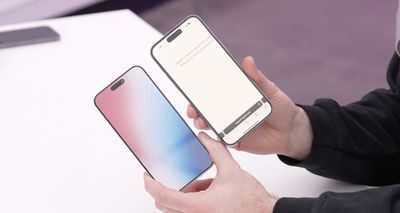 iPhone 15 Pro Max dummy model with thinner bezels compared to an iPhone 14 Pro Max, via Unbox Therapy.
Apple apparently asked Samsung and LG Display to develop the new OLED display panels, intending to implement them while maintaining the iPhone's current design, in contrast to the curved displays that some smartphone brands with ultra-slim bezels offer. Apple is reportedly reluctant to implement a display that curves over the side of the iPhone due to concerns about optical distortion and durability.
Apple purportedly wants the bezelless displays to facilitate improved thin film encapsulation (TFE) and under-panel camera (UPC) technology, as well as increase space for components like antennas while reducing interference. Retaining a design with a flat display reportedly enables these improvements, where they would otherwise currently be impossible with a curved display.
Overall, this suggests that Apple is currently planning to offer the bezelless OLED display as soon as the iPhone 17 Pro in 2025, since this device is rumored to be the first to feature under-display Face ID technology, sitting alongside a hole-shaped cutout for the front-facing camera. Likewise, Apple is likely targeting a release date sometime before its own custom microLED display technology makes its way to the iPhone. Apple's first device with a custom microLED display is expected to be the 2025 Apple Watch Ultra, with various reports suggesting that the iPhone will be soon to follow in subsequent years.
Apple plans to reduce the iPhone's bezel over time until there is no bezel at all upon utilizing the next-generation OLED panels from Samsung and LG. This year's iPhone 15 Pro and iPhone 15 Pro Max models are expected to have the thinnest bezels of any smartphone to date at just 1.55mm.
Popular Stories
Apple today confirmed to Reuters that it has acquired Q.ai, an Israeli startup that is working on artificial intelligence technology for audio.
Apple paid close to $2 billion for Q.ai, according to sources cited by the Financial Times. That would make this Apple's second-biggest acquisition ever, after it paid $3 billion for the popular headphone and audio brand Beats in 2014.
Q.ai has...
Apple recently updated its online store with a new ordering process for Macs, including the MacBook Air, MacBook Pro, iMac, Mac mini, Mac Studio, and Mac Pro.
There used to be a handful of standard configurations available for each Mac, but now you must configure a Mac entirely from scratch on a feature-by-feature basis. In other words, ordering a new Mac now works much like ordering an...
A newly surfaced resale operation is seemingly offering Apple Store–exclusive display accessories to the public for the first time, potentially giving consumers access to Apple-designed hardware that the company has historically kept confined to its retail environments.
Apple designs a range of premium MagSafe charging stands, display trays, and hardware systems exclusively for displays in ...
Update: Apple Creator Studio is now available.
Apple Creator Studio launches this Wednesday, January 28. The all-in-one subscription provides access to the Final Cut Pro, Logic Pro, Pixelmator Pro, Motion, Compressor, and MainStage apps, with U.S. pricing set at $12.99 per month or $129 per year.
A subscription to Apple Creator Studio also unlocks "intelligent features" and "premium...
Apple today introduced its first two physical products of 2026: a second-generation AirTag and the Black Unity Connection Braided Solo Loop for the Apple Watch.
Read our coverage of each announcement to learn more:Apple Unveils New AirTag With Longer Range, Louder Speaker, and More
Apple Introduces New Black Unity Apple Watch BandBoth the new AirTag and the Black Unity Connection Braided...