Leaked MacBook Schematics Have Aided Independent Technicians Performing Complicated Repairs
Independent technicians have reportedly been able to use leaked MacBook schematics to aid repairs (via Vice).
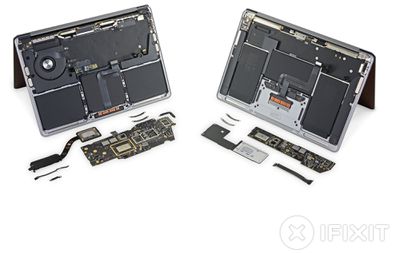
Last month, Apple supplier Quanta Computer was hit with an attack by the ransomware group known as "REvil," leading to a large quantity of internal Apple documents about both released and unreleased devices being exposed. The leaked PDFs, available on a number of forums and online marketplaces, have apparently helped technicians understand how some MacBook components fit together.
Repair advocate and owner of the Rossmann Repair Group, Louis Rossmann, told Vice:
Our business relies on stuff like this leaking. This is going to help me recover someone's data. Someone is going to get their data back today because of this.
You can't go to Apple and say "I will give you $800,000 to give me this data." When we fix the board, most of the time we preserve the data.
I'm not saying I'm in favor of people hacking into computers to get this information. I would prefer to get this by going to Apple and giving them $1,000 every year to get this information.
Although basic repairs, such as battery replacements, are possible with guides and tools from the likes of iFixit, logic board repairs are considerably more complex and can involve minute adjustments to circuitry and chips, and often risk data loss. Such repairs also have very little margin for error.
Apple does not provide detailed repair manuals and schematics for its hardware, forcing third-party repair technicians to look elsewhere. Simple trial and error can help repair technicians understand how a device's circuitry works, but can be very time-consuming and risk the complete breakage of multiple components.
Reverse-engineered blueprints put together by third parties are often shared online, but the REvil leak has presented a new opportunity for technicians to get specific information to help the repair process.
Popular Stories
Apple today confirmed to Reuters that it has acquired Q.ai, an Israeli startup that is working on artificial intelligence technology for audio.
Apple paid close to $2 billion for Q.ai, according to sources cited by the Financial Times. That would make this Apple's second-biggest acquisition ever, after it paid $3 billion for the popular headphone and audio brand Beats in 2014.
Q.ai has...
Apple today introduced its first two physical products of 2026: a second-generation AirTag and the Black Unity Connection Braided Solo Loop for the Apple Watch.
Read our coverage of each announcement to learn more:Apple Unveils New AirTag With Longer Range, Louder Speaker, and More
Apple Introduces New Black Unity Apple Watch BandBoth the new AirTag and the Black Unity Connection Braided...
Alongside iOS 26.2.1, Apple today released an updated version of iOS 12 for devices that are still running that operating system update, eight years after the software was first released.
iOS 12.5.8 is available for the iPhone 5s and the iPhone 6, meaning Apple is continuing to support these devices for 13 and 12 years after launch, respectively. The iPhone 5s came out in September 2013,...
Update: Apple Creator Studio is now available.
Apple Creator Studio launches this Wednesday, January 28. The all-in-one subscription provides access to the Final Cut Pro, Logic Pro, Pixelmator Pro, Motion, Compressor, and MainStage apps, with U.S. pricing set at $12.99 per month or $129 per year.
A subscription to Apple Creator Studio also unlocks "intelligent features" and "premium...
On an earnings call with equity analysts today, Apple CEO Tim Cook responded to fast-rising RAM and SSD storage chip prices in the supply chain.
Prices for RAM and NAND storage chips are surging lately due to high demand from companies building out AI servers, resulting in supply constraints.
Cook said that rising memory chip prices had a "minimal impact" on Apple's gross margin in the...