Security Researchers Develop Framework for Tracking Bluetooth Devices Using Find My
Ahead of the debut of AirTags and support for locating third-party Bluetooth items through Find My in iOS 14.5, a team of security researchers from the Secure Mobile Networking Lab at the Technical University of Darmstadt in Germany has reverse engineered the Find My protocol and developed an app that's designed to let anyone create an "AirTag" based on a Bluetooth-capable device.
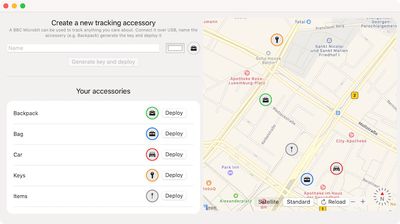
Called OpenHaystack, the app and the source code are available on GitHub for those who are interested in taking a look. The app allows users to create their own Bluetooth tags based on the Find My network by installing an "AirTag" firmware image on a Bluetooth dongle.
The app displays the most recent location of a created Bluetooth tag reported by any iPhone using Apple's Find My network that was implemented in iOS 13, plus it shows the location of the tag on a map.
According to the security researchers, the created tags send out Bluetooth beacons, which are picked up by nearby iPhones that interpret the sending device as lost. The current geolocation is end-to-end encrypted and then uploaded to Apple, with the OpenHaystack app then downloading the encrypted report from Apple and decrypting it locally on the Mac.
In the process of developing this tool, the Secure Mobile Networking Lab researchers also identified a macOS Catalina Find My vulnerability that was reported to Apple and addressed in a 10.15.7 update released back in November. The vulnerability allowed a malicious app to access iCloud decryption keys to download and decrypt location reports submitted by the Find My network.
Apple's iOS 14.5 update includes support for tracking third-party Bluetooth devices in the Find My app using a new "Items" tab, which takes advantage of the same Find My protocol used for the Mac app.
At the current time, in-app tracking is limited to Beats headphones and upcoming Belkin wireless earbuds, but in the future, many third-party Bluetooth devices may include Find My integration, making it easier to keep track of them. This system will also be used by Apple's own rumored AirTags, which have yet to be released.

Popular Stories
Next year's iPhone 18 Pro and iPhone 18 Pro Max will be equipped with under-screen Face ID, and the front camera will be moved to the top-left corner of the screen, according to a new report from The Information's Wayne Ma and Qianer Liu.
As a result of these changes, the report said the iPhone 18 Pro models will not have a pill-shaped Dynamic Island cutout at the top of the screen....
There's now a dedicated Apple Music app for ChatGPT, which allows ChatGPT to make music recommendations and build playlists.
Apple Music can be added to ChatGPT through the Settings section in the Mac app, website, or iOS app. Apple Music is listed under the apps option, and connecting to it requires signing in with your Apple Account for authorization purposes.
ChatGPT can be used to...
You'd think things would be slowing down heading into the holidays, but this week saw a whirlwind of Apple leaks and rumors while Apple started its next cycle of betas following last week's release of iOS 26.2 and related updates.
This week also saw the release of a new Apple Music integration with ChatGPT, so read on below for all the details on this week's biggest stories!
Top Stories
i...
Since the AirPods Pro 3 launched, there have been complaints from users who have noticed a static-like sound or a crackling issue when using the earbuds, particularly when Active Noise Cancellation is on but no media is playing. Users have also run into strange high-pitched whistling sounds that happen intermittently.
We shared the issues back in late October, and despite two subsequent...
There has been a whirlwind of rumors over the last few days, sourced from leaked internal software designed for the iPhone and the Mac, and news sites like The Information. Below, we have a quick recap of everything we've heard this week, which serves as a guide to Apple's product plans in 2026 and beyond.
We've organized the info by likely release date, though there are some products that...
Since the beginning of December, Apple has been pushing iPhone users who opted to stay on iOS 18 to install iOS 26 instead. Apple started by making the iOS 18 upgrades less visible, and has now transitioned to making new iOS 18 updates unavailable on any device capable of running iOS 26.
If you have an iPhone 11 or later, Apple is no longer offering new versions of iOS 18, even though there...
Apple Maps no longer offers a Flyover feature that provides users with automated tours of notable landmarks in major cities. The Flyover option appears to have been nixed around when iOS 26 launched, but its removal went largely unnoticed.
Flyover city tours were introduced in 2014 with iOS 8 and OS X Yosemite, using Flyover imagery to generate an aerial tour. Most cities with Flyover...