Apple Working With Johnson & Johnson on 'Heartline Study' Aimed at Reducing Risk of Stroke
Apple and Johnson & Johnson today announced a new study that aims to gather more information surrounding atrial fibrillation and other conditions tracked by iPhone and Apple Watch. The "Heartline Study" will include an iPhone app, and explores whether health tracking features of iPhone and heart health features on Apple Watch can improve health outcomes.
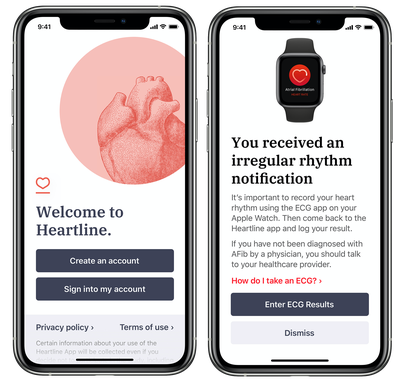
The study is specifically aimed at individuals over 65 years of age. Apple and Johnson & Johnson are looking to see if Apple's health tracking technology can help reduce the risk of stroke thanks to earlier detection of atrial fibrillation, which is a leading cause of stroke in the United States and detectable with the Apple Watch's ECG feature.
The main issue with atrial fibrillation is that it is difficult to diagnose, due to the lack of physical symptoms in most patients. With Apple Watch, watchOS can alert users to a potential AFib event even if they are unaware of what's happening to them.
"Apple technology is making a meaningful impact on scientific research through the powerful capabilities of iPhone and Apple Watch, all with privacy at the center of the participant experience," said Myoung Cha, Apple's Head of Health Strategic Initiatives. "The Heartline Study will help further understanding of how our technology could both contribute to science and help improve health outcomes, including reducing the risk of stroke."
Those interested in the study must be 65 or older, a U.S. resident for the duration of the study, have traditional Medicare, own an iPhone 6s or later (with iOS 12.2 or later), and agree to provide access to their Medicare claims data. Once randomized participants are selected, they will be divided into two groups: one will only use the iPhone app and the other will use the iPhone app in addition to obtaining an Apple Watch. The study will last three years.
Apple and its devices regularly participate in scientific studies, most recently at Stanford Medicine with the "Apple Heart Study." This study began in 2017, and in November 2019 Stanford Medicine published results that ultimately determined the Apple Watch can successfully detect atrial fibrillation.
Popular Stories
Bloomberg's Mark Gurman has high expectations for Apple's first foldable iPhone.
In his Power On newsletter today, he said the foldable iPhone will be "the most significant overhaul in the iPhone's history."
"iPhone 4, iPhone 6 and iPhone X were clearly a big deal, but this is a whole new design," he said.
Like Samsung's Galaxy Z Fold 7, the foldable iPhone will reportedly open up like ...
iOS 26.5 is now available for developers, and while it doesn't include any new Siri capabilities, there are some major changes for the European Union, and smaller tweaks for features available worldwide.
Suggested Places
In the Maps app, there's a new "Suggested Places" feature that recommends locations to visit based on trending places nearby and recent searches. When Apple launches ads in ...
Apple has been celebrating its upcoming 50th anniversary by hosting surprise performances and other events around the world over the past few weeks, and now Bloomberg's Mark Gurman has revealed details about the company's grand finale.
In a social media post, Gurman said Apple's celebrations will conclude this week with a finale at its Apple Park headquarters for employees.
A special...
Popular Stories
Apple is hoping to 3D-print aluminum device enclosures in the future, according to Bloomberg's Mark Gurman.

In today's "Power On" newsletter, Gurman revealed that Apple is pushing to move to 3D-printed aluminum enclosures for for future devices. The MacBook Neo relies on a new aluminum manufacturing process that saves as much metal as possible to drive down costs and speed up production....

Apple today launched its atrial fibrillation history feature for Apple Watch in mainland China.
Since 2022, Apple Watch in the U.S. has supported AFib History, which allows users diagnosed with atrial fibrillation to view an estimate of how frequently their heart is in this type of irregular rhythm.
The feature analyzes pulse rate data collected by a photoplethysmography (PPG) sensor to...
Apple's current blood oxygen sensing implementation in the U.S. does not infringe on patents owned by Masimo and Apple will not face a revived import ban, a U.S. International Trade Commission judge said this week (via Reuters).
After Apple was found to have violated Masimo's patents related to blood oxygen sensing, the Apple Watch faced a U.S. import ban that caused Apple to briefly pause...