Skip to Content

iPhone XS Max Ranks 'Among the Best' in DxOMark’s Selfie Camera Test, but Loses Points for Low-Light Performance

DxOMark today published the results of its "Selfie scores" test, which gauged the performance of the front-facing cameras for 12 modern smartphones. Apple's iPhone XS Max sits at fourth place on the overall selfie rankings with a score of 82, beaten out by Google Pixel 3, Galaxy Note 9, and Xiaomi Mi MIX 3.
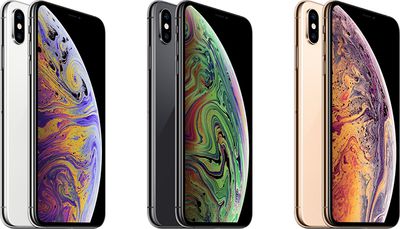
iphonexsmaxfront
According to DxOMark, the ‌iPhone‌ XS Max produces "some of the best" still images and video quality when it's placed in brightly lit situations, but it lost points because of poor performance in dim lighting. The only other Apple smartphone on the list is the ‌iPhone‌ X, with a score of 71 in 10th place.

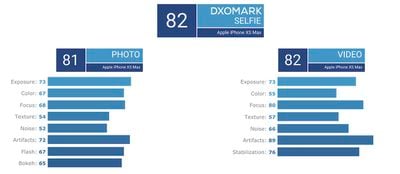
DxOMark also broke down its results by providing a specific "selfie photo score" and "selfie video score." The ‌iPhone‌ XS Max received a score of 81 and 82, respectively in each category, again staying in fourth place in both instances.

The company said that Portrait Mode selfies are a major strength of the ‌iPhone‌ XS Max, with very good depth estimation and accurate subject masking. Overall, DxOMark said the ‌iPhone‌ XS Max was "among the best results we've observed for front cameras" thanks to features like HDR and Portrait Mode's bokeh effect.


dxo selfie 1

‌iPhone‌ XS Max bokeh effect

dxo selfie 2
Google Pixel 2 bokeh effect

Overall, DxOMark pointed out that one of the XS Max's big weak spots on its front-facing camera is noise, noting that luminance noise is visible on faces in many of the outdoor images taken during the testing process. The company noted that results remained "acceptable," but things only got worse in low lighting conditions, and even explained that these results are slightly poorer than those found on the ‌iPhone‌ X's front-facing camera.

Achieving a DxOMark front camera score of 82, the Apple iPhone XS Max puts in a solid performance for both still and moving images during our tests, and is a nice improvement over its predecessor, the iPhone X. For still photos, the device boasts some great strengths for selfie shooters, including excellent HDR, bokeh shots, and detail at close range, which are among the best results we’ve observed for front cameras.

There are some areas in which Apple can continue to improve for stills, however, with noise visible in all lighting conditions; and white balance and skin rendering issues, especially in indoor images and occasionally outdoors, too, where color casts and low-contrast faces can look unnatural.

The full ratings breakdown for the ‌iPhone‌ XS Max's front-facing selfie camera can be seen below:
dxo selfie xs max
The two phones topping the list -- Pixel 3 and Galaxy Note 9 -- tied for first with a score of 92. DxOMark said that the Pixel 3 edges out the Note 9 in terms of its focus system, but the Note 9 achieves better results for exposure and color in selfie photos. "Images captured with the Google device show slightly stronger contrast and a cooler white balance," DxOMark's Lars Rehm mentioned. "The Samsung is a little better at exposing for faces and applies a little less contrast to faces, making for a slightly more natural look."

You can check out the full ‌iPhone‌ XS Max front camera review by DxOMark right here.
Tag: DxOMark

Popular Stories

MacBook Neo Feature Pastel 1

First MacBook Neo Benchmarks Are In: Here's How It Compares to the M1 MacBook Air

Thursday March 5, 2026 4:07 pm PST by
Benchmarks for the new MacBook Neo surfaced today, and unsurprisingly, CPU performance is almost identical to the iPhone 16 Pro. The MacBook Neo uses the same 6-core A18 Pro chip that was first introduced in the iPhone 16 Pro, but it has one fewer GPU core. The MacBook Neo earned a single-core score of 3461 and a multi-core score of 8668, along with a Metal score of 31286. Here's how the...
HomePod mini and Apple TV Sage

New Apple TV and HomePod Mini Are Still Missing, Here's Why

Thursday March 5, 2026 6:11 am PST by
Apple this week unveiled seven products, ranging from the iPhone 17e to the MacBook Neo, but new Apple TV and HomePod mini models were not among them. Given that there have been rumors about the next-generation Apple TV and HomePod mini since all the way back in late 2024, some customers are wondering why the devices have yet to launch, and the answer likely relates to Siri. In September, ...
MacBook Neo Feature Pastel 1

Apple Announces $599 'MacBook Neo' With A18 Pro Chip

Wednesday March 4, 2026 6:15 am PST by
Apple today announced the "MacBook Neo," an all-new kind of low-cost Mac featuring the A18 Pro chip for $599. The MacBook Neo is the first Mac to be powered by an iPhone chip; the A18 Pro debuted in 2024's iPhone 16 Pro models. Apple says it is up to 50% faster for everyday tasks than the bestselling PC with the latest shipping Intel Core Ultra 5, up to 3x faster for on-device AI workloads,...

Top Rated Comments

applebreed Avatar
93 months ago
Maybe just me, but between the included test photos, the Google Pixel 2 looks a little better. Seems like the person in the foreground is separated a little more precisely from the background.

Also, it looks like the 'bokeh' in the XS photo is more like a layered blur, like it has a gaussian blur layer at reduced opacity over a focused layer.
Score: 9 Votes (Like | Disagree)
AngerDanger Avatar
93 months ago
Meanwhile, the photos my Nokia 8210 take feature far superior blurring, but nobody is bragging about that!


Attachment Image
Score: 8 Votes (Like | Disagree)
Madmic23 Avatar
93 months ago
Maybe just me, but between the included test photos, the Google Pixel 2 looks a little better. Seems like the person in the foreground is separated a little more precisely from the background.

Also, it looks like the 'bokeh' in the XS photo is more like a layered blur, like it has a gaussian blur layer at reduced opacity over a focused layer.
I thought the same thing at first, but after really looking at it, I'd say the iPhone is doing a better job.

The Pixel has done a great job of identifying the person, but it seems like it's just cut him out and blurred the whole background. But that's not how bokeh works. If you took this photo with an actual camera, the wall beside him would be in focus with him, and then gradually blurred out as you get further away.

It's an interesting shot for this test with that wall there. If the angle was changed and the wall was just directly behind him and he was standing a distance away from it, I think the Pixel would look the best. But because the iPhone has taken the depth into account in this shot, I think the iPhone picture is better.
Score: 8 Votes (Like | Disagree)
93 months ago
Yah that Pixel “bokeh” makes no sense. The portion of the fence beside his shoulder is blurred while his shoulder (the exact same distance from the lens) is sharp.
Score: 8 Votes (Like | Disagree)
93 months ago
Maybe just me, but between the included test photos, the Google Pixel 2 looks a little better. Seems like the person in the foreground is separated a little more precisely from the background.

Also, it looks like the 'bokeh' in the XS photo is more like a layered blur, like it has a gaussian blur layer at reduced opacity over a focused layer.
It is more separated, but incorrectly, ie. not what real camera with wide open lens would do. The fencing to the left should be as sharp as objects face, when at the same distance from the lens...
Score: 4 Votes (Like | Disagree)
bchery21 Avatar
93 months ago
Maybe just me, but between the included test photos, the Google Pixel 2 looks a little better. Seems like the person in the foreground is separated a little more precisely from the background.

Also, it looks like the 'bokeh' in the XS photo is more like a layered blur, like it has a gaussian blur layer at reduced opacity over a focused layer.
The Pixel's example definitely has a sharper subject but I'm assuming the iPhone receives its points with the gradual background blur that is said to be more realistic.
Score: 4 Votes (Like | Disagree)