Researchers Discover Vulnerabilities in PGP/GPG Email Encryption Plugins, Users Advised to Avoid for Now

A warning has been issued by European security researchers about critical vulnerabilities discovered in PGP/GPG and S/MIME email encryption software that could reveal the plaintext of encrypted emails, including encrypted messages sent in the past.
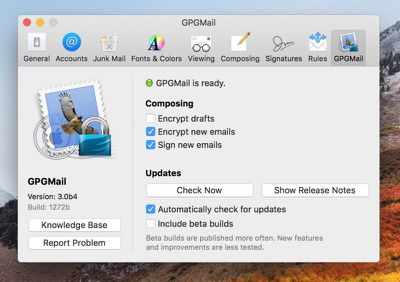
GPGMail pane
The alert was put out late on Sunday night by professor of computer security Sebastian Schinzel. A joint research paper, due to be published tomorrow at 07:00 a.m. UTC (3:00 a.m. Eastern Time, 12:00 am Pacific) promises to offer a thorough explanation of the vulnerabilities, for which there are currently no reliable fixes.


Details remain vague about the so-called "Efail" exploit, but it appears to involve an attack vector on the encryption implementation in the client software as it processes HTML, rather than a vulnerability in the encryption method itself. A blog post published late Sunday night by the Electronic Frontier Foundation said:

"EFF has been in communication with the research team, and can confirm that these vulnerabilities pose an immediate risk to those using these tools for email communication, including the potential exposure of the contents of past messages."

In the meantime, users of PGP/GPG and S/MIME are being advised to immediately disable and/or uninstall tools that automatically decrypt PGP-encrypted email, and seek alternative end-to-end encrypted channels such as Signal to send and receive sensitive content.

Update: The GPGTools/GPGMail team has posted a temporary workaround against the vulnerability, while MacRumors has compiled a separate guide to removing the popular open source plugin for Apple Mail until a fix for the vulnerability is released. Other popular affected clients include Mozilla Thunderbird with Enigmail and Microsoft Outlook with GPG4win. Click the links for EFF's uninstall steps.


Popular Stories

imac video apple feature

Apple Unveils First New Products of 2026

Monday January 26, 2026 1:55 pm PST by
Apple today introduced its first two physical products of 2026: a second-generation AirTag and the Black Unity Connection Braided Solo Loop for the Apple Watch. Read our coverage of each announcement to learn more:Apple Unveils New AirTag With Longer Range, Louder Speaker, and More Apple Introduces New Black Unity Apple Watch BandBoth the new AirTag and the Black Unity Connection Braided...
Second Generation AirTag Feature

Apple Unveils New AirTag With Longer Range, Louder Speaker, and More

Monday January 26, 2026 6:07 am PST by
Apple today introduced the second-generation AirTag, with key features including longer range for tracking items and a louder speaker. For those who are not familiar, the AirTag is a small accessory that you can attach to your backpack, keys, or other items. Then, you can track the location of those items in the Find My app on the iPhone, iPad, Mac, Apple Watch, and iCloud.com. The new...


iPhone 5s

iPhone 5s Gets New Software Update 13 Years After Launch

Monday January 26, 2026 3:56 pm PST by
Alongside iOS 26.2.1, Apple today released an updated version of iOS 12 for devices that are still running that operating system update, eight years after the software was first released. iOS 12.5.8 is available for the iPhone 5s and the iPhone 6, meaning Apple is continuing to support these devices for 13 and 12 years after launch, respectively. The iPhone 5s came out in September 2013,...
Apple Logo Spotlight

Apple to Launch These 20+ Products This Year

Sunday January 25, 2026 6:02 pm PST by
2026 promises to be yet another busy year for Apple, with the company rumored to be planning more than 20 product announcements over the coming months. Beyond the usual updates to iPhones, iPads, Macs, and Apple Watches, Apple is expected to release its all-new smart home hub, which was reportedly delayed until the more personalized version of Siri is ready. Other unique products rumored for ...
M5 MacBook Pro

Apple Reportedly Aiming to Upgrade the MacBook Pro Twice This Year

Sunday January 25, 2026 11:46 am PST by
Apple plans to release new MacBook Pro, MacBook Air, Mac Studio, and Studio Display models in the first half of this year, according to Bloomberg's Mark Gurman. In his Power On newsletter today, Gurman added that redesigned MacBook Pro models with an OLED touch screen "should be hitting toward the end of 2026," meaning that the MacBook Pro line would be upgraded twice this year. First up...

Top Rated Comments

flyinmac Avatar
101 months ago
Hmm.... security protocol creates a vulnerability. To protect yourself, stop encrypting your emails???

Interesting.
Score: 12 Votes (Like | Disagree)
arekm Avatar
101 months ago
This looks like another clickbait by (almost pseudo) research teams. The problem is within mail software and not PGP encryption standard or tools.

https://lists.gnupg.org/pipermail/gnupg-users/2018-May/060315.html
Score: 7 Votes (Like | Disagree)
rodpascoe Avatar
101 months ago
Oh the irony.
Score: 6 Votes (Like | Disagree)
flyinmac Avatar
101 months ago
Hope the alert was not sent by email LOL
Going back to using birds to deliver my messages. Considered pigeons... but I want a bird that can shred anyone who tries to intercept my message. Decided on Hawks.
Score: 4 Votes (Like | Disagree)
Detektiv-Pinky Avatar
101 months ago

<snip>
From what I've read, it's a bug in PGP, not mail
I heard differently. It is supposedly a bug affecting any kind of Email encryption using MIME and automatically loading remote content. Also the in-build S/MIME encryption is at risk.
Score: 3 Votes (Like | Disagree)
belvdr Avatar
101 months ago
From what I've read, it's a bug in PGP, not mail
It's a problem in the mail user agent (MUA), not PGP/GPG. From the mailing list:

https://lists.gnupg.org/pipermail/gnupg-users/2018-May/060315.html


The topic of that paper is that HTML is used as a back channel to create an oracle for modified encrypted mails. It is long known that HTML mails and in particular external links like <img href="tla.org/TAG"/> are evil if the MUA actually honors them (which many meanwhile seem to do again; see all these newsletters). Due to broken MIME parsers a bunch of MUAs seem to concatenate decrypted HTML mime parts which makes it easy to plant such HTML snippets.

There are two ways to mitigate this attack

- Don't use HTML mails. Or if you really need to read them use a
proper MIME parser and disallow any access to external links.

- Use authenticated encryption.
It also appears that some versions of OpenPGP already use authenticated encryption. From what I'm reading, this is a really old bug that many wanted to get fixed, but the MUAs fail to fix it.
Score: 3 Votes (Like | Disagree)