Android Continues to Have More Loyal Customers Than iOS

Android customers continue to be loyal to the Android operating system than iOS users are to the iOS operating system, according to new data shared today by Consumer Intelligence Research Partners.

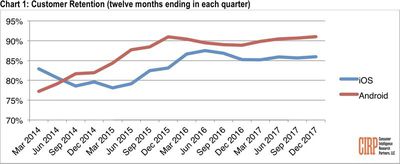
Android saw a 91 percent loyalty rate in 2017, compared to 86 percent for iOS, with loyalty rates for the two operating systems remaining largely steady since early 2016. Android loyalty has hovered at 89 to 91 percent since January 2016, while iOS loyalty has been between 85 and 88 percent.
androidioscustomerloyalty
Operating system loyalty for the year was measured by the percentage of customers that remained with each operating system when activating a new phone over the twelve months ending in December 2017. CIRP says its findings are based on quarterly surveys with a sample of 500 subjects each.

"Loyalty for both Android and iOS increased in 2015 and into 2016, when it leveled off for both operating systems," said Mike Levin, Partner and Co-Founder of CIRP. "Loyalty is also as high as we've ever seen, really from 85-90% at any given point. With only two mobile operating systems at this point, it appears users now pick one, learn it, invest in apps and storage, and stick with it. Now, Apple and Google need to figure out how to sell products and services to these loyal customer bases."

With the Android operating system, customers have access to a range of different smartphones that are all able to run Android, which may explain why it has a higher loyalty rate. Android devices are also typically more affordable than iOS devices, with a wider range of low-priced options available.

As CIRP points out, with fewer and fewer first-time smartphone buyers available, poaching customers from competing operating systems is becoming increasingly important. Apple regularly aims to lure Android users to iOS through trade-in options, videos, a Move to iOS app to make transitioning simple, and a "Switch" website dedicated to explaining all of the reasons why the iPhone is better than competing smartphones.

"We know Android has a larger base of users than iOS, and because of that larger base, the absolute number of users that switch to iOS from Android is as large or larger than the absolute number of users that switch to Android from iOS. Looking at absolute number of users in this way tends to support claims that iOS gains more former Android users, than Android does former iOS users."

These loyalty rates are not equivalent to switcher rates, where iOS wins out. With a larger Android customer base, more customers are switching over to iOS devices on a regular basis. During earnings calls, Apple CEO Tim Cook always touts the high number of Android switchers Apple sees, with each quarter setting a new record.
Tags: Android, CIRP

Popular Stories

airpods pro 3 purple

New, Higher End AirPods Pro Coming This Year

Tuesday January 20, 2026 9:05 am PST by
Apple is planning to debut a high-end secondary version of AirPods Pro 3 this year, sitting in the lineup alongside the current model, reports suggest. Back in September 2025, supply chain analyst Ming-Chi Kuo reported that Apple is planning to introduce a successor to the AirPods Pro 3 in 2026. This would be somewhat unusual since Apple normally waits around three years to make major...

iOS 27 Mock Quick

iOS 27 Will Add These 8 New Features to Your iPhone

Sunday January 18, 2026 3:51 pm PST by
iOS 27 is still many months away, but there are already plenty of rumors about new features that will be included in the software update. The first beta of iOS 27 will be released during WWDC 2026 in June, and the update should be released to all users with a compatible iPhone in September. Bloomberg's Mark Gurman said that iOS 27 will be similar to Mac OS X Snow Leopard, in the sense...
14 inch MacBook Pro Keyboard

MacBook Pro Buyers Now Facing Up to a Two-Month Wait Ahead of New Models

Sunday January 18, 2026 6:50 pm PST by
MacBook Pro availability is tightening on Apple's online store, with select configurations facing up to a two-month delivery timeframe in the United States. A few 14-inch and 16-inch MacBook Pro configurations with an M4 Pro chip are not facing any shipping delay, but estimated delivery dates for many configurations with an M4 Max chip range from February 6 to February 24 or even later. At...
smaller dynamic island iphone 18 pro Filip Vabrous%CC%8Cek

iPhone 18 Pro Leak: Smaller Dynamic Island, No Top-Left Camera Cutout

Tuesday January 20, 2026 2:34 am PST by
Over the last few months, rumors around the iPhone 18 Pro's front-panel design have been conflicted, with some supply-chain leaks pointing to under-display Face ID, reports suggesting a top-left hole-punch camera, and debate over whether the familiar Dynamic Island will shrink, shift, or disappear entirely. Today, Weibo-based leaker Instant Digital shared new details that appear to clarify the ...
iPhone Top Left Hole Punch Face ID Feature Purple

iPhone 18 Pro Launching Later This Year With These 12 New Features

Thursday January 15, 2026 10:56 am PST by
While the iPhone 18 Pro and iPhone 18 Pro Max are not expected to launch for another eight months, there are already plenty of rumors about the devices. Below, we have recapped 12 features rumored for the iPhone 18 Pro models, as of January 2026: The same overall design is expected, with 6.3-inch and 6.9-inch display sizes, and a "plateau" housing three rear cameras Under-screen Face ID...

Top Rated Comments

25ghosts Avatar
103 months ago
That depends on how you measure loyalty...

I'd say that Apple iOS has the MOST loyal clients on the planet. No in the entire Solar System....

That they still have ANY clients at all after what they put they clients through with iOS 11 speaks fathoms about loyalty :D
Score: 44 Votes (Like | Disagree)
mtneer Avatar
103 months ago
Android loyalty is 89 - 91% and iOS loyalty is between 85 - 88%. What is the margin of error on this survey? Most political surveys have a margin of 3 - 5 % and they have thousands of samples to get there. The difference here does not look statistically significant enough to claim that one is better than the other (even if the roles were reversed).
Score: 27 Votes (Like | Disagree)
v0lume4 Avatar
103 months ago
Having been an iOS user that now uses Android, I gotta say -- it's pretty nice here. Unless I see some big changes in iOS 12, I expect my next phone to be an Android device as well. Android is really terrific, objectively speaking.

Now, my experiences are with STOCK Android -- that is, Android the way that Google intended for it to be. Many of the folks I've seen hating Android unsurprisingly have experiences with Samsung, LG, and the like. Or no experience with Android at all. But I digress. I implore for them to try the Pixel. Go take a look at the Pixel sub on Reddit and you'll find pages of pleasantly surprised iOS users.

(Before the Samsung lovers lynch me -- I think the Note 8 and S9 look amazing, guys! I kind of want one!)
Score: 24 Votes (Like | Disagree)
HiVolt Avatar
103 months ago
Apple could put a much more significant dent into Android, if they chose to "open up a little", and offer more customization for its devices. After 10 years of iOS, we still can't have weather on the lock screen, app icons can't be interactive, ie a weather app cannot show what the current weather/temp is, and still the stale-ass grid of icons that cannot be resized or changed how many icons appear on the grid...

on a 12.9" iPad you could have easily have an extra 10 icons at least.
Score: 24 Votes (Like | Disagree)
mi7chy Avatar
103 months ago
Disagree. iOS has more loyal customers. Android has smarter customers that are agnostic to any company or OS.
Score: 17 Votes (Like | Disagree)
tkukoc Avatar
103 months ago
This does not shock me at all. Power users are using Android, you can do so much more. IOS has not grown up and that is a pretty serious issue as many long time users start to see how much more they can do elsewhere. And I love Apple products but IOS is a massive joke these days, zero innovation.. oh wait Animated Emojis for the win! lol
Score: 17 Votes (Like | Disagree)