Next Year's iPhone Said to Include Iris Scanner to Authenticate With Your Eyes
Apple is planning to include iris scanning capabilities on the tenth-anniversary iPhone launching in 2017, according to a Chinese-language MoneyDJ report translated by DigiTimes. The latter website, citing supply chain sources, previously said the feature would not debut on iPhones until at least 2018.
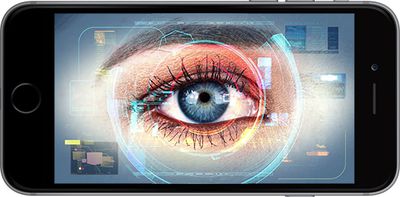
An iris scanner could complement or replace Touch ID as a way to verify a user's identity, enabling iPhone users to unlock their smartphone, make payments, and more by authenticating with their eyes. A person's iris, or the circular colored muscle of the eye, contains a complex and random pattern that is unique to each individual.
An iris scanner on a smartphone would not be unprecedented, as Samsung included one on the new Galaxy Note7 released earlier this month.
Taiwan-based supplier Xintec, an affiliate of Apple manufacturer TSMC, will begin mass production of iris-recognition chips in 2017, likely in an effort to secure orders from Apple and other smartphone vendors next year:
Xintec is expected to enter mass production for iris-recognition chips in 2017, which will boost the backend house's revenues for the year, the report cited market watchers as saying. New orders for iris-recognition sensors include those for the chips that will be embedded in the 2017 series of iPhone, the watchers were also quoted in the report.
Xintec said the company does not comment on rumors or speculation about specific products or customer orders.
Based on rumors, Apple's tenth-anniversary iPhone is shaping up to be a more significant upgrade compared to the iPhone 7 series expected at Apple's September 7 event. Other rumors surrounding the so-called iPhone 8 include a 5.8-inch curved OLED screen, glass casing, an embedded or completely removed home button, wireless charging, an enhanced Taptic Engine, and more.
Popular Stories
Apple today confirmed to Reuters that it has acquired Q.ai, an Israeli startup that is working on artificial intelligence technology for audio.

Apple paid close to $2 billion for Q.ai, according to sources cited by the Financial Times. That would make this Apple's second-biggest acquisition ever, after it paid $3 billion for the popular headphone and audio brand Beats in 2014.
Q.ai has...
Last year, Apple launched CarPlay Ultra, the long-awaited next-generation version of its CarPlay software system for vehicles. Nearly nine months later, CarPlay Ultra is still limited to Aston Martin's latest luxury vehicles, but that should change fairly soon.
In May 2025, Apple said many other vehicle brands planned to offer CarPlay Ultra, including Hyundai, Kia, and Genesis. At the time,...
Apple recently updated its online store with a new ordering process for Macs, including the MacBook Air, MacBook Pro, iMac, Mac mini, Mac Studio, and Mac Pro.
There used to be a handful of standard configurations available for each Mac, but now you must configure a Mac entirely from scratch on a feature-by-feature basis. In other words, ordering a new Mac now works much like ordering an...
Apple today introduced its first two physical products of 2026: a second-generation AirTag and the Black Unity Connection Braided Solo Loop for the Apple Watch.
Read our coverage of each announcement to learn more:Apple Unveils New AirTag With Longer Range, Louder Speaker, and More
Apple Introduces New Black Unity Apple Watch BandBoth the new AirTag and the Black Unity Connection Braided...
A newly surfaced resale operation is seemingly offering Apple Store–exclusive display accessories to the public for the first time, potentially giving consumers access to Apple-designed hardware that the company has historically kept confined to its retail environments.
Apple designs a range of premium MagSafe charging stands, display trays, and hardware systems exclusively for displays in ...