Safari in macOS Sierra Deactivates Flash and Other Plug-ins By Default
In Safari 10, set to ship with macOS Sierra, Apple plans to disable common plug-ins like Adobe Flash, Java, Silverlight, and QuickTime by default in an effort to focus on HTML5 content and improve the overall web browsing experience.
As explained by Apple developer Ricky Mondello in a post on the WebKit blog, when a website offers both Flash and HTML5 content, Safari will always deliver the more modern HTML5 implementation. On a website that requires a plug-in like Adobe Flash to function, users can activate it with a click as can be done in Google's Chrome browser.
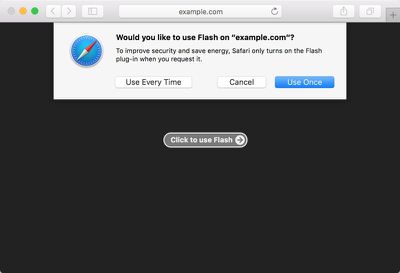
Most websites that detect that Flash isn't available, but don't have an HTML5 fallback, display a "Flash isn't installed" message with a link to download Flash from Adobe. If a user clicks on one of those links, Safari will inform them that the plug-in is already installed and offer to activate it just one time or every time the website is visited. The default option is to activate it only once. We have similar handling for the other common plug-ins.
When a website directly embeds a visible plug-in object, Safari instead presents a placeholder element with a "Click to use" button. When that's clicked, Safari offers the user the options of activating the plug-in just one time or every time the user visits that website. Here too, the default option is to activate the plug-in only once.
Safari 10 will also include a command to reload a page with installed plug-ins activated to give users additional options for controlling the content that's displayed, and there are preferences for choosing which plug-ins are visible to which websites in Safari's Security preferences.
Apple recommends web developers implement features using technologies built into Safari to avoid forcing users to activate plug-ins.
Plug-ins like Adobe Flash and Java have been problematic for Apple, requiring frequent security fixes and forced updates to patch an unending stream of vulnerabilities. Apple has long had a policy of blocking older versions of web plug-ins from functioning and its change in Safari 10 is another push towards fully retiring the older technology.

Popular Stories
Macworld's Filipe Espósito today revealed a handful of features that Apple is allegedly planning for iOS 26.4, iOS 27, and even iOS 28.
The report said the features are referenced within the code for a leaked internal build of iOS 26 that is not meant to be seen by the public. However, it appears that Espósito and/or his sources managed to gain access to it, providing us with a sneak peek...
The first foldable iPhone will feature a series of design and hardware firsts for Apple, according to details shared by the Weibo leaker known as Digital Chat Station.
According to a new post, via machine translation, Apple is developing what the leaker describes as a "wide foldable" device, a term used to refer to a horizontally oriented, book-style foldable with a large internal display....
Last week, details about unreleased Apple devices and future iOS features were shared by Macworld. This week, we learned where the information came from, plus we have more findings from the leak.
As it turns out, an Apple prototype device running an early build of iOS 26 was sold, and the person who bought it shared the software. The OS has a version number of 23A5234w, and the first...
Apple today released iOS 26.2, the second major update to the iOS 26 operating system that came out in September, iOS 26.2 comes a little over a month after iOS 26.1 launched. iOS 26.2 is compatible with the iPhone 11 series and later, as well as the second-generation iPhone SE.
The new software can be downloaded on eligible iPhones over-the-air by going to Settings >...
Apple seeded the second iOS 26.2 Release Candidate to developers earlier this week, meaning the update will be released to the general public very soon.
Apple confirmed iOS 26.2 would be released in December, but it did not provide a specific date. We expect the update to be released by early next week.
iOS 26.2 includes a handful of new features and changes on the iPhone, such as a new...
Software from an iPhone prototype running an early build of iOS 26 leaked last week, giving us a glimpse at future Apple devices and iOS features. We recapped device codenames in our prior article, and now we have a list of some of the most notable feature flags that were found in the software code.
In some cases, it's obvious what the feature flags are referring to, while some are more...
Apple today released macOS Tahoe 26.2, the second major update to the macOS Tahoe operating system that came out in September. macOS Tahoe 26.2 comes five weeks after Apple released macOS Tahoe 26.1.
Mac users can download the macOS Tahoe update by using the Software Update section of System Settings.
macOS Tahoe 26.2 includes Edge Light, a feature that illuminates your face with soft...
Apple today released new firmware designed for the AirPods Pro 3 and the prior-generation AirPods Pro 2. The AirPods Pro 3 firmware is 8B30, up from 8B25, while the AirPods Pro 2 firmware is 8B28, up from 8B21.
There's no word on what's include in the updated firmware, but the AirPods Pro 2 and AirPods Pro 3 are getting expanded support for Live Translation in the European Union in iOS...