In a new study performed by InfoScout, nearly half as many possible Apple Pay customers used the mobile payments system on Black Friday in 2015 as they did in 2014 on the same sales-laden holiday (via Quartz). The study polled a total of 300,000 people to gather the information, discerning the time around March 2015 as Apple Pay's peak, with another understandable resurgence in the fall surrounding the launch of the iPhone 6s and iPhone 6s Plus.
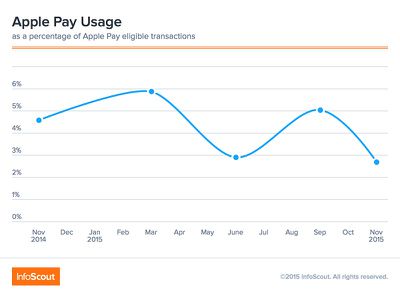
The research organization found that Apple Pay was used for only 2.7 percent of total possible Apple Pay-eligible transactions on Black Friday this year. This is opposed to 2014, where new iPhone 6 and 6 Plus customers used Apple Pay in 4.9 percent of eligible transactions. As InfoScout points out, simple early adopter curiosity -- Apple Pay was barely a month old at the time -- could have helped in the service's early-on surge in numbers.
InfoScout's survey didn't track in-app payments made on Black Friday through Apple Pay, however, so customers who shopped on mobile devices in apps like Target and Best Buy were not included in the results. 300,000 participants is a large sample size, but given the popularity of mobile and online shopping, there's a good possibility that a large swath of Apple Pay's numbers were subsequently excluded from the poll.
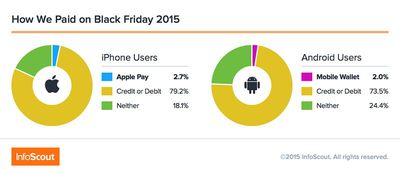
Despite the tepid usage of Apple Pay on Black Friday this year as reported by the survey, Apple has been in full force behind the year-old service. With its launch in new countries like Canada and Australia, the company has continued to educate its customers on Apple Pay's various features with new guided tour videos. Other stores have launched loyalty rewards support and the service is available at more places than ever thanks to Square's $49 NFC and Chip reader.

Bloomberg's Mark Gurman has high expectations for Apple's first foldable iPhone.
In his Power On newsletter today, he said the foldable iPhone will be "the most significant overhaul in the iPhone's history."
"iPhone 4, iPhone 6 and iPhone X were clearly a big deal, but this is a whole new design," he said.
Like Samsung's Galaxy Z Fold 7, the foldable iPhone will reportedly open up like ...
March has been an incredibly busy month for Apple, with the company unveiling more than 10 new products and accessories. We said hello to the MacBook Neo at the start of the month, and we bid farewell to the Mac Pro at the end of it.
Nevertheless, there is still a lot more to come this year.
Beyond the usual annual updates to iPhones and Apple Watches, Apple's all-new smart home hub is...
Saturday March 28, 2026 8:00 am PDT by Joe Rossignol
Apple is expected to release two new iPhone apps this year, including an Apple Business app and a Siri app with chatbot-like functionality.
With the Apple Business app, employees at businesses using the new Apple Business platform will be able to install apps for work, view contact information for colleagues, and request support. Apple Business is launching on April 14, and it replaces Apple ...
Bloomberg's Mark Gurman has high expectations for Apple's first foldable iPhone.
In his Power On newsletter today, he said the foldable iPhone will be "the most significant overhaul in the iPhone's history."
"iPhone 4, iPhone 6 and iPhone X were clearly a big deal, but this is a whole new design," he said.
Like Samsung's Galaxy Z Fold 7, the foldable iPhone will reportedly open up like ...
March has been an incredibly busy month for Apple, with the company unveiling more than 10 new products and accessories. We said hello to the MacBook Neo at the start of the month, and we bid farewell to the Mac Pro at the end of it.
Nevertheless, there is still a lot more to come this year.
Beyond the usual annual updates to iPhones and Apple Watches, Apple's all-new smart home hub is...
Saturday March 28, 2026 8:00 am PDT by Joe Rossignol
Apple is expected to release two new iPhone apps this year, including an Apple Business app and a Siri app with chatbot-like functionality.
With the Apple Business app, employees at businesses using the new Apple Business platform will be able to install apps for work, view contact information for colleagues, and request support. Apple Business is launching on April 14, and it replaces Apple ...
Well, here is the thing with this survey. November 2014, the iPhone 6/6+ were the only devices with it, and it was only a month old (3 months for the phone). Today, there are 14 months worth of iPhone 6/6+ sales, Apple Watches, and iPhone 6s/6s+ sales. In other words, a larger pool of "eligible" transactions.
What are the raw numbers? How many transactions? Did it go from 100,000 to 1 million, but represent a decline % wise? And what defines an "Apple Pay" eligible transaction? Every transaction made at Apple Pay accepting stores, regardless if the customer has an Apple Pay ready device?
Lots of questions, very light on the facts, and the facts provided tell us almost nothing.
It's beyond frustrating because I can never remember which stores take it and which don't.
All these places have the NFC readers but only like 10% take Apple Pay. Even places like Best Buy, not all of their stores take it.
Bad job by Apple not getting this out to more customers. Why hasn't Starbucks signed up? Why haven't any grocery stores signed up?
I've only used it at BB, GameStop, McDs, and Panera Bread.
There's a pizza place that has Apple stickers everywhere saying they take it, but they don't have an NFC card reader. How is that possible? How can I report this to Apple?
I am sure that it is the retailers. Here in the States, effective 10/1, the retailers are now responsible for fraud if they don't support the "chip and pin" technology. I would say that 50% of the places I go? Still don't have terminals that accept the chip.
Of those that do? Their units largely also support NFC payments. But....
...not only do they have NFC turned off, they have tape and post-it notes covering the spot to insert your chip card. It's beyond ridiculous, but retailers, much like government agencies (schools, etc), are horrible at implementing technology, and often too cheap to hire the right people to do so.
I am sure that it is the retailers. Here in the States, effective 10/1, the retailers are now responsible for fraud if they don't support the "chip and pin" technology. I would say that 50% of the places I go? Still don't have terminals that accept the chip.
Of those that do? Their units largely also support NFC payments. But....
...not only do they have NFC turned off, they have tape and post-it notes covering the spot to insert your chip card. It's beyond ridiculous, but retailers, much like government agencies (schools, etc), are horrible at implementing technology, and often too cheap to hire the right people to do so.
Chip and pin would be nice but that is in Europe. We have chip and sign which is only more secure in the transmission. Its no more secure at the store level and its slower.
For some reason I envisioned that when October 2015 hit it would be like a switch was flipped, and all of these retailers would have updated terminals with NFC and chip support. Since October I've found very few additional retailers who support NFC unfortunately. Whenever it's available, I always use Apple Pay. Primarily for the security, but also because of the great offer from Discover (10% cash back through the end of 2015 and double cash back rewards for the first year of membership).
Well, here is the thing with this survey. November 2014, the iPhone 6/6+ were the only devices with it, and it was only a month old (3 months for the phone). Today, there are 14 months worth of iPhone 6/6+ sales, Apple Watches, and iPhone 6s/6s+ sales. In other words, a larger pool of "eligible" transactions.
What are the raw numbers? How many transactions? Did it go from 100,000 to 1 million, but represent a decline % wise? And what defines an "Apple Pay" eligible transaction? Every transaction made at Apple Pay accepting stores, regardless if the customer has an Apple Pay ready device?
Lots of questions, very light on the facts, and the facts provided tell us almost nothing.
Exhibit 23955739 of Statistics can say anything you want. Despite the wavy line, I imagine the total purchases is more like a hockey stick upwards.
I use it wherever I can. There are loads of UK retailers supporting Apple Pay but most are still restricted by the £30 limit which means it's not an option for a lot of my shopping.