EU Inquiry Finds No Evidence Apple Colluded With Record Labels to End Freemium Music
The European Commission has failed to find evidence that Apple conspired with record labels to put a stop to free music streaming services, reports Re/code, citing sources with knowledge of the investigation.
The European Commission spoke with multiple digital music services and record labels, but was not able to find evidence of illegal activity, putting an end to the probe. Investigators' "files will remain open," however, as Spotify continues with licensing talks with major labels.
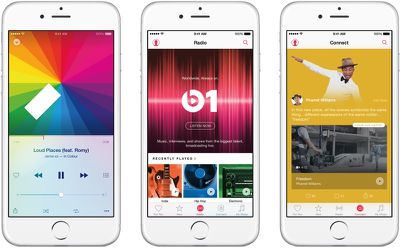
European regulators began scrutinizing Apple's discussions with record labels in April, over concerns Apple would use its influence to persuade music companies to put an end to free ad-supported music services such as Spotify. Apple Music, unlike Spotify, does not offer a free listening tier.
Rumors later suggested Apple was indeed leveraging its power in the music industry to push record labels to stop offering licensing options for freemium music tiers, leading to investigations by the U.S. Department of Justice and the Federal Trade Commission, both of which are ongoing.
According to Re/code's sources, while the European Commission has found no evidence of collusion between Apple and record labels, it has also launched a separate investigation into Apple's App Store policies concerning competing music services.
Separately, the EU has asked Spotify and other music streaming services for information pertaining to Apple's mobile App Store, according to people with knowledge of the situation. Regulators are seeking information on the restrictions Apple places on apps offered through the store.
Apple's App Store policies are also currently being looked at by the U.S. Federal Trade Commission, due to the 30 percent fee the company collects on app and subscription revenue. The FTC is concerned that Apple's fee and its policies, such as a ban on links to outside stores, are illegal under antitrust law.
Popular Stories
Apple today confirmed to Reuters that it has acquired Q.ai, an Israeli startup that is working on artificial intelligence technology for audio.

Apple paid close to $2 billion for Q.ai, according to sources cited by the Financial Times. That would make this Apple's second-biggest acquisition ever, after it paid $3 billion for the popular headphone and audio brand Beats in 2014.
Q.ai has...
Last year, Apple launched CarPlay Ultra, the long-awaited next-generation version of its CarPlay software system for vehicles. Nearly nine months later, CarPlay Ultra is still limited to Aston Martin's latest luxury vehicles, but that should change fairly soon.
In May 2025, Apple said many other vehicle brands planned to offer CarPlay Ultra, including Hyundai, Kia, and Genesis.
In his Powe...
Apple recently updated its online store with a new ordering process for Macs, including the MacBook Air, MacBook Pro, iMac, Mac mini, Mac Studio, and Mac Pro.
There used to be a handful of standard configurations available for each Mac, but now you must configure a Mac entirely from scratch on a feature-by-feature basis. In other words, ordering a new Mac now works much like ordering an...
The calendar has turned to February, and a new report indicates that Apple's next product launch is "imminent," in the form of new MacBook Pro models.
"All signs point to an imminent launch of next-generation MacBook Pros that retain the current form factor but deliver faster chips," Bloomberg's Mark Gurman said on Sunday. "I'm told the new models — code-named J714 and J716 — are slated...
Apple is planning to launch new MacBook Pro models with M5 Pro and M5 Max chips alongside macOS 26.3, according to Bloomberg's Mark Gurman.
"Apple's faster MacBook Pros are planned for the macOS 26.3 release cycle," wrote Gurman, in his Power On newsletter today.
"I'm told the new models — code-named J714 and J716 — are slated for the macOS 26.3 software cycle, which runs from...