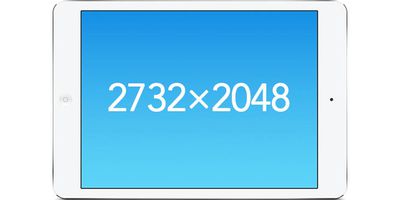
Taiwanese iOS developer Hiraku Wang has shared further iOS 9 beta code (via Steven Troughton-Smith) that suggests the 12.9-inch "iPad Pro" could have a 2,732×2,048 pixels display at 264 PPI based on Apple's @2x high-resolution modifier. The findings corroborate a DisplaySearch report from last January, in which the research firm said that Apple had a tablet display with a resolution of 2,732×2,048 pixels and 265 PPI under development.
Apple's existing lineup of iPads with Retina displays, ranging from the third-generation iPad to iPad Air 2, each have 9.7-inch screens at 264 PPI, so it would make sense that the larger 12.9-inch "iPad Pro" would have a scaled up resolution with the same pixel density. Specifically, a 2,732×2,048 display with 264 PPI points towards an approximately 12.93" diagonal screen size. As a @2x display, this would represent 1,366x1,024 points as shown in the onscreen dimensions for the keyboard.
Earlier today, iOS developer Steven Troughton-Smith discovered that the new iPad keyboard on iOS 9 beta is capable of scaling to a larger size with rearranged keys, providing further evidence that Apple could be planning to release the much-rumored 12.9-inch "iPad Pro" in the future. The A9-based tablet is rumored to feature a flexible display with increased pressure sensitivity, built-in NFC chip, Force Touch, USB-C port and possibly a pressure-sensitive Bluetooth stylus.
Apple's next entry-level iPad models, codenamed J581 and J582, will not arrive until early 2027, according to Bloomberg's Mark Gurman.
He added that Apple plans a major iPad Air refresh to add an OLED display and a new iPad Pro in 2027. The latter could gain a vapor chamber to improve thermals and performance. A new iPad mini is still expected to arrive at the end of October this...
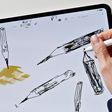
The iPad is set to gain significantly narrower borders around its display, according to the leaker known as "Instant Digital" on Weibo. The post gives no model or timeline; it could refer to the entry-level iPad or to Apple's tablet lineup in general.
Refreshes of the entry-level iPad, iPad mini, iPad Air, and iPad Pro are in the pipeline. The next iPad mini is already rumored to gain OLED and ...
Monday October 19, 2026 9:37 am PDT by Joe Rossignol
Apple today sent out invites for an experience in Los Angeles on Wednesday, October 28, and the "Pro and tell" tagline on the invitation likely means that the rumored MacBook models with touch-enabled OLED displays will stick with MacBook Pro branding instead of the once-rumored "MacBook Ultra" name.
The long-rumored "iPhone Ultra" ended up being named iPhone Duo, so speculation that Apple...
Still at a loss as why Apple needs iPad Pro. I mean the tablet market in general has declined and what "professionals" are preferring today are hybrid devices like Surface Pro and detachable laptop touch screens. Not sure Apple truly understands that a tablet only with "casual" business applications may not be enough to kick start iPad sales again. I think Apple discriminating against hybrid devices is another poor decision that will come back to haunt them when their customer base demands an Mac Air hybrid with removable touch screen.
Apple seems to think professionals just want a bigger tablet screen, but professionals want to run REAL applications on a device that isn't based on a phone processor that can also double as a tablet when the need arises. Professionals don't want a backpack full of devices to choose from.
In this respect Microsoft was way more forward thinking then Apple. Merging their kernels into one universal OS will clearly cater to more products that professionals want, while Apple continues to fragment their OS for a bunch of add-on devices.
For all intents and purposes, the device doesn't exist. So, what's the point of worrying about what Apple's thinking here? Let Apple explain the purpose when it is out.
Oh by the way, iOS, OS X and watchOS all share the same kernel just like Microsoft. Don't confuse the top levels of the OS as the kernel.
Still at a loss as why Apple needs iPad Pro. I mean the tablet market in general has declined and what "professionals" are preferring today are hybrid devices like Surface Pro and detachable laptop touch screens. Not sure Apple truly understands that a tablet only with "casual" business applications may not be enough to kick start iPad sales again. I think Apple discriminating against hybrid devices is another poor decision that will come back to haunt them when their customer base demands an Mac Air hybrid with removable touch screen.
Apple seems to think professionals just want a bigger tablet screen, but professionals want to run REAL applications on a device that isn't based on a phone processor that can also double as a tablet when the need arises. Professionals don't want a backpack full of devices to choose from.
In this respect Microsoft was way more forward thinking then Apple. Merging their kernels into one universal OS will clearly cater to more products that professionals want, while Apple continues to fragment their OS for a bunch of add-on devices.
You're making some broad generalizations here. What "professionals" are you referring to? It's not like the surface Pro has been lighting the world on fire in terms of sales. And iPad is still huge in enterprise.
Why is the iPad Pro rumored to include an NFC chip? Using an iPad Pro for Apple Pay would be even more cumbersome than the smaller iPad sizes. If this rumor is true, hopefully it means Apple is planning to allow developers to access the NFC chip!
You could potentially accept payments from a phone on the iPad, making it a great point-of-sale system.
Blew the chance to go 16:9. More like iPhone, 11"Air and iMac, please. I wanted the MacBook for the retina screen, but 16:10 is such a "wrong" aspect ratio for me.
4:3 / 3:4 is a much more sensible aspect ratio for a tablet as it's designed for portait (closer to documents) and landscape. 16:9 is ok for a landscape only device... Even Microsoft recognized 16:9 was a bad idea and went some of the opposite way with the 3:2 Surface Pro 3. A long skinny tablet just seems wrong for every type of content except movies.
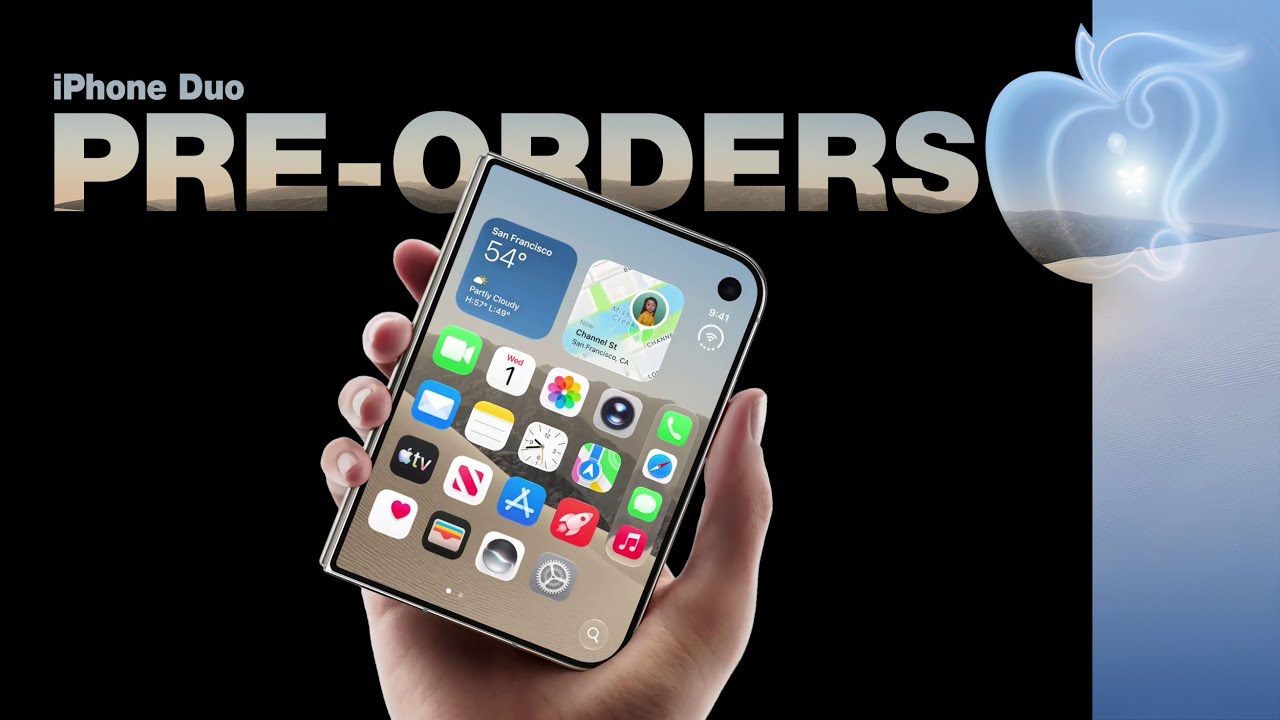
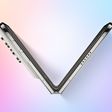
Apple's first foldable iPhone, with a book-style design featuring a 5.4-inch outer display and a 7.6-inch inner display with a minimal crease down the middle.