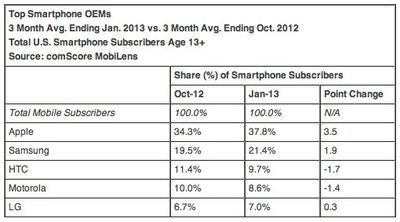
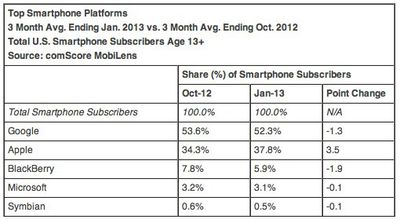
comScore today released the results of its monthly rolling survey of U.S. mobile phone users for the November-January period, finding that Apple's smartphone marketshare rose 3.5 percentage points between October and January, up to 37.8% of both U.S. smartphone platform and hardware sales.
Samsung was second in hardware makers with 21.4%, up from 19.5% three months earlier. HTC and Motorola both experienced significant drops in market share, while LG gained slightly.
Google's Android was the largest smartphone platform with 52.3% of smartphone platform share, down from 53.6% three months ago. Android, BlackBerry, Microsoft and Symbian all lost share, to the benefit of Apple. As a result, Apple and Google control more than 87 percent of the smartphone market.
Notably, comScore's data tracks installed user base rather than new handset sales, making it more reflective of real-world usage but slower to respond to shifting market trends than some other studies.
Sunday September 13, 2026 3:00 am PDT by Eric Slivka
Update 10:04 a.m.: iOS 27 is rolling out now, though it may take a bit for all users to see it, so keep checking!
Apple is about to release iOS 27, which will finally deliver more advanced Siri AI capabilities as well as a variety of other refinements, improvements, and new features to iPhones. It's Apple's biggest software update of the year, and Apple announced at Wednesday's iPhone event...
Monday September 14, 2026 9:00 am PDT by Joe Rossignol
Update — 10 a.m. Pacific Time: Apple has released iOS 27.
During its iPhone 18 Pro and iPhone Duo event last week, Apple announced that iOS 27 will be released widely on Monday, September 14.
iOS 27 should be available around 10 a.m. Pacific Time / 1 p.m. Eastern Time today via the Settings app, under General → Software Update.
Below, we have highlighted eight new features and...
Tuesday September 15, 2026 1:43 am PDT by Tim Hardwick
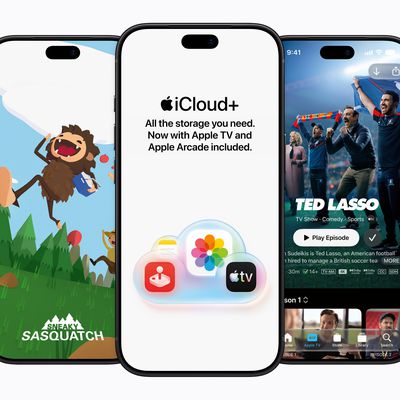
Apple today announced a new subscription initiative that turns paid iCloud+ subscriptions into a broader services bundle in more than 100 countries.
In select countries, Apple says every paid iCloud+ plan, including the cheapest 50GB tier, now includes Apple TV and Apple Arcade "at no additional cost," while family sharing extends the storage, TV and Arcade access to up to five people....
I really don't think it's right to call android the largest "smartphone platform", because:
1. Really its "mobile platform" and when you look at the post-PC era, tablets, namely the iPad Market is a big chunk of mobil devices, and when you include these numbers- the iPad has really dominant share making iOS the dominant platform. Looking just at "smartphones" is selective reporting to try and exclude the market where Apple has had the most success, skewing the numbers in favor of android.
2. Android is hugely fragmented. iOS devices are mostly all running the latest iOS software and even ones that aren't can all run apps without modification. This is not true on android where covering %80 of the market requires changing your app to support 167!!! different devices.
3. I don't consider android to really be a platform, simply because it is so compromised. As a ripoff of iOS they had to rush it to market and in doing so compromised a lot of functionality.
4. Android is primarily sold to feature phone buyers as if it were a featurephone. These people walk in to get "a phone" and get sold android by the weenies at the carriers store... but they don't use them for apps or for even browsing the web, which is why the web stats on android are so pitiful. Android is really a feature phone operating system (hence the fragmentation and incompatibility)
5. You'd be just as correct to lump all the other Linux derivatives together and claim that there's a "linux smartphone platform".
6. We don't have real hard numbers for shipping devices for android. Amazon doesn't publish actual numbers. Google doesn't publish actual numbers. Samsung doesn't publish actual numbers. There's a lot of hype and BS claims that these devices are selling in huge numbers, but when samsung was forced to report actual sales in the lawsuit last year, it turns out that when journalists were claiming big sales the reality was pitiful. Most of these "sales" are actually non-android featurephones also sold by these companies who don't break them out because they want to seem more dominant than they are.
Get me real numbers reported in annual or quarterly reports that would result in an investigation by the SEC and charges of fraud if they were made up-- and use those.
Apple provides them. Until android manufacturers are willing to report the numbers under penalty of perjury like Apple does, they're just PR smoke, nothing more. (or analysts "projections")
These stats are being distorted by the propaganda of android fans who claim that it is a platform, and a smartphone platform at that and that it is dominant
Considering that there are only 6 iPhone models and at least 1000 Android phones I wouldn't say that 37.8% (iOS) to 52.3% (Android) is too bad of a margin
People use iPhones more because they last longer. It's not built from really poor quality plastic (ala Samsung). It's got software updates for at least twice or thrice as long as Android based devices (exception are Nexus devices). And let's not forget there are better quality apps on iOS in general. Oh and iOS is easier to use and the interface is consistent across multiple devices, multiple versions of the OS.
BTW - "rushed to market" ? Yeah - maybe MAYBE OS1.0 - but now? Not so much. ICS and JB weren't "rushed" no matter how much you really want to say it.
What functionality has been compromised in Android. Name some.
Your rationalization is hilarious.
Lastly - why so defensive and dismissive? Someone at Google kidnap a loved one?
I really don't think it's right to call android the largest "smartphone platform", because:
1. Really its "mobile platform" and when you look at the post-PC era, tablets, namely the iPad Market is a big chunk of mobil devices, and when you include these numbers- the iPad has really dominant share making iOS the dominant platform. Looking just at "smartphones" is selective reporting to try and exclude the market where Apple has had the most success, skewing the numbers in favor of android.
2. Android is hugely fragmented. iOS devices are mostly all running the latest iOS software and even ones that aren't can all run apps without modification. This is not true on android where covering %80 of the market requires changing your app to support 167!!! different devices.
3. I don't consider android to really be a platform, simply because it is so compromised. As a ripoff of iOS they had to rush it to market and in doing so compromised a lot of functionality.
4. Android is primarily sold to feature phone buyers as if it were a featurephone. These people walk in to get "a phone" and get sold android by the weenies at the carriers store... but they don't use them for apps or for even browsing the web, which is why the web stats on android are so pitiful. Android is really a feature phone operating system (hence the fragmentation and incompatibility)
5. You'd be just as correct to lump all the other Linux derivatives together and claim that there's a "linux smartphone platform".
6. We don't have real hard numbers for shipping devices for android. Amazon doesn't publish actual numbers. Google doesn't publish actual numbers. Samsung doesn't publish actual numbers. There's a lot of hype and BS claims that these devices are selling in huge numbers, but when samsung was forced to report actual sales in the lawsuit last year, it turns out that when journalists were claiming big sales the reality was pitiful. Most of these "sales" are actually non-android featurephones also sold by these companies who don't break them out because they want to seem more dominant than they are.
Get me real numbers reported in annual or quarterly reports that would result in an investigation by the SEC and charges of fraud if they were made up-- and use those.
Apple provides them. Until android manufacturers are willing to report the numbers under penalty of perjury like Apple does, they're just PR smoke, nothing more. (or analysts "projections")
These stats are being distorted by the propaganda of android fans who claim that it is a platform, and a smartphone platform at that and that it is dominant