Skip to Content

iTunes 10.5 Beta is 64-bit, and... Cocoa?

The beta version of iTunes 10.5 released to developers last week is the first version of iTunes to run in 64-bit mode. The distinction is perhaps a bit minor for an app like iTunes, but has been the source of much discussion over the years. What's perhaps of more significance is the belief that this 64-bit support must mean that iTunes has been ported from Carbon to Cocoa, though that line seems to be rather blurred.

The primary advantage afforded 64-bit applications is the ability to address more than 4GB of memory which can be a distinct advantage for applications which use large data sets. Adobe, for example, received some criticism in 2008 that their Photoshop products were slow to adopt 64-bit mode on the Mac. 64-bit Photoshop for Mac ultimately arrived with CS5.

The reason for the long delay was the fact that Apple dropped support for 64-bit mode in Carbon back in 2007, requiring developers to port their existing Carbon applications to Cocoa in order to take advantage of 64-bit mode. This primarily affected older applications such as Photoshop and iTunes which had existed prior to Mac OS X and were still using Carbon, Apple's legacy API. Meanwhile, Cocoa was Apple's native API for Mac OS X and offered some additional user interface advantages. For better or worse, many users saw Cocoa applications as superior to their Carbon counterparts due to historic baggage of many of the Carbon applications.
itunes 10 5
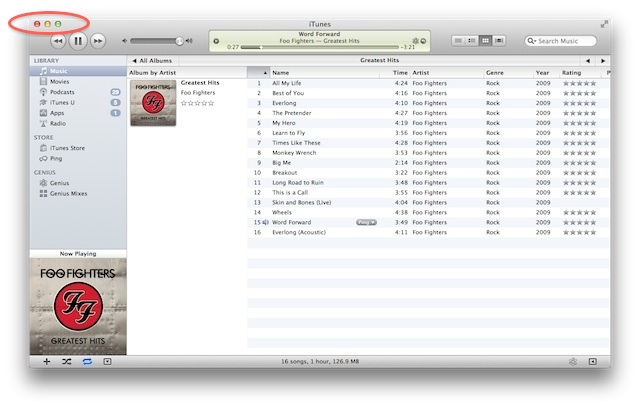
The latest iTunes 10.5 developer beta does run in 64-bit mode in Mac OS X Lion, but still runs in 32-bit mode in previous versions of Mac OS X. Discussions in the forum, however, point out that there is still some debate about the "Cocoa vs Carbon" status. Despite the changeup, iTunes reportedly feels very similar to the previous versions, and doesn't come with dramatic changes. So those hoping for a complete revamp will be disappointed.

A couple of notable changes, however, include the fact that iTunes for Lion now supports Full Screen Mode and also returns the close/minimize/maximize buttons to their usual horizontal location.

Popular Stories

MacBook Neo Feature Pastel 1

First MacBook Neo Benchmarks Are In: Here's How It Compares to the M1 MacBook Air

Thursday March 5, 2026 4:07 pm PST by
Benchmarks for the new MacBook Neo surfaced today, and unsurprisingly, CPU performance is almost identical to the iPhone 16 Pro. The MacBook Neo uses the same 6-core A18 Pro chip that was first introduced in the iPhone 16 Pro, but it has one fewer GPU core. The MacBook Neo earned a single-core score of 3461 and a multi-core score of 8668, along with a Metal score of 31286. Here's how the...
HomePod mini and Apple TV Sage

New Apple TV and HomePod Mini Are Still Missing, Here's Why

Thursday March 5, 2026 6:11 am PST by
Apple this week unveiled seven products, ranging from the iPhone 17e to the MacBook Neo, but new Apple TV and HomePod mini models were not among them. Given that there have been rumors about the next-generation Apple TV and HomePod mini since all the way back in late 2024, some customers are wondering why the devices have yet to launch, and the answer likely relates to Siri. In September, ...
MacBook Neo Feature Pastel 1

Apple Announces $599 'MacBook Neo' With A18 Pro Chip

Wednesday March 4, 2026 6:15 am PST by
Apple today announced the "MacBook Neo," an all-new kind of low-cost Mac featuring the A18 Pro chip for $599. The MacBook Neo is the first Mac to be powered by an iPhone chip; the A18 Pro debuted in 2024's iPhone 16 Pro models. Apple says it is up to 50% faster for everyday tasks than the bestselling PC with the latest shipping Intel Core Ultra 5, up to 3x faster for on-device AI workloads,...

Top Rated Comments

iindigo Avatar
192 months ago
I didn't realize that switching to Cocoa resulted in a palpable difference in an Application's UI :p
Actually, it does. If you go back to Xcode 3.2, open Interface Builder, and create a Carbon application window, the set of widgets it gives you to work with is largely different than when creating a Cocoa window. Also, the way the system draws windows is different between Cocoa and Carbon - for instance, Cocoa stretches the titlebar's gradient across the width of the titlebar while Carbon tiles it.

And of course, features that we've taken for granted in Cocoa applications are not present in Carbon counterparts - at least without extra effort on the developer's part. These things include spell checking, grammar checking, the Command-Ctrl-D dictionary popup among several other things.

Also, while it's not true in all cases, many carbon applications have ancient codebases with years of code fragments and bloat scattered throughout, sometimes leading to a more "clunky" experience for the user.
Score: 10 Votes (Like | Disagree)
cmaier Avatar
192 months ago
I know this is only a beta, but I'm going to say this flat out: iTunes 10.5 is crap. Full screen mode is glitchy. Traffic lights don't perform properly when iTunes is behind another application (no scroll over effect). Not all of the scroll bars have that "rubber band/springy" effect. And, a host of other minor issues. Basically, it feels subpar for a native application.

Not only is it a beta, but it's a beta designed only for developers to test their stuff. Chill.
Score: 8 Votes (Like | Disagree)
192 months ago
And you are either in breach of an NDA or using a pirated application.

Who the hell cares. You're on a website whose purpose is to post news about people leaking information.
Score: 6 Votes (Like | Disagree)
192 months ago
iTunes 10.5

Whether or not iTunes 10.5 is Cocoa depends on your definition, but let's check instead of speculating. It's easy to attach a debugger (returning from ptrace calls to avoid NOATTACH) and inject F-Script Anywhere. Using FSA, you can navigate the view hierarchy.

It turns out that iTunes 10.5 is Cocoa in that it uses AppKit windows containing views. The toolbar in Preferences is even an NSToolbar, and after enabling customization using FSA, you can even move the items around! Views in the main window seem to be NSView wrappers ("ITBackingHostView") for something implemented in C++ ("ITView"), presumably to be able to share code with Windows (for which I guess they use another wrapper).

So yes, it is Cocoa. Partially wrapping non-native controls.
Score: 5 Votes (Like | Disagree)
192 months ago
iTunes 10.5 is not Cocoa... or at least not fully Cocoa. Cocoa apps are dock aware; meaning when you pull their window title bar below the dock and let go it will move the window title above the dock. iTunes 10.5 does not exhibit this behavior.
Score: 5 Votes (Like | Disagree)
deannnnn Avatar
192 months ago
I'm just happy the traffic lights are back in the correct orientation.
Score: 4 Votes (Like | Disagree)