Nehalem Mac Pros Arrive: Unboxing and Benchmarks
MacRumors forum user
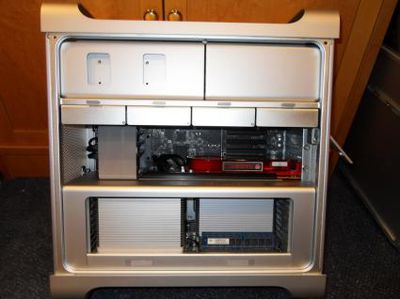
WonderSausage received his 2009 Nehalem Mac Pro yesterday. The system was configured as a Dual 2.93GHz Quad-Core system with 6GB of RAM and an ATI Radeon HD 4870 card. Additional high quality photos
posted to Flickr with
commentary in the discussion thread.
The early GeekBench benchmark for the Nehalem system gave a whopping total score of 17,665, placing it at the very top of the list of all GeekBench 2 scores. The previous #1 placeholder was a Sun Microsystems Sun Fire X4450. This also eclipses the results of the previous top-of-the-line 3.2GHz 8-core Mac Pro which delivers a score as high as 11,030 but with many results in the 9,000 range. As expected, the largest gains in the new systems revolved around multi-threaded functions and memory performance. To give some more perspective on this value, see GeekBench's cumulative table of all Mac performance benchmarks as of January 2009.
Meanwhile, another reader was able to benchmark his Nehalem 2.26GHz Mac Pro which resulted in a Geekbench score of 11226-13113. Again the Nehalem processors excelled at multi-threaded tasks but the raw clock speed of the 2.26GHz processor was slower than the 3.2GHz processor at single-threaded tasks.
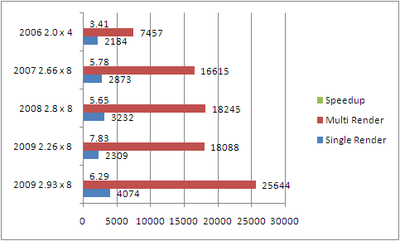
This same observation was also seen in Cinebench benchmarks compiled by Tesselator and charted by PowerPaw:
In this example, the new 2.26GHz 8-core Nehalem performed comparably to previous 2.8GHz 8-core processor in multi-threaded tasks, but worse at single threaded tasks. Meanwhile, the multi-core performance of the new 2.93GHz processor significantly outpaced the previous generation machines.
As a result, depending on your work flow (multi-threaded vs single-threaded), it may make more sense to buy a faster Quad-Core than a slower Octo-Core. While some are hoping that Apple's push for multi-threaded support in Snow Leopard may change this equation, developer support and the eventual impact of Grand Central remain unknown.
Popular Stories
Apple today confirmed to Reuters that it has acquired Q.ai, an Israeli startup that is working on artificial intelligence technology for audio.
Apple paid close to $2 billion for Q.ai, according to sources cited by the Financial Times. That would make this Apple's second-biggest acquisition ever, after it paid $3 billion for the popular headphone and audio brand Beats in 2014.
Q.ai has...
Apple recently updated its online store with a new ordering process for Macs, including the MacBook Air, MacBook Pro, iMac, Mac mini, Mac Studio, and Mac Pro.
There used to be a handful of standard configurations available for each Mac, but now you must configure a Mac entirely from scratch on a feature-by-feature basis. In other words, ordering a new Mac now works much like ordering an...
A newly surfaced resale operation is seemingly offering Apple Store–exclusive display accessories to the public for the first time, potentially giving consumers access to Apple-designed hardware that the company has historically kept confined to its retail environments.
Apple designs a range of premium MagSafe charging stands, display trays, and hardware systems exclusively for displays in ...
Update: Apple Creator Studio is now available.
Apple Creator Studio launches this Wednesday, January 28. The all-in-one subscription provides access to the Final Cut Pro, Logic Pro, Pixelmator Pro, Motion, Compressor, and MainStage apps, with U.S. pricing set at $12.99 per month or $129 per year.
A subscription to Apple Creator Studio also unlocks "intelligent features" and "premium...
Apple today introduced its first two physical products of 2026: a second-generation AirTag and the Black Unity Connection Braided Solo Loop for the Apple Watch.
Read our coverage of each announcement to learn more:Apple Unveils New AirTag With Longer Range, Louder Speaker, and More
Apple Introduces New Black Unity Apple Watch BandBoth the new AirTag and the Black Unity Connection Braided...