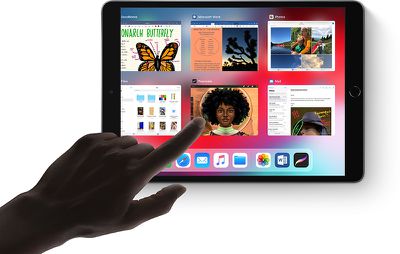
Amazon has kicked off the week with new low prices on Apple's iPad Pro models from 2018, discounting the tablets by as much as $200 off their original prices. Models on sale include the Wi-Fi only versions of the 11-inch and 12.9-inch iPad Pro.
Note: MacRumors is an affiliate partner with these vendors. When you click a link and make a purchase, we may receive a small payment, which helps us keep the site running.
These iPad Pros were updated in 2018 with an edge-to-edge display, Face ID, Apple Pencil 2 support, up to 1TB of storage, an A12X processor, and more. Amazon's sales today represent the lowest price available for each model, and in a few cases Best Buy provides a better discount.
Apple customers who ordered new AirPods last week on the same day they were announced have been receiving shipping notifications over the weekend with delivery dates beginning Tuesday, March 26.
People who ordered the second-generation AirPods on Wednesday as soon as they appeared on Apple's online store were quoted delivery dates between March 26-28. Looking at the AirPods order status thread on the MacRumors forums, some customers in the US are saying they have subsequently been given March 27 as a confirmed ship date, but this seems to depend on which courier they've been assigned.
There are a few scattered reports in the UK of customers receiving Monday delivery dates from some couriers, which means their AirPods could potentially arrive before Apple's "It's Showtime" event, scheduled to take place later today at 10:00 a.m. Pacific Time (or 5.00 p.m. Greenwich Mean Time) at the Steve Jobs Theater in Apple Park, Cupertino, California.
However, given that the new AirPods require OS versions that Apple has yet to publicly release, they probably won't be able to use all the new features until later in the day. The second-generation AirPods require iOS 12.2, watchOS 5.2, and macOS Mojave 10.14.4, and Apple is expected to release these updates during or shortly after its services-focused keynote.
Apple's new second-generation AirPods don't have any of the exciting new features that were rumored like a new black color and health updates, but they're a solid upgrade over the previous version.
There's a new H1 wireless chip inside that powers hands-free "Hey Siri" functionality so you don't need to tap to access the voice assistant. The AirPods are also able to switch between devices two times faster when playing music, and there's an extra hour of talk time, bringing total talk time to three hours.
The new Wireless Charging Case allows the AirPods to charge using Qi-based wireless charging accessories, and it perhaps heralds the upcoming launch of the AirPower.
As of today, AirPods shipping time on Apple's online store is listed as 3-5 business days, with a 7-10 day wait for AirPods with Wireless Charging Case. Apple will likely have some stock of the new AirPods models in its retail stores later this week for those who were unable to order and receive a March delivery date.
We've been watching the stream at a glance for around six hours now, over which time we've seen everything from people cleaning the stage to a video of a dancer to an incoming iPhone call from Captain America actor Chris Evans. Marvel fans will be disappointed to hear that Apple missed the call.
Update: NBA star Kevin Durant may be at the Apple Event tomorrow based on the latest teaser of an iMessage conversation with Tim Cook. Apple is working on an original series about Durant's early life for its streaming video service.
Steve Jobs Theater live stream fun continues…@tim_cook: So you're at Apple Park?@KDTrey5: Yeah.
Kevin Durant at the Apple Event tomorrow? Apple ordered a TV series about the NBA star's early life for its streaming video service. pic.twitter.com/ihUB120DFA
— MacRumors.com (@MacRumors) March 24, 2019
As we've heard previously, the report claims Apple plans to unveil the first footage from some of its new original TV shows at the event. Hollywood stars such as actress Reese Witherspoon and director J.J. Abrams have been invited to attend.
The report claims Apple plans to charge a fee for its original content, despite some sources previously saying it would be free to Apple device owners.
Apple's revamped TV app will make it easier to subscribe to networks such as Starz, Showtime and HBO, with which Apple has been "negotiating to offer their shows to users for $9.99 a month each." It's unclear if that means each network will cost $9.99 per month or if each user will pay $9.99 per month total.
Apple is said to be negotiating to bring its new TV app to multiple platforms, including Roku and smart TVs. This could refer to an expansion of the new iTunes movies and TV shows app coming to Samsung's latest smart TVs to other leading TV brands such as Sony and LG and to cheaper brands such as TCL and Sharp via Roku.
Apple is also expected to unveil a revamped News app with an optional premium tier that provides access to more than 200 magazines, including Bon Appétit, People, and Glamour, as well as newspapers such as The Wall Street Journal. The report claims Apple plans to charge $9.99 per month for the service.
The revamped Apple News app is expected to be based on Texture, the magazine subscription service that Apple acquired last year. The report claims The Washington Post and The New York Times are not participating in the service at launch due to disagreements over Apple's alleged 50-50 revenue split.
The report goes on to mention how Apple CEO Tim Cook began holding monthly meetings with Apple's services division around late 2017 as the company aims to grow its revenue from existing subscription offerings such as Apple Music and iCloud storage.
These meetings are said to include "monitoring of apps that benefit and threaten Apple":
For Mr. Cook's monthly services meetings, the company has intensified monitoring of apps that benefit and threaten Apple. The team has created a release radar for the CEO to track apps that are expected to sell well and other metrics for the apps that have challenged Apple's business, including iTunes sales decreases compared with Apple Music subscription growth…
Apple's video and news subscription offerings will certainly help the company expand its service portfolio further, but its exact plans are still clouded in secrecy. In less than 24 hours, we'll have a better understanding.
A previously reported "Netflix for Games" subscription service that Apple has been working on may be shown at the Apple Event scheduled for Monday, March 25.
Bloomberg reports that beyond Apple's news and video services which are expected to debut on Monday, Apple may be ready to unveil a similar gaming service.
Apple is also working on a premium games subscription for its App Store and discussing it with potential partners, according to people with knowledge of the plans. This service won’t take on new cloud-based streaming offerings like Google Stadia. Instead, it will focus on iPhones and iPads and bundle together paid games from different developers that consumers can access for a monthly fee.
The monthly service fee would be divided amongst the games in the service based on how much time is spent in each game. The service would likely focus on paid games rather than the popular free-to-play genre.
Bloomberg isn't certain the service will debut Monday, but Apple has certainly cleared the way for a focus on new services for the event. Earlier this week, Apple quietly debuted new AirPods, iMacs, and iPads.
Japanese blog Mac Otakara posted a new report tonight which indicates that Apple will maintain the Lightning connector on the 2019 iPhones but may finally be including an 18W Fast Charger and USB-C to Lightning cable.
In addition, the next iPhone seems to continue to adopt the Lightning connector, but the charging cable has been changed to the USB-C to Lightning cable, and it seems that the attached power adapter may also be changed to the Apple 18W USB-C power adapter is.
The inclusion would represent an upgrade to the currently shipping 5W USB adapter. The 18W adapter allows fast charging with iPhone X charging from 1 percent to 79 percent in one hour.
This rumor actually contradicts a previous report by the same site which expected Apple to retain the 5W adapter. Mac Otakara also reiterates Ming-Chi Kuo's claim that this year's iPhones will have the ability to wirelessly charge other devices.
Apple will debut its rumored television service on Monday, and ahead of the event, The Washington Post has shared some new details on the planning that has gone into Apple's TV service.
When deciding how to distribute its original television content and at what cost, Apple reportedly considered offering free television shows to customers who paid the extra fee for AppleCare for their Mac and iOS devices.
Apple also considered an offering through the Apple TV, and recent rumors have suggested that the content Apple offers will actually be provided through the TV app on iOS devices and the company's set-top box. There's also a possibility that Apple will distribute its content outside of its own platform as well, which is something else the company has mulled.
Apple's plans are still not clear to industry insiders and Hollywood executives, and one source that provided the above info to The Washington Post said that Apple's plans have changed multiple times.
"Whatever they try to sell on Monday, it's not what they started with and they are trying to figure out what kind of engine to put in while the plane is in the air," the executive said.
Film and TV creators who are working with Apple have been left in the dark about the company's plans and do not know if content will be exclusive to Apple users or available to everyone. Creators received "obfuscation and ambiguous responses" when asking about distribution, with some speculating that Apple may not have made up its mind about the finer details of the streaming service.
"Apple is the only company in the world that can drop a couple million dollars in entertainment and get Reese Witherspoon and M. Night Shamalayan on board without any articulation of a plan in terms of marketing or distribution," said one well-connected Hollywood executive, who spoke on condition of anonymity so as not to upset Apple.
Recent reports from The Information and Recode have suggested Apple may be planning to offer its own content in the TV app at no cost as a way to lure Apple users to purchase subscriptions for other services, such as Showtime or Starz, within the TV app.
Apple plans to offer a range of different content from various content partners, and has plans to provide bundles of cable channels. These partnerships are said to be the true focus of Apple's TV service, and what will drive up the company's services revenue.
As we've previously heard, Apple has invested millions of dollars in its original television shows. Reese Witherspoon and Jennifer Aniston, who will star in a morning show drama tentatively called "The Morning Show," are being paid approximately $1.1 million per episode each.
While there have been mixed rumors about Apple's efforts to control the content that's released on its platform, Apple has been willing to create "edgy" shows. One person involved with Apple said Apple executives in Cupertino have stayed out of the creative process.
Apple CEO Tim Cook has, however, "passed notes" to writers on Apple shows through Apple's Hollywood team because Tim Cook, as we've heard before, is aiming to protect Apple's brand and reputation. Apple, for example, shelved "Vital Signs," a show starring Dr. Dre, as was reported earlier last year. Apple could perhaps release this show sometime later, according to sources that spoke to The Washington Post.
Apple will answer at least some of the questions about its streaming service plans on Monday, March 25, which is when its "It's Showtime" event will take place. The event will start at 10:00 a.m. Pacific Time, with MacRumors planning to offer live coverage both on MacRumors.com and the MacRumorsLive Twitter account.
Every year, Apple holds three or four events to unveil new products. There's often a spring event around March or April, the Worldwide Developers Conference in June, a September event focused on the iPhone and Apple Watch, and sometimes, an October or November event that features Macs and iPads.
In this guide, we're tracking the Apple events that are on the horizon, including what we're expecting to see at each one. Make sure to check in often, because we'll be updating this guide with new rumors regularly.
January 2026
In January 2026, Apple unveiled the second-generation AirTag. There was no event held because it was a one-off product announcement. Apple instead announced the new device via a press release.
The AirTag 2 features a louder, upgraded speaker and a second-generation Ultra Wideband (UWB) chip that improves the range of Precision Finding.
March 4 Apple Experience
Apple is planning an "Apple Experience" in New York, London, and Shanghai on March 4. We are expecting to see the iPhone 17e, new Macs, and possibly new iPads in the days preceding the event. Apple will likely unveil new products with a press release.
Expected in early 2026, the iPhone 17e could have slimmed down bezels, and there's a possibility it will feature a Dynamic Island instead of a notch. It is expected to include MagSafe support, and the same A19 chip that Apple used in the iPhone 17.
Apple is working on an updated MacBook Air, and rumors suggest that it will come out in the first few months of 2026. It's going to get the M5 chip, but no other new features are rumored. The design will remain the same, and we'll get the same 13-inch and 15-inch size options.
Apple is planning to refresh the 14-inch and 16-inch MacBook Pro models with M5 Pro and M5 Max chips early in the year. No major changes are expected aside from the new chips.
Apple is working on a low-cost MacBook that will be cheaper than the MacBook Air. It's expected to be around 13 inches in size, and it will use the A18 Pro chip.
Apple is working on an updated version of the low-cost iPad, and rumors suggest it will have the newest A19 chip that was first used in the iPhone 17. No other features are known at this time, but major design changes are not expected.
Apple plans to update the iPad Air with the M4 chip in early 2026. No design changes are rumored, so expect the same 11-inch and 13-inch size options. The iPad Air is also likely to get Apple's N1 networking chip.
First Half of 2026
There are several other devices that are rumored for the first half of 2026. We probably won't see these in March, but we could see them before WWDC.
The HomePod mini 2 is reportedly ready to launch, so it could come early in 2026. It will feature an updated S-series chip based on the Apple Watch Series 10, and we're expecting new color options to be available. Some rumors suggest that it will use Apple's N1 networking chip, but leaked code indicates that it will not use Apple's new chip technology.
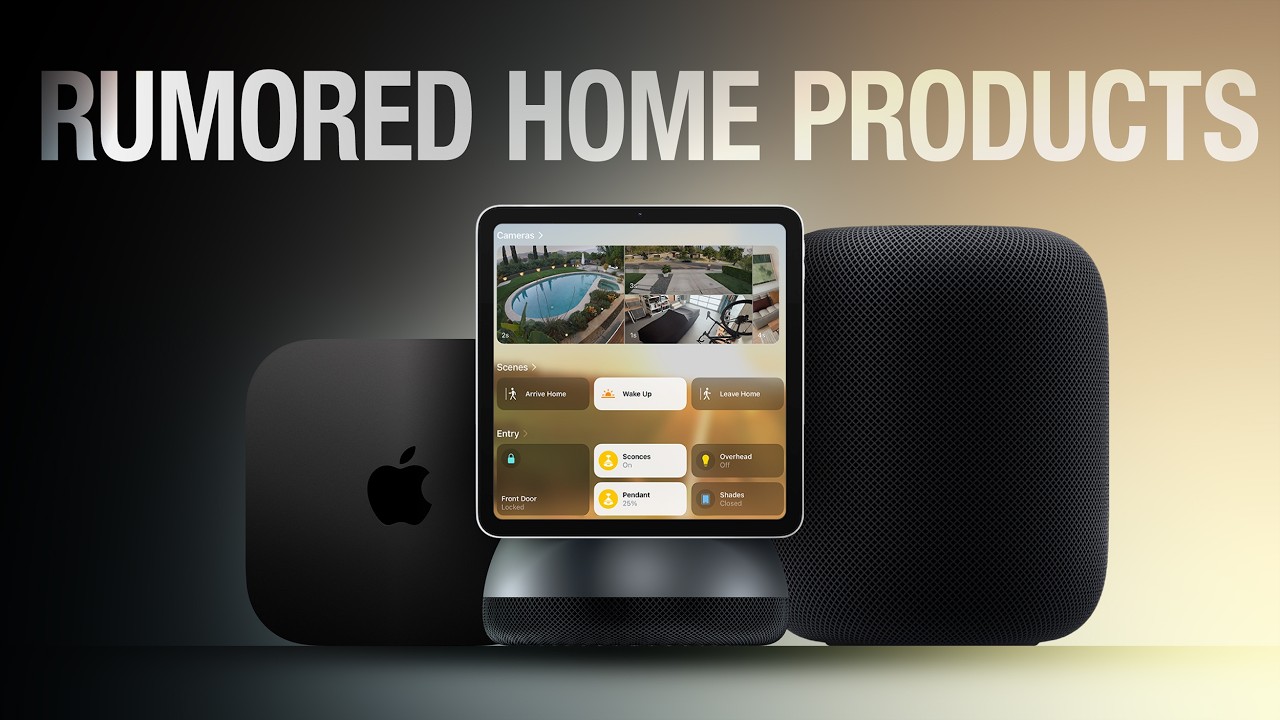
Apple is planning to launch a home hub that will support smart home products, listening to music, making video calls, getting the weather, looking things up with Siri, displaying photos, making notes, viewing calendar events, and more. The home hub has an all-display design with an iPad-like 7-inch display. There are two models, one that's designed to be mounted to the wall and one that's got an included speaker base that looks like a HomePod mini.
Apple is working on a Mac mini, and new models with codenames J873g and J873s were spotted in leaked Apple software. The codenames correspond to M5 and M5 Pro chips, but refresh timing is unclear. Given that it uses chips coming to the MacBook Air and MacBook Pro, it could come early in the year alongside those devices. We're not expecting any design changes to the Mac mini, with the update focusing on internal improvements.
The Apple TV will get a new Apple-designed Wi-Fi and Bluetooth chip, along with a faster A17 Pro processor that will add support for console-quality games and Apple Intelligence. No design changes are expected.
WWDC 2026
WWDC will take place in the middle of the year, likely during the first week or two of June. At WWDC, Apple will unveil the next-generation versions of its software, plus there are sometimes hardware announcements.
New versions of iOS, macOS, and Apple's other software platforms will be previewed in June at WWDC before launching in September. New Apple Intelligence features are expected, and rumors suggest Apple is going to turn Siri into a ChatGPT-style chatbot.
Sometime around the middle of 2026, the Mac Studio will get M5 Max and M5 Ultra chip technology. The M5 Max will offer much faster CPU and GPU performance than the M5, and the M5 Ultra will double the M5 Max.
Apple is reportedly developing two new display models that could launch in 2026. The next-generation version of the Studio Display could feature the same 27-inch screen size, but with mini-LED technology instead of LCD. mini-LED means better HDR, brightness, contrast, and colors. The current Studio Display has an A-series chip inside, and the next-generation version could get the A19 Pro that Apple used in the iPhone 17 Pro.
September iPhone Event
Apple's September event will see the unveiling of new iPhone models and new Apple Watches. This year, we're expecting Apple's first foldable iPhone.
The iPhone 18 Pro could get under-screen Face ID, which would allow Apple to remove the Dynamic Island, but some rumors claim there will be a hole-punch camera cutout in the top left corner of the display. The iPhone 18 Pro will use an A20 Pro chip built on Apple's 2nm process, and it could have a variable aperture Main lens.
Apple's first foldable iPhone is expected in fall 2026. It's rumored to have a 5.3-inch external display that unfolds into a 7.6-inch internal display, with a book-style design that resembles an iPad mini when it's open. The "iPhone Fold" could be super thin at 4.5mm when open, and Apple is said to have used advanced display techniques and a highly durable hinge to nearly eliminate the device's crease. It will be equipped with an A20 chip, dual rear cameras, and a Touch ID fingerprint sensor built into the power button in the frame rather than Face ID. It could cost as much as $2,500.
The Apple Watch Series 12 isn't expected to feature any major design changes, and we haven't heard any rumors about new capabilities that might be added. It could just get a chip refresh.
The next-generation version of the iPad mini is rumored to feature a major technology upgrade, with Apple set to adopt an OLED display. The iPad mini 8 could have a more water resistant design with a vibration-based speaker system that allows Apple to eliminate the device's speaker holes, plus it could use the same A20 chip that Apple plans to use in the iPhone 18 Pro.
Late 2026
Apple could hold a second fall event, in either October or November. In years that Apple has done a second event, it has typically featured Macs and iPads.
Apple is developing a revamped touchscreen OLED MacBook Pro that uses next-generation 2-nanometer M6 chip technology, and it could come in either late 2026 or early 2027. Rumors suggest that the OLED MacBook Pro will feature a hole-punch camera without a notch, maximizing the available display area. Apple plans to adopt a reinforced hinge that stays stationary when the display is touched, and cuts down on any vibration associated with touch-based gestures.
Apple Security Camera
Rumors suggest that Apple is designing its own indoor security cameras that will connect to HomeKit and interface with the planned home hub. It could come as soon as late 2026.
Products With Unknown Release Dates
There are several new devices in the works that don't have solid release dates, so we could get these at any time, but toward the end of the year is most likely.
AirPods 5 - Apple is developing the AirPods 5, but release timing is unknown. The AirPods 5 could get an updated H3 chip with improved sound quality and lower latency. There are two models in the works, with Apple likely continuing to offer ANC and non-ANC versions.
AirPods Pro - Apple is working on another version of the AirPods Pro that could have at least one tiny infrared camera and a next-generation H3 chip with improved sound quality and lower latency. The camera would perhaps add support for in-air gestures, improving functionality with the Vision Pro. The next AirPods Pro could still be branded AirPods Pro 3 rather than AirPods Pro 4.
Apple Watch Ultra 4 - There is an Apple Watch Ultra 4 in development, but we don't know what features might be added, nor is it clear when it might launch. Apple so far hasn't necessarily refreshed the Apple Watch Ultra on an annual basis.
M5 Max iMac - Apple is testing an M5 Max iMac, based on leaked internal software. Nothing is known about the machine except for the chip inside, but if it's a product slated for release, it could feature mini-LED display technology like the rumored Studio Display 2. Max chips are typically in "Pro" machines, so Apple could be planning to revive the iMac Pro. There may also be an M5 chip refresh for the 24-inch iMac.
Mac Pro - Apple has deprioritized the Mac Pro, so it's not clear if there's going to be an update. If there is, the Mac Pro will get an M5 Ultra chip, Thunderbolt 5, and upgrades like 512GB RAM maximum and 16TB storage space.
AI Smart Glasses - Apple is working on smart glasses that will rival Meta's AI Ray-Bans, and Apple might introduce them in 2026 before a 2027 launch. The smart glasses will include cameras, speakers, sensors, and AI, but no displays. The glasses will support taking photos, listening to music, making phone calls, and interacting with AI.
2027 Product Launches
Apple is working on multiple products that are currently rumored for 2027.
iPhone 18 - Apple isn't going to release an iPhone 18 in September 2026, and will hold it until spring 2027. Apple is pursuing a split launch strategy, with more expensive iPhones launching in the fall and more affordable models coming the following spring. September 2026 will see the launch of the iPhone 18 Pro, iPhone 18 Pro Max, and Apple's first foldable iPhone.
AirPods Max - Apple could refresh the AirPods Max in 2027, cutting down on weight. The headphones could get Apple's H2 chip or newer, adding features that include improved sound quality, better Active Noise Cancellation, longer battery life, Adaptive Audio, Personalized Volume, Conversation Awareness, and support for "Siri" instead of "Hey Siri."
iPad Pro - There is no new iPad Pro expected in 2026, but in 2027, it's expected to get a faster M6 chip and vapor chamber cooling to maximize performance.
OLED iMac - Apple is working on a 24-inch iMac with an OLED display, and rumors suggest that it could come out as early as 2027.
iPhone 18e - Also slated for spring 2027, the iPhone 18e could launch alongside the iPhone 18. It is expected to feature few changes.
iPhone Air 2 - There is no second-generation iPhone Air planned for fall 2026 because Apple has delayed it. It could instead come in spring 2027. Apple is reportedly looking at adding a second camera to make the device more appealing to consumers. The next iPhone Air might also be more affordable.
20th Anniversary iPhone - The 2027 iPhone will have an "enclosure on the front and back that curves around the device edges," which allows for a bigger screen with no bezels. The Information says that it is not sure if the display itself will curve around the edges, but instead of a full metal frame, it has a "narrow metal band running around the midpoint of the device's edge. The selfie camera will move under the display, and it will be the first iPhone with no display cutouts at all. The 20th anniversary iPhone will launch in September 2027.
Tabletop robot (J595) - Apple's tabletop robot with a thin robotic arm and swivel base is expected to be a more powerful version of the home hub. It's rumored to be launching sometime in 2027.
2026 Product Refresh Timeline
This list includes all of the devices that Apple has released in 2026 so far.
LG recently debuted a new 32UL950 32-inch UltraFine 4K display, but this latest model, priced at $1300, wasn't designed in partnership with Apple.
It still shares quite a few design similarities with prior UltraFine models, though, so we thought we'd check it out in our latest YouTube video to see whether it's a solid option for the purchase price.
The LG 32UL950 UltraFine Display features a black front panel with slim bezels and a curved base with a plastic monitor arm. It's tilt and height adjustable, so you can get it into the perfect position, and it can even be used in portrait orientation.
As with many LG displays, it's VESA compatible so you can mount it on the wall to save desk space. It is equipped with two USB-C Thunderbolt 3 ports, which can be used for fast data transfer, 60W charging for your MacBook, and daisychaining an additional 4K monitor if desired. There are also two USB-A ports, a DisplayPort, an HDMI port, a 3.5mm headphone jack, and built-in speakers.
The 4K display of the LG 32UL950 UltraFine is great, with crisp, detailed images and sharp text, though it's not quite as nice as the 5K UltraFine that LG offers in partnership with Apple.
This is a 32-inch display, but it's not ultrawide, and it has a resolution of 3840 x 2160 at 60Hz. Running this display at full resolution makes the on-screen elements quite small, so buyers might want to use it at 3360 x 1890 or 3200 x 1800 instead. Other display features include HDR and DCI-P3 support for excellent contrast and color.
For content creation or digital media, the LG 32UL950 is a solid choice, but it's not the greatest for gaming because it maxes out at 60Hz. It does support Radeon FreeSync and Dynamic Action Sync, though.
LG charges $1300 for the display, but it's available on Amazon at a cheaper price of $1100. That still makes it more expensive than LG's 5K monitor, so it's not going to be for everyone.
Make sure to watch our video up above for a closer look at LG's new UltraFine display, and let us know what you think of it in the comments below.
Nomad is a company that creates useful accessories built around rugged simplicity, and in the past it has released iPhone cases, Lightning cables, and Apple Watch straps.
This year, Nomad launched its first metal strap for the Apple Watch, called the Titanium Band, a full-metal link bracelet built with over twenty titanium links and a set of custom lugs, designed for the 44mm Apple Watch Series 4 and the older generation 42mm models.
Design
Similar in design to other metal link bracelets for Apple Watch -- including Apple's own accessory -- Nomad's Titanium Band has a series of metal links connected by a slim clasp system that snaps closed around your wrist. The Titanium Band comes in both Silver and Black, to match both metal finishes available for the Apple Watch Series 4.
To adjust the fit, the accessory has up to ten removable links that lets you customize the band length so that it can fit any wrist, according to Nomad. On the clasp, which sits under your wrist, there is a small and unobtrusive Nomad logo, and the lugs on the band are designed like most other third-party Apple Watch bands, built to slide easily into the Apple Watch case.
Adjusting Size
The Titanium Band ships at the largest size, so most people will have to go through the size adjustment process before they're able to wear the band. I found this process to be lengthier and a bit more troublesome than I was expecting, and definitely not as simple as Apple's Link Bracelet.
Nomad provides you with a link removal tool, which is a small metal device with a screw system that pushes out links in the band. To start, you have to adjust the bottom part of the tool so that the Titanium Band will be at the right height, allowing the tool's needle to slide into one of the links on the band.
Then, you place the Titanium Band on this round platform and align one of the link holes on the band with the needle. Once aligned, you turn the big screw on the tool to push the link in the band out the other end, and continue doing that until you have a few links removed.
Once you have a size you think could fit your wrist, you'll have to reattach the segmented band. To do this, you line up the two sides of the band and re-insert one of the removed pins back into the pin hole. You can only insert the pin so far manually, so you must place the band back on the tool and align the protruding pin with the tool's needle, twisting the screw so that the needle head hits directly onto the pin until it slots back into the Titanium Band.
From this point, you can try on the Titanium Band and make sure it fits. If it doesn't, you'll have to remove more links and repeat the process. For me, it took upwards of 30 minutes to finally find the size that fit well on my wrist, and after much trial-and-error with the link removal tool.
As a point of comparison, Apple's removal process is a simple button-based system that requires you to press down on specific links to remove them, without the need of an external tool. Nomad's solution is noticeably lengthier and more arduous, and it definitely offset the initial excitement I had of getting a new Apple Watch band.
Daily Use
Thankfully, this is a one-time process and in the weeks since I adjusted it Nomad's Titanium Band has been one of my favorite Apple Watch bands to wear. The metal band has notable heft to it, but feels light on my wrist and once I had the right size, it sat super comfortably throughout the day and never moved up or down my wrist.
The process of putting it on and taking it off is easy thanks to the band's clasp system, which folds together and snaps shut to put on, and opens easily by pressing two small buttons on each side to remove it. When putting the Titanium Band on I would occasionally pinch myself as the two ends of clasps came down together too close to my skin, but over time the process became a bit smoother.
I tend to prefer keeping workout-friendly bands on my Apple Watch, since the process of taking bands off and on every day can get a bit cumbersome. Just to test it out, I decided to wear Nomad's Titanium Band during a few workouts, and I came away largely impressed. Although I'd still prefer to wear a Sport Loop, Nomad's metal band never felt heavy or distracting during my workouts, and although it was a bit wet afterwards the metal dried quickly and hasn't been stained in any way.
Although I haven't exactly banged or hit the Titanium Band against many other surfaces over the past few weeks, I can also say that it appears to be largely scratch-free under pretty solid daily wear. One potential worry is that the lugs that connect the Nomad band to the Apple Watch case do have a little bit of wiggle room even when they're secured, lacking the satisfying fit of a first party Apple band.
Still, I've never worried about the Titanium Band unlatching, and it's a breeze to remove it from the case when you want to swap out for a different band, which is not something I can say for all third-party link bracelets I've used over the years.
Bottom Line
Nomad's Titanium Band is a quality, good-looking Apple Watch accessory that's comfortable to wear and has a more reasonable price tag compared to Apple's Link Bracelet. At $179.95 for Nomad's watch band, you'll be saving about $170 when compared to Apple's $349.00 Link Bracelet.
The downside of this trade off means that you'll also be spending more time adjusting the size of Nomad's Titanium Band, a process that is streamlined and far easier with Apple's option. But once this slightly annoying process is completed, the Nomad band is a sleek accessory that pairs nicely with any 42mm or 44mm stainless steel Apple Watch.
How to Buy
You can head to Nomad's website to purchase the Titanium Band for $179.95.
For this week's giveaway, we've teamed up with Tile to give MacRumors readers a chance to win a set of Tile Bluetooth trackers that are designed to help you keep track of your most precious and essential items.
Tile makes small Bluetooth enabled tracking accessories that you can put on anything that you don't want to lose, from keys and wallets to your phone, your camera, your watch, your purse, or anything else you don't want to lose.
The idea is that you attach a Tile to something like your keys, and then if and when those keys are misplaced, you open up the Tile app and use the Bluetooth connection between the Tile and your phone to see a map with the location of your keys and to play a sound on the Tile itself. If you lose your phone, you can tap on the Tile and it'll ping your phone, so there's two-way tracking available.
Tile makes a whole range of trackers for different items and purposes. The Tile Pro, for example, is Tile's most advanced tracking accessory. It has a Bluetooth tracking range of 300 feet and it's 3x as loud as other Tile trackers, so it's best for your most valuable items.
With Tile Pro's long tracking range and loud volume, it's appropriate for your purse, your camera bag, your laptop bag, and other things you want to make sure you can keep an eye on and protect from being lost or stolen. Tile Pro is Tile's most expensive tracker at $35, but discounts are available for multi-pack purchases.
Tile Mate is similar to the Tile Pro, but it's a bit more compact and it's more affordable at $25. Tile Mate, like Tile Pro, has a user replaceable battery so you can use it indefinitely. Tile Mate can work from up to 150 feet away over Bluetooth, and 1.5 times louder than other Tile products.
Tile Slim, priced at $30, is Tile's slimmest Bluetooth tracker that's perfect for tucking into a wallet, a passport, or sticking onto the back of a device like a laptop or iPad. Tile Slim has a 100 foot range and it's not quite as loud as the other Tile trackers, but it's still perfect for items where thinness is key.
All of Tile's trackers, from the Pro to the Mate to the Slim will last for one year with the original battery that ships with them. On all trackers but the Slim, you can replace this battery when the year is up, a feature that was added to Tile trackers last October. If you don't want to hassle with battery replacements, Tile has a premium program that offers free battery replacements along with a detailed location history and unlimited sharing, so you can let friends and family help you find a misplaced item.
Tile's trackers are designed to locate your devices close by when they're in Bluetooth range, but the Tile app has a Community Find feature that leverages all the Tile trackers out in the wild to find a lost item if it's not in the vicinity of your own phone, which is a useful bonus.
For MacRumors readers, Tile is offering two tracker bundles that include four Tile Pros, four Tile Mates, and 1 Tile Slim so you can add Bluetooth tracking to all of your important belongings. To participate in the giveaway, use the Gleam.io widget below and enter an email address. Email addresses will be used solely for contact purposes to reach the winners and send the prizes. You can earn additional entries by subscribing to our weekly newsletter, subscribing to our YouTube channel, following us on Twitter, following us on Instagram, or visiting the MacRumorsFacebook page.
Due to the complexities of international laws regarding giveaways, only U.S. residents who are 18 years or older and Canadian residents (excluding Quebec) who have reached the age of majority in their province or territory are eligible to enter. To offer feedback or get more information on the giveaway restrictions, please refer to our Site Feedback section, as that is where discussion of the rules will be redirected.
The contest will run from today (March 22) at 11:00 a.m. Pacific Time through 11:00 a.m. Pacific Time on March 29. The winners will be chosen randomly on March 29 and will be contacted by email. The winners will have 48 hours to respond and provide a shipping address before new winners are chosen.
Later on Friday, Cook met with politician Sun Chunlan, a Vice Premier of the People's Republic of China. The state-run news agency Xinhua claims that Sun made positive remarks about Apple and the company's role in Sino-U.S. relations.
Cook will then likely take a direct flight back to California in time for Apple's media event on Monday at Steve Jobs Theater, where the company is widely expected to introduce two new services for streaming video and magazines/newspapers.
Apple's Beats brand will soon release an entirely wire-free version of its Powerbeats Wireless Earphones designed for workouts, reports CNET. The updated earphones will be similar to the AirPods, in that there will be no wire between them.
Apple won't be cannibalizing its own AirPods sales because Powerbeats are designed for working out, running, and other athletic activities that aren't really meant for AirPods.
Apple's current Powerbeats earphones
The newly updated AirPods that Apple launched this week feature an updated H1 chip that brings faster switching between devices, quicker connections when making phone calls, "Hey Siri" support and longer talk time, and this chip could also be included in updated Powerbeats.
The W1 chip that Apple used in the previous version of the AirPods was also incorporated into its Beats headphones.
CNET says that the information comes from a source that has provided reliable details on Apple's plans in the past, with Apple's Beats brand set to release the new earphones in April. Compared to the AirPods, the upcoming Powerbeats could offer better bass and water resistance, as well as the ability to better stay in the ears during rigorous activity.
There's no word on what the new Powerbeats will cost. Apple priced the new AirPods with Wireless Charging Case at $199, and current Powerbeats also cost $199, so the price could potentially go up.
It's not clear if there are other headphone updates in the works that would be announced at the same time as the wire-free Powerbeats, but Apple's Beats brand has not introduced a significant update since summer 2018 when the Beats Studio3 Wireless Headphones were updated with a W1 chip.
Starting with the iOS 12.2 beta, AT&T began displaying a 5G Evolution or 5GE icon on iPhones, misleading AT&T subscribers into thinking they're getting 5G transfer speeds when in fact, 5G on iPhone is not supported and AT&T has no 5G network as of yet.
AT&T uses the 5GE labeling to describe its 4G LTE networks that offer features like three-way carrier aggregation, 256 QAM, and 4x4 MIMO. These options are in no way limited to AT&T and are offered by other carriers, but no other carrier has chosen to use fake 5G branding.
As should come as no surprise, a recent test from OpenSignal has proven that AT&T's 5GE network is no faster than 4G networks from Verizon and AT&T that have the same speed upgrades.
AT&T users that have a 5GE capable smartphone, which includes modern iPhones and some Android devices, receive a "better experience" than other AT&T users with less capable smartphone models, but those same iPhones and Android devices get similar speeds on other carriers. Verizon, AT&T, and T-Mobile are all offering the same LTE advancements on iPhones with the newest LTE technology, but only AT&T is confusing customers with 5G branding.
What Opensignal's data shows is the extent to which LTE, or 4G, networks have improved since LTE's original launch. Technologies like carrier aggregation -- where two or more bands are used to simultaneously connect a user's smartphone -- 256 QAM or 4x4 MIMO, which together are normally called LTE Advanced Pro, offer a much faster experience than the initial version of 4G that was launched back in 2009-2011.
AT&T's fake branding has struck a nerve with other carriers, especially Sprint. Sprint has launched a full anti-AT&T campaign, filing a lawsuit against AT&T for its misleading branding and taking out ads in The New York Times.
Sprint rightly claims that AT&T is confusing customers and damaging the understanding of true 5G, which has the potential to impact Sprint's own 5G launch.
5G smartphones are only now just beginning to trickle out, and Apple isn't expected to launch one until 2020. No existing iPhone will be able to connect to a 5G network because it requires new hardware. 5G networks from the four major carriers in the United States will become available starting in 2019, but the technology is still new and there will be many bugs and coverage issues to work out.
Artist Billie Eilish has achieved a new streaming milestone on Apple Music, breaking the service's all-time record for users "pre-adding" an album to their libraries ahead of its release. According to Apple, Eilish's upcoming album "When We All Fall Asleep, Where Do We Go?" has earned more than 800,000 pre-adds on Apple Music ahead of the album's launch on March 29 (via Music Business Worldwide).
By pre-adding an album, subscribers can save it in their Apple Music libraries and listen to any songs that may already be out for it. Then, when the full album is released Apple adds the entire album to their account.
Although this process can be unreliable on Apple Music, and sometimes the full album isn't added at the time of its release, Apple Music executive Oliver Schusser sees pre-adds as a sort of modern pre-order feature for the streaming era. Schusser said that, "While most services focus the majority of their efforts around playlists, Apple Music still emphasizes albums because we understand their value as a storytelling tool for artists to create context around their music."
“To that end, pre-adds are great early indicators of engagement around an artist and the intention of the fans. To actively pre-add an album, much like the pre-order we invented with iTunes, means that the fan is excited about the content and wants to be among the first to enjoy it the moment its available. That kind of engagement is very valuable to an artist and to us.”
He added: “For Billie in particular it’s really exciting because she is such a big part of the Apple artist community and someone the whole company has really rallied around. It’s amazing to see the positive reaction from our subscribers.”
Apple has been a longtime supporter of Eilish, first featuring her as the Up Next artist for September 2017, showcasing her in interviews with Beats 1 Radio hosts, exclusively premiering some of her songs and videos, and partnering with her to host her own Beats 1 show. Apple also worked with Eilish on its holiday commercial "Share Your Gifts" last year, where her single "Come Out and Play" was featured.
Eilish's team also commented on the pre-add numbers, with Interscope vice chairman Steve Berman stating, "These pre-add numbers are incredibly exciting for Billie, and a real validation of everything we – the artist, Darkroom, Apple and Interscope – have worked together on over the last three years. Internally, hearing these [Apple pre-add] results, it makes us all incredibly proud – and it makes us want to work that much harder, because we can see exactly what the opportunity is."
According to Schusser, the criticism that streaming music services have taken the personality out of artists is incorrect, and he points toward Eilish as the prime example: "Apple has always given creators platforms to connect with audiences around the world and the space and freedom to be creative. It goes to the core of who we are as a company."
Apple Music recently updated the New Music section of the "Browse" tab with a small refresh that highlights an assortment of different playlists from various musical genres. Apple sometimes pushes silent updates to Apple Music, like last summer when it added a "Coming Soon" section, more specific launch dates for albums, and updated artist profiles.
Now, in the central Browse tab of Apple Music, you'll find Apple's "Daily Top 100" playlist featured prominently at the top of the section, just below the traditional carousel of new music. These Global Top 100 playlists launched last September and have been available to listen to by navigating to Browse, scrolling down, and finding the Top Charts area. Now, they're much easier to find right at the top of Browse.
The section under Daily Top 100 is "Weekend Warrior," a list of pop, dance, hip-hop, country, and more music all centered around celebrating the weekend. Just like the Daily Top 100, these playlists have all been available in Apple Music before, but the service's organization and presentation of them is new. Slightly lower in Browse you can now find an area that features "Just Updated" playlists across genres and moods.
The rest of Browse looks mostly the same, with Hot Tracks and New Music showcasing the most popular new songs on the service. Near the bottom of the tab are a few more changes, including a "We're Loving" area that features new album recommendations from the Apple Music editors, and a "Get Down Tonight" section curating dance music. Because a few of these sections are dedicated to the weekend, it appears that Apple will more frequently update Browse with new themed areas.
It's also worth mentioning that Apple Music is highlighting a collection of classical music today in the Browse tab's main carousel, aimed at celebrating the Los Angeles Philharmonic's 100 year anniversary. This new area has albums, playlists, brief histories about the Los Angeles Philharmonic's conductors and relevant albums, music videos, and an exclusive playlist curated by Deutsche Grammophon celebrating the anniversary. Many problems still remain for classical music on Apple Music, but it's reassuring to see Apple highlight a major event in the classical world among new modern album releases.
You can check out the updates to the New Music section of the Browse tab on both macOS and iOS devices.
Apple plans to release its long-awaited wireless charging mat AirPower in "late March" according to Taiwanese publication DigiTimes. We're in late March now, so if the report is accurate, then a release should be imminent.
The report cites unnamed "industry sources" within Apple's supply chain:
Lite-On Semiconductor, a maker of discrete and analog IC components, is expected to see its second-quarter revenues register a double-digit sequential growth as it will soon kick off volume shipments of GPP (glass passivated package) bridge rectifiers needed for Apple's wireless charger AirPower, according to industry sources.
The sources said that Apple's AirPower wireless charger for iPhones, Apple Watch and AirPods is set to be officially launched in late March, which will significantly drive up Lite-On's revenues for the second quarter of 2019.
There are 10 days remaining in March including today.
DigiTimes has a mixed track record when it comes to predicting the timing of Apple product releases. While the publication has sources within Apple's suppliers in Asia, particularly in Taiwan, supply chain sources are typically more privy to what is coming rather than when. In short, we'll see.
There is certainly increasing evidence pointing towards an upcoming release.
AirPower is designed to charge multiple Apple devices at once, including the iPhone 8 and newer, Apple Watch Series 3 and newer, and AirPods when they are placed in the new optional wireless charging case introduced on Wednesday.
Apple has inked a deal with Vox for Vox to become a part of its upcoming subscription service that will be available in Apple News, reports Bloomberg.
Vox is owned by Vox Media, which also owns the Verge, Recode, Eater, and SB Nation, but Apple's deal is only for the Vox site for now. Vox does not have a subscription offering at the current time, but Vox CEO Jim Bankoff recently said that paid subscriptions would be added to the Vox site later this year.
Apple News subscribers who sign up for Apple's paid service, set to be called Apple News Magazines, will be able to access a variety of magazines and paywalled news from participating publishers.
Rumors have suggested Apple plans to charge around $9.99 for the service, with the Cupertino company keeping 50 percent of the fee while splitting the rest of the fee among publishers.
The Wall Street Journal and many magazine publishers have signed up to participate, but other news sites like the Washington Post and The New York Times have declined.
Apple plans to unveil its new Apple News Magazine service at an event that will take place at 10:00 a.m. Pacific Time on March 25.