Peacock is offering new subscribers a chance to get a full year of its premium plan for just $24.99 for your first year, down from the regular price of $79.99 per year. This is only a $5 difference when compared to Peacock's Black Friday discount from last year, making it one of the service's best offers so far in 2025.
Note: MacRumors is an affiliate partner with Peacock. When you click a link and make a purchase, we may receive a small payment, which helps us keep the site running.
Peacock's premium annual plan is the ad-supported tier of the streaming service. This offer excludes current paying subscribers of Peacock, and after it ends the service will return to the regular $79.99 per year price (or then-current price, if a price hike happens).
If you do already have a Peacock account, but you're not a paid subscriber, you can sign in and enter the code SPRINGSAVINGS to redeem this offer. This sale will run through the end of the month and expire on May 30.
If you're on the hunt for more discounts, be sure to visit our Apple Deals roundup where we recap the best Apple-related bargains of the past week.
Deals Newsletter
Interested in hearing more about the best deals you can find in 2025? Sign up for our Deals Newsletter and we'll keep you updated so you don't miss the biggest deals of the season!
Tesla updated its iPhone app on Tuesday with Live Activities support on iOS 17.2 and later, allowing you to view your vehicle's live Supercharging status on the Lock Screen, and in the Dynamic Island on iPhone 14 Pro models and newer.
Supercharging status updates will begin automatically, as soon as your charging session begins, according to the release notes for the latest version of the Tesla app.
Within the Live Activity widget on the Lock Screen, you can view your Tesla vehicle's current battery percentage, the time remaining until the charging session is completed, the charging output in kilowatts, and more. You can also view the charging time remaining at a glance in the Dynamic Island on newer iPhone models.
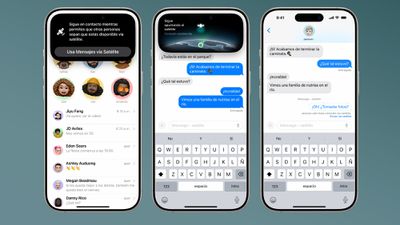
Apple today expanded the Messages via Satellite and Find My via Satellite features to Mexico, allowing iPhone users in Mexico to take advantage of Globalstar satellites for communication when cellular and Wi-Fi connectivity options are unavailable.
To use satellite connectivity in Messages and Find My in Mexico, an iPhone 14 or later with satellite capabilities is required, as is iOS 18.4 or later. The person on the receiving end of an iMessage sent using a satellite connection needs iOS 18 or later, while SMS messages require iOS 17.6 or later or a non-Apple device.
With Messages via Satellite, iMessages and SMS messages can be sent using a satellite connection, while location information can also be updated in the Find My app using satellite connectivity.
Using Messages and Find My without Wi-Fi or cellular will require users to hold their iPhones up to the sky to establish a connection. Open spaces with no trees or buildings make it easier to connect, and speed up message sending and receiving. Emoji and Tapback responses are supported, but images, videos, audio messages, stickers, and group messages do not work over satellite.
The option to use satellite connectivity for Messages will display automatically when Wi-Fi and cellular connections are not available, and users will be able to tap to connect by following Apple's instructions.
Messages via Satellite is now available in the United States, Canada, and Mexico. The functionality continues to be free for all iPhone users with a compatible device.
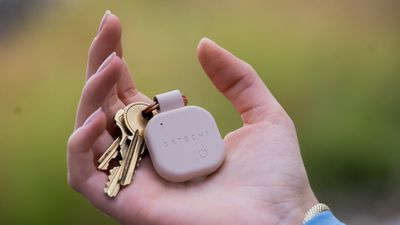
Satechi today added a range of new accessories to its line of FindAll products, all of which integrate with Apple's Find My app. Satechi is debuting a new FindAll Luggage Tag, a FindAll Keychain, a FindAll Card, and a FindAll Glasses Case. Satechi's FindAll products work like Apple's AirTags, but come in different shapes and sizes that are more convenient than the $29 AirTag.
The FindAll Keychain, priced at $30, is an alternative to the AirTag. It is made from a vegan leather material and can be attached to keys or any other item with the included keyring. The battery lasts for up to 12 months before it needs to be recharged.
Satechi's FindAll Luggage Tag is $44.99 and also made of the same vegan leather material as many of the FindAll products. It is designed to attach to a suitcase, and it includes a name card slot that's protected with a privacy flap and an adjustable strap. Since it looks like a regular luggage tag, it is more covert than an AirTag. Its battery lasts for up to eight months before needing to be recharged.
For wallets, the FindAll Card is $34.99. It is sized to fit inside a wallet, and it is made from aluminum and tempered glass. To ensure that it can withstand any conditions, it features IP67 water resistance.
To keep glasses or sunglasses safe and easy to find, Satechi offers the $49.99 FindAll Glasses Case. The Glasses Case has a collapsible design that folds out to accommodate a pair of glasses, with a microsuede lining to prevent scratches and a magnetic closure. The battery in the case lasts for up to eight months before it needs to be recharged.
The FindAll devices can be purchased in black, white, or desert rose, and they recharge wirelessly with a Qi, Qi2, or MagSafe charger. All of the products can be added to the Items tab in the Find My app, and can be tracked alongside Apple devices. Apple's Find My network is able to leverage nearby Apple devices owned by other people to get location information when a device is out of Bluetooth range.
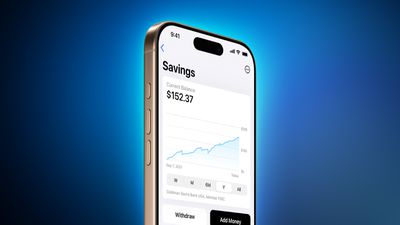
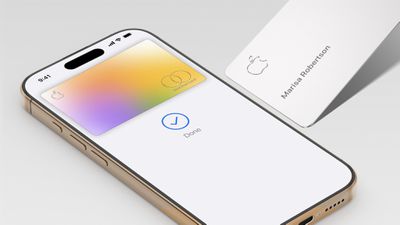
In the United States, the Apple Card offers a high-yield savings account option, allowing you to earn far more interest on your money compared to the average bank's basic savings account. However, the account's interest rate was lowered this week, with the annual percentage yield (APY) dropping from 3.75% to 3.65%.
If you deposited $1,000 into the account, and maintained that balance for one year, you would earn $36.50 in interest based on the current APY.
The chart below compares the Apple Card savings account's APY to some other popular high-yield savings accounts in the United States.
Provider
APY*
Ally
3.60%
Discover
3.60%
American Express
3.60%
Capital One
3.60%
Apple Card Savings
3.65%
Marcus by Goldman Sachs
3.65%
Citizens Bank
3.70%
SoFi
3.80%
Barclays
3.80%
PNC Bank
3.95%
Synchrony
4.00%
Betterment
4.00%
Wealthfront
4.00%
UFB Direct
4.01%
Fierce
4.25%
Openbank by Santander
4.40%
Pibank
4.60%
* Advertised APYs as of May 28, 2025, excluding promotional rates and affiliate bonuses. Minimum balance requirements and other conditions vary per account. APYs can change at any time, so we cannot guarantee the accuracy of the rates listed above.
Apple launched its savings account in April 2023, in partnership with Goldman Sachs. The account can be opened and managed in the Wallet app on the iPhone, and it has no fees, no minimum deposits, and no minimum balance requirements. To open an account, you must have an Apple Card, be a U.S. resident, and be at least 18 years old.
The account allows Apple Card holders to earn interest on their Daily Cash cashback balance, and on funds deposited via a linked bank account or an Apple Cash balance. The maximum balance allowed is $1 million, up from $250,000 originally.
When the account launched, Apple and Goldman Sachs offered an APY of 4.15%, but the rate has fluctuated, often in line with U.S. Federal Reserve benchmark rate changes. The APY peaked at 4.5% in early 2024, and the current 3.65% is an all-time low.
To open a savings account in the Wallet app, tap on your Apple Card, tap on the circle with three dots in it, tap Daily Cash, and select Set Up next to Savings.
Apple today announced that it recently launched a Genuine Parts Distributor program in the U.S. and Europe, broadening access to genuine repair parts.
The program allows repair shops that do not have a direct relationship with Apple to order genuine Apple parts via third-party distributors, including MobileSentrix and Mobileparts.shop. Currently, these distributors are offering display, battery, camera, and charging port components for the iPhone 12 series and newer, and SIM card trays are available for the iPhone X and newer. Apple said that iPad parts will be available starting tomorrow.
iOS 18 and iPadOS 18 include a new Repair Assistant feature for completing post-repair configuration on a device, if necessary.
This new program has fewer limitations compared to Apple's existing Independent Repair Provider program. Repair shops do not need to apply to be part of the program, technicians do not need to be certified by Apple, and repairs are not limited to devices with expired warranty coverage. On the other hand, the Independent Repair Provider program provides access to parts for select Macs and a wider range of iPhone models.
Apple now provides both repair shops and customers with access to genuine parts, tools, and repair manuals through a variety of programs, including the Self-Service Repair program, the Independent Repair Provider program, and now the Genuine Parts Distributor program. As always, customers can also take their devices to the Genius Bar at an Apple Store or to an Apple Authorized Service Provider for repairs.
Earlier today, Apple announced that the Self-Service Repair program now covers select iPad models, and it will be launching in Canada this summer.
All three programs launched amid mounting "Right to Repair" legislation in the U.S. and other countries over the past several years.
Amazon today has low prices across nearly the entire M4 MacBook Air lineup, with up to $223 off both 13-inch and 15-inch models. Some of the notebooks in this sale are seeing delayed delivery estimates, with most arriving in early or mid June, but if you're interested you can lock in these deals now ahead of those delivery dates.
Note: MacRumors is an affiliate partner with some of these vendors. When you click a link and make a purchase, we may receive a small payment, which helps us keep the site running.
Starting with the 13-inch models, Amazon has up to $182 off all three of the new configurations of this notebook. Prices start at $867.88 for the 256GB model, then raise to $1,037.19 for the 16GB/512GB model and $1,216.87 for the 24GB/512GB model. While the 256GB model is a solid second-best price, the latter two models are new record low prices for the M4 MacBook Air.
Moving to the larger display models, Amazon has both 512GB versions of the 15-inch M4 MacBook Air on sale this week, as well as the 256GB model. The 16GB/512GB model is available for $1,236.59 and the 24GB/512GB model is on sale for $1,375.85. Across the board, these are all new all-time low prices on the 15-inch M4 MacBook Air.
If you're on the hunt for more discounts, be sure to visit our Apple Deals roundup where we recap the best Apple-related bargains of the past week.
Deals Newsletter
Interested in hearing more about the best deals you can find in 2025? Sign up for our Deals Newsletter and we'll keep you updated so you don't miss the biggest deals of the season!
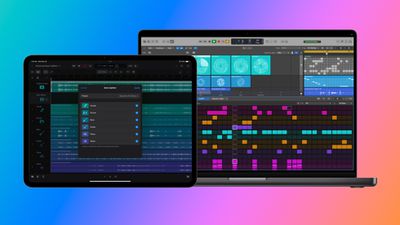
Apple today announced that it has updated its professional music-making app Logic Pro with several new features on the Mac and iPad.
First, a new Flashback Capture feature lets you recover a performance that otherwise may have been lost because you forgot to set Logic Pro to record.
Next, there are enhancements to the Stem Splitter feature that allows you to extract stems from an audio track for vocals, bass, drums, and other instrumental parts. With today's update, Apple says Stem Splitter now supports guitar and piano, and the feature now offers even greater audio fidelity. Stem Splitter requires a Mac with an M1 chip or newer, or an iPad with an A12 Bionic chip or newer running iPadOS 18.4 or later.
The new version of Logic Pro also includes a new Dancefloor Rush sound pack for the Mac and iPad, offering drum-and-bass sounds with over 400 dynamic loops and punchy drum kits. Two more sound packs added to the Mac app include Magnetic Imperfections with analog tape sounds, and Tosin Abasi with progressive metal guitar sounds.
On the Mac, Logic Pro's built-in notepad now supports Apple Intelligence's Writing Tools.
Logic Pro version 11.2 for Mac and version 2.2 for iPad are available now in the App Store, as free updates for existing users. In the U.S., Logic Pro costs $199.99 on the Mac for new users, and $4.99 per month or $49 per year on the iPad.
The interest rate on Apple Card's savings account was today lowered from 3.75% to 3.65%—an all-time low.
The drop follows the last interest rate cut in March, where it reduced from 3.9% to 3.75%. If you deposited $1,000 into the account, and maintained that balance for one year, you would earn $36.50 in interest based on the current annual percentage yield (APY).
Apple introduced its high-yield savings account in April 2023 in partnership with Goldman Sachs. Available in the Wallet app on the iPhone, the account features no fees, no minimum deposit, and no minimum balance requirements. To be eligible, users must have an Apple Card, reside in the U.S., and be at least 18 years old.
The account enables Apple Card users to earn interest on both their Daily Cash rewards and any additional funds deposited via a linked bank account or Apple Cash. The balance cap was raised to $1 million, up from the previous limit of $250,000.
At launch, the APY was set at 4.15%, but it has varied in response to U.S. Federal Reserve rate changes. It reached a peak of 4.5% in early 2024, while the current rate sits at a record low of 3.65%.
In an email to Apple Card users, Apple explains the reason for the adjustment and highlights that the rate remains well above that of standard savings accounts:
Why did the APY on Savings change?
The APY on Savings is variable, and we may change rates at any time. Rates are influenced by many factors, including the Federal Reserve Funds Rate. When this rate is lowered, it affects all US financial institutions and we evaluate potential adjustments to our rates.
Our current APY remains 8X the national average and we will continue to strive to keep it competitive.
To get started with Apple's savings account, open the Wallet app, select your Apple Card, tap the three-dot icon, go to Daily Cash, and tap "Set Up" next to Savings.
Apple has been given until June 22 to bring the App Store into full compliance with the European Union's Digital Markets Act (DMA) or face recurring financial penalties following a €500 million fine imposed in April.
The European Commission yesterday published its complete 67-page ruling outlining Apple's violations of the DMA's anti-steering provisions. The Commission concluded that Apple's business terms continue to restrict developers' ability to inform users about alternative payment methods outside the App Store and to facilitate transactions through external platforms.
The Commission determined that Apple's remaining restrictions contravene Article 5(4) of Regulation (EU) 2022/1925, which mandates that designated gatekeepers must allow app developers to communicate freely with their users and offer competing payment systems without being subject to unfair conditionsg or excessive fees.
The Digital Markets Act came into force in November 2022 and became applicable to designated gatekeepers in 2023. It prohibits platform owners like Apple from using its market position to impose anti-competitive limitations on how developers operate within or outside their ecosystems. The law explicitly requires that gatekeepers enable developers to inform users about more favorable offers available outside the gatekeeper's platform, to include links to external payment methods, and to do so free of charge.
Apple previously argued that its newly introduced business terms, which allow developers to add one external link per app to direct users to their own websites, met the DMA's requirements. Under these rules, developers are required to follow a standardized Apple-designed flow, which includes an interstitial warning screen that appears before users are redirected to external sites. In addition, Apple prohibits developers from pre-filling user-specific data such as login credentials or purchase details into the URL used for redirection.
Despite these changes, the Commission found that Apple's implementation falls significantly short of the law's intent and legal requirements. According to the ruling, developers are still unable to promote alternative payment systems within their apps in a meaningful way, and the structure imposed by Apple continues to create friction and discourage user redirection. Furthermore, Apple still imposes a 27% commission on any digital purchases made through external websites linked from within an app, which is only slightly lower than the 30% standard in-app purchase commission and allegedly undermines the concept of allowing free steering.
The Commission rejected Apple's interpretation of the DMA, in which the company claimed it was only required to "allow" steering, not to "facilitate" it. In its ruling, the Commission said that Apple's technical and procedural barriers had the effect of discouraging developers from directing users to external purchasing options and therefore violated the law. It added that Apple had "not put forward any convincing arguments calling into question the serious gravity of the non-compliance." The ruling also criticized Apple's claim that its measures were designed to protect user security and privacy.
In a statement provided to 9to5Mac following the publication of the full ruling, Apple said:
There is nothing in the 70-page decision released today that justifies the European Commission's targeted actions against Apple, which threaten the privacy and security of our users in Europe and force us to give away our technology for free. Their decision and unprecedented fine came after the Commission continuously moved the goalposts on compliance, and repeatedly blocked Apple's months-long efforts to implement a new solution. The decision is bad for innovation, bad for competition, bad for our products, and bad for users. While we appeal, we'll continue engaging with the Commission to advocate on behalf of our European customers.
Apple has until June 22 to rectify the issues or face "periodic penalty payments." These ongoing fines would be determined based on the seriousness of the infringement and the company's revenue. Apple must also pay the initial €500 million fine by July 23 or begin accruing interest.
Note: Due to the political or social nature of the discussion regarding this topic, the discussion thread is located in our Political News forum. All forum members and site visitors are welcome to read and follow the thread, but posting is limited to forum members with at least 100 posts.
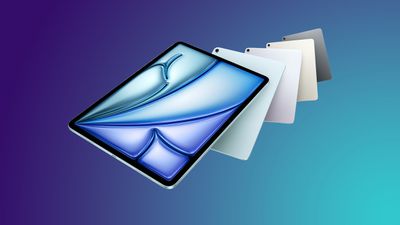
The program will provide iPad owners with manuals, genuine Apple parts, Apple Diagnostics troubleshooting sessions, tools, and rental toolkits to conduct their own repairs. It will now support the iPad Air (M2 and later), iPad Pro (M4), iPad mini (A17 Pro), and iPad (A16) starting tomorrow for display, battery, camera, and charging port repairs.
Apple launched the Self Service Repair program in 2022 to support individuals who are comfortable with undertaking their own device repairs, with the same resources used by Apple. Self Service Repair now supports 65 Apple devices, including the iPhone 16e, MacBook Air, and Mac Studio. The program is set to expand to Canada this summer, becoming the 34th country to offer it.
Apple also today revealed more details about its Genuine Parts Distributor program, which allows businesses who do not have a direct service relationship with Apple to order genuine Apple service parts and components. iPhone and iPad displays, batteries, and charging ports can be ordered from MobileSentrix in the U.S., and MobileSentrix and Mobileparts.shop in Europe.
Apple's upcoming iOS 19 update could make it easier for iPhone users to transfer an eSIM to an Android smartphone, according to a report from Android Authority.
The site found strings in the Android 16 beta version of Google's SIM Manager that reference a new "Transfer to Android" feature. The setting would include an option for wirelessly transferring an eSIM from an iPhone to an Android phone.
While it is simple to transfer an eSIM from iPhone to iPhone, that is not true when trying to transfer an eSIM from an iPhone to an Android device as of right now. Moving from an iPhone to an Android phone typically requires contacting a carrier, but that might not be the case in the future.
Transfer to Android could be added to the "Transfer or Reset iPhone" interface that's located under the General section of the Settings app. Apple may expand the eSIM Quick Transfer feature for swapping an eSIM between iPhones to Android devices, plus it looks like there may be a QR code backup in case a wireless connection fails.
Code in the Google SIM Manager suggests that iOS 19 will be required to initiate a transfer, hence why it may be an iOS 19 feature.
On your other device, go to Settings app > General > Transfer or Reset iPhone > Transfer to Android >
"Still can't connect wirelessly?"" Make sure your other device is running iOS 19 or later versions."
We could perhaps hear more about the eSIM transferring feature at WWDC, though it may also be something that's quietly introduced. Google could also be working on a reciprocal feature that would make it easier for an Android user to transfer to an iPhone.
Texas Governor Greg Abbott today signed into law the App Store Accountability Act, which will require Apple and Google to verify the age of App Store and Play Store users, respectively. The law will require users who are under the age of 18 to receive parental consent to download apps or make in-app purchases, according to Reuters.
Apple CEO Tim Cook had reportedly asked Abbott to veto the legislation on a phone call, but evidently his attempt was unsuccessful.
The bill had already passed both the Senate and House of Representatives in Texas, and now that it has been signed by Abbott, it will take effect on January 1, 2026. Texas is the second U.S. state to pass a child safety law of this kind, following Utah in March. Utah's law took effect earlier this month, but it will not be fully enforced until next year.
Apple already announced several new child safety measures in February, after these bills were proposed. While setting up an iPhone or iPad running iOS 18.4 or iPadOS 18.4 or later, the person who will be using the device must select their age range, with the available options including 12 or younger, 13 to 18, and 19 or older. If the account is for a child under the age of 13, there is a Connect to Family option. A parent needs to provide consent for a child to use the App Store and other features, with Face ID or Touch ID authentication required.
It remains to be seen if Apple's expanded age-verification measures will be enough to fully satisfy the laws in Texas and Utah, and others that may follow.
Apple and Google both opposed these age verification laws, citing privacy concerns related to having to collect age information for all users.
"If enacted, app marketplaces will be required to collect and keep sensitive personal identifying information for every Texan who wants to download an app, even if it's an app that simply provides weather updates or sports scores," said Apple.
Note: Due to the political or social nature of the discussion regarding this topic, the discussion thread is located in our Political News forum. All forum members and site visitors are welcome to read and follow the thread, but posting is limited to forum members with at least 100 posts.
Apple is working on a standalone multi-platform app for games, reports Bloomberg. The app will let Apple users launch games, plus it will have sections for in-game achievements, leaderboards, editorial content, and communication.
Apple plans to preinstall the app on the iPhone, iPad, Mac, and Apple TV later this year, which corresponds with the launch timing of iOS 19, macOS 16, and tvOS 19. The gaming app will debut at the Worldwide Developers Conference that's set to take place on June 9.
The upcoming app is set to replace Game Center, which Apple has long used for inviting friends to play mobile games and tracking achievements. While Apple plans to use the new gaming app to promote Apple Arcade, it will include all of the third-party games that are currently located in the Games section of the App Store.
It sounds like Apple is aiming to split out the App Store's gaming, making it easier for customers to find and download games on their devices. On the Mac, the app will also "tap into" games that are downloaded outside of the Mac App Store.
While the gaming app will be previewed at WWDC, it will roll out to iPhones, iPads, Macs, and Apple TVs in September when the operating systems launch to the public.
Apple has purchased game studio RAC7, according to a report from Digital Trends. RAC7 is a small, two-person company that developed Apple Arcade game Sneaky Sasquatch, and the acquisition was confirmed by an Apple spokesperson.
From Digital Trends:
We love Sneaky Sasquatch and are excited that the 2-person RAC7 team has joined Apple to continue their work on it with us. We will continue to deliver a great experience for Apple Arcade players with hundreds of games from many of the best game developers in the world.
RAC7 will become an internal game studio within Apple, and Apple purchased the company to help Sneaky Sasquatch continue to grow on Apple Arcade. Sneaky Sasquatch was one of the first games to launch on Apple Arcade when the service went live, and it has continued to be popular with subscribers.
Apple already works with developers and game companies to create titles for Apple Arcade, but this is the company's first game studio acquisition. Digital Trends notes that Apple does not appear to be implementing a new gaming strategy, describing the RAC7 acquisition as a unique situation.
Apple Arcade is Apple's subscription gaming service, priced at $6.99 per month. Apple Arcade has hundreds of games, with no additional subscription fees or in-app purchases.

Apple's next Apple Watch activity challenge is set to take place on June 4 to celebrate Global Running Day. Apple started hosting an activity challenge for running day last year.
To complete the challenge, Apple Watch owners will need to record a running workout of at least five kilometers (aka a 5K run) on June 4.
Let's run this one together. On June 4, record a running workout and go at least 5K (3.1 mi) to earn this special badge. Record it with any app that adds workouts to Health.
Completing the challenge will provide Apple Watch users with a dedicated award in the Fitness app along with animate stickers that can be used in the Messages app.
Last month, Apple provided a limited-edition pin to celebrate Global Close Your Rings day, which Apple introduced to highlight the 10th anniversary of the Apple Watch.
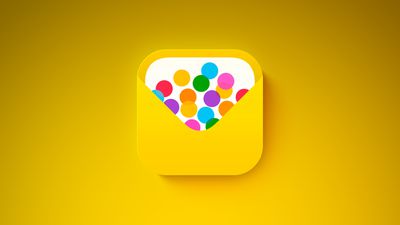
Apple today updated the Invites app to introduce a new option to add a link to an invitation. Event creators can use the feature to send important details to invitees.
Apple says that links can be used for things like planning a trip, adding a gift registry, or working out who is bringing what to a potluck. Links are open ended, so any website can be added to an invite that you create.
Links are located in a new "Tiles" section in the Invites app. Tapping on "Add Tile" at the bottom of the app allows for link insertion, with users able to include the link, a link title, and a link description.
Introduced earlier this year, Invites is an event planning app designed by Apple. It supports creating custom invitations with unique background images, fonts, and relevant information like directions and weather. Today's 1.2 app update is the first feature update that Invites has received.
Invites is an iCloud+ service, and an iCloud+ subscription is needed to create an event. iCloud+ is Apple's paid iCloud storage upgrade option, with plans that start at $0.99 per month.
While an iCloud+ subscription is needed for creating an event, anyone can respond to an invitation through an RSVP feature. Invitations can be sent to iPhone users and Android users alike, with the app facilitating planning and RSVPs.
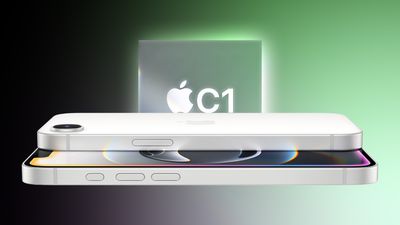
A new Cellular Insights report commissioned by Qualcomm has found that two unnamed Android smartphone models equipped with Qualcomm's Snapdragon X75 and Snapdragon X80 modems achieved faster 5G speeds compared to the iPhone 16e, which is equipped with Apple's first-ever, custom-designed C1 modem.
Testing was conducted with T-Mobile's sub-6GHz 5G network in New York City, across a variety of real-world environments, according to Cellular Insights.
The report found that the Android devices "consistently outperformed" the iPhone 16e in terms of 5G connectivity, especially indoors. Specifically, the Android devices achieved up to 35% faster download speeds compared to the iPhone 16e, and up to 91% faster upload speeds. The report also found that the iPhone 16e frequently became hot to the touch during testing, but it could not confirm if this directly impacted performance.
The two Android smartphones were priced at $619 and $799 in the U.S., the report said, while the iPhone 16e starts at $599.
Based on its findings, Cellular Insights concluded that the Qualcomm-powered devices "hold a clear edge" over the iPhone 16e for individuals seeking "consistent, high-throughput 5G performance." Qualcomm's PR department is now touting the favorable results, which they relayed to us in an email sent earlier today.
Apple's C1 modem achieved equal to faster performance than some Qualcomm modems in some earlier tests, but a Qualcomm spokesperson said this study is the "only comprehensive, scientific" comparison completed on a U.S. network so far.
Performance is not the only metric that matters for a smartphone modem, with power efficiency also being an important factor. Apple has advertised the C1 modem as being the most power-efficient iPhone modem ever, which contributes to the iPhone 16e offering the longest battery life of any 6.1-inch iPhone model ever. With its next-generation C2 and C3 modems, Apple hopes to continue to close the gap on the performance front.


 Note: MacRumors is an affiliate partner with Peacock. When you click a link and make a purchase, we may receive a small payment, which helps us keep the site running.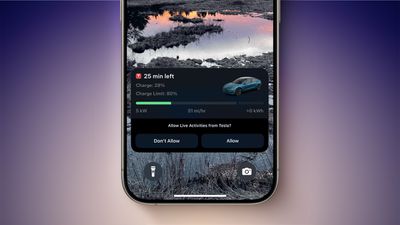





 Note: MacRumors is an affiliate partner with some of these vendors. When you click a link and make a purchase, we may receive a small payment, which helps us keep the site running.